|
#1
●
07-08-2013, 03:32 PM
|
 My Rank: MAJOR Poster Rank:12 Join Date: Jun 2009 Posts: 93,062
Contributions: 239
93,062Posts 137,694Thanked 2,009Quoted 91Mentioned 239Contrib. |
|
Mercury - From Messengers Mission
This colorful view of Mercury was produced by using images from the color base map imaging campaign during MESSENGER’s primary mission. These colors are not what Mercury would look like to the human eye, but rather the colors enhance the chemical, mineralogical, and physical differences between the rocks that make up Mercury’s surface. Young crater rays, extending radially from fresh impact craters, appear light blue or white. Medium- and dark-blue areas are a geologic unit of Mercury’s crust known as the “low-reflectance material”, thought to be rich in a dark, opaque mineral. Tan areas are plains formed by eruption of highly fluid lavas. The giant Caloris basin is the large circular tan feature located just to the upper right of center of the image. The MESSENGER spacecraft is the first ever to orbit the planet Mercury, and the spacecraft’s seven scientific instruments and radio science investigation are unraveling the history and evolution of the Solar System’s innermost planet. During the one-year primary mission, MESSENGER acquired 88,746 images and extensive other data sets. MESSENGER is now in a yearlong extended mission. Mercury is the smallest and closest to the Sun of the eight planets in the Solar System, with an orbital period of about 88 Earth days. Because it has almost no atmosphere to retain heat, Mercury’s surface experiences the greatest temperature variation of all the planets, ranging from 100 K (−173 °C; −280 °F) at night to 700 K (427 °C; 800 °F) during the day at some equatorial regions. http://messenger.jhuapl.edu/index.php 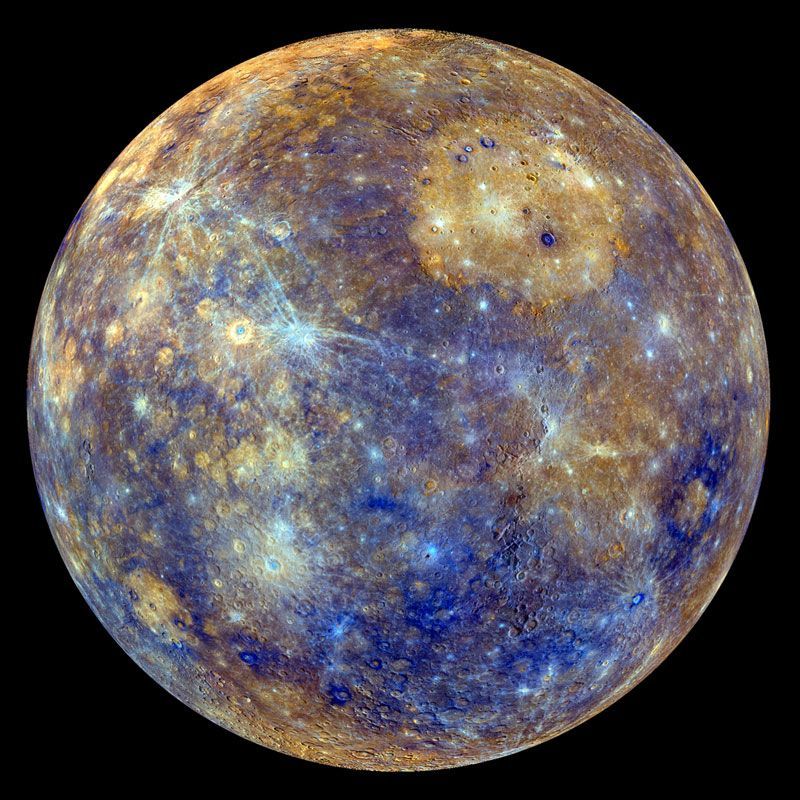 · |