|
Killers Tell Their Tales
We got out of the car and I fetched a rope from the carry-all section of the station wagon. I leaned
against the bumper and fashioned the line into a hangman’s noose while she watched.
She’d picked a wild daisy and was twirling it in her fingers, picking it apart petal by petal and chanting as she dropped each piece, “He loves me loves me not.” She finished up on “he loves me not” and shot me a crooked smile. “Bad luck in love.”
“Ah, you don’t believe in bad luck, do you? Come on over here, Kate!” I tossed the noose over the heavy beam at the front of the garage where at one time engines were raised from the bodies of cars.
I widened the loop and placed it over her head. She fiddled with her long ponytail while I adjusted the coil around her neck. I set the knot behind her ear just like the picture in the magazine. I asked her if it was too tight. She said it wasn’t tight at all. Then I tied her wrists behind her with green nylon twine, and arranged her ankles the same way: took a few turns around them and made a nice tight knot. I moved a few steps back, put my hands on my hips, and told her that she made a perfect Cattle Kate.
She smiled, stuck out her tongue, and crossed her eyes. I told her to hold the pose, and I’d take a picture of her and mail it to Otto Preminger in Hollywood with a movie suggestion. She thought that was a great idea. I told her I’d get the camera from the glove compartment, turned and picked up the loose end of the rope and tied it to the car bumper. I slid behind the wheel, cranked up the ignition, put the car in reverse and backed up.
The whore rose right up in the air and once again stuck out her tongue.
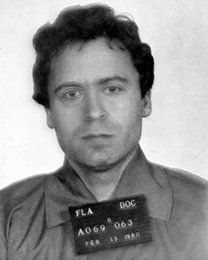
It was comical the way it popped right out of her mouth, all wet and pink. Her eyes were wide open and staring straight at me. Her expression was fascinating. Her face turned pink, then red, then blue—a pleasant lavender-blue. Her body quivered and shimmied; as she turned blue she wet her pants. A dark stain materialized at the juncture of her thighs, then quickly slid down the legs of her pedal pushers. The pee streamed down over her calves and dribbled from her toes making a puddle on the concrete floor under her. The pretty face turned purple, her body shivered violently; then she went limp. It was interesting to watch. Here are the relevant parts of the interview: Bundy:As a young boy of twelve or thirteen, I encountered, outside the home, in the local grocery and drug stores, soft-core pornography. Young boys explore the sideways and byways of their neighborhoods, and in our neighborhood, people would dump the garbage. From time to time, we would come across books of a harder nature—more graphic. This also included detective magazines, etc., and I want to emphasize this. The most damaging kind of pornography—and I’m talking from hard, real, personal experience—is that that involves violence and sexual violence. The wedding of those two forces —as I know only too well—brings about behavior that is too terrible to describe.
Dobson:Walk me through that. What was going on in your mind at that time?
Bundy:Before we go any further, it is important to me that people believe what I’m saying. I’m not blaming pornography. I’m not saying it caused me to go out and do certain things. I take full responsibility for all the things that I’ve done. That’s not the question here. The issue is how this kind of literature contributed and helped mold and shape the kinds of violent behavior.
Dobson:It fueled your fantasies.
Bundy:In the beginning, it fuels this kind of thought process. Then, at a certain time, it is instrumental in crystallizing it, making it into something that is almost a separate entity inside.
Dobson:You had gone about as far as you could go in your own fantasy life, with printed material,
photos, videos, etc., and then there was the urge to take that step over to a physical event.
Bundy:Once you become addicted to it, and I look at this as a kind of addiction, you look for more
potent, more explicit, more graphic kinds of material. Like an addiction, you keep craving something which is harder and gives you a greater sense of excitement, until you reach the point where the pornography only goes so far—that jumping-off point where you begin to think maybe actually doing it will give you that which is just beyond reading about it and looking at it.
Dobson:How long did you stay at that point before you actually assaulted someone?
Bundy:A couple of years. I was dealing with very strong inhibitions against criminal and violent behavior. That had been conditioned and bred into me from my neighborhood, environment, church, and schools. I knew it was wrong to think about it, and certainly, to do it was wrong. I was on the edge, and the last vestiges of restraint were being tested constantly, and assailed through the kind of fantasy life that was fueled, largely, by pornography.
Dobson:Do you remember what pushed you over that edge? Do you remember the decision to “go for it”? Do you remember where you decided to throw caution to the wind?
Bundy:It’s a very difficult thing to describe—the sensation of reaching that point where I knew I
couldn’t control it anymore. The barriers I had learned as a child were not enough to hold me back from seeking out and harming somebody.
Dobson:You hadn’t known you were capable of that before?
Bundy:There is no way to describe the brutal urge to do that, and once it has been satisfied, or spent, and that energy level recedes, I became myself again. Basically, I was a normal person. I wasn’t some guy hanging out in bars, or a bum. I wasn’t a pervert in the sense that people look at somebody and say, “I know there’s something wrong with him.” I was a normal person. I had good friends. I led a normal life, except for this one, small but very potent and destructive segment that I kept very secret and close to myself.
Those of us who have been so influenced by violence in the media, particularly pornographic violence, are not some kind of inherent monsters. We are your sons and husbands. We grew up in regular families. Pornography can reach in and snatch a kid out of any house today. It snatched me out my home twenty or thirty years ago. As diligent as my parents were, and they were diligent in protecting their children, and as good a Christian home as we had, there is no protection against the kinds of influences that are loose in a society that tolerates. To the murderer(s) of my son, Jamie,
Would it be easier for you if I wrote words of hate? I can’t because I don’t feel hate. I feel deep sorrow
at losing my son. You took a light from my life November 10 and left me with many days of darkness.
Have you thought of your own death? Unless you confess your sin and ask for God’s forgiveness, you
will face the fire and fury of hell. When you are caught, I will be sorry for your family. They will have the burden of your guilt all their lives.
Though this letter produced no results, a second plea, published eleven months later, brought a remarkable reply—an anonymous typewritten note that revealed the utterly callous, sadistic sensibility of a classic psychopathic killer:
I am the murderer of Jamie Paxton. Jamie Paxton was a complete stranger to me. I never saw him before in my life, and he never said a word to me that Saturday. Paxton was killed because of an irresistible compulsion that has taken over my life. I knew when I left my house that day that someone would die by my hand. I just didn’t know who or where. Technically, I meet the definition of a serial killer, but I’m an average-looking person with a family, job, and home just like yourself.
Something in my head causes me to turn into a merciless killer with no conscience. To the Paxtons, you deserve to know the details. I was very drunk and a voice inside my head said “do it.” I stopped my car behind Jamie’s and got out. Jamie started walking very slowly down the hill toward the road. He appeared to be looking past me at
something in the distance.
I raised my rifle to my shoulder and lined him up in the sights. It took at least five seconds to take
careful aim. My first shot was off a little bit and hit him in the right chest. He groaned and went down. I wanted to make sure he was finished so I fired a second shot aimed half way between his hip and
shoulder. He was crawling around on the ground. I jerked the shot and hit him in the knee. He raised his head and groaned again. My third shot also missed and hit him in the butt. He never moved again.
Five minutes after I shot Paxton, I was drinking a beer and had blocked out all thoughts of what I had just done out of my mind. I thought no more of shooting Paxton than I thought of shooting a bottle at the dump. I know you hate my guts, and rightfully so. I think about Jamie every hour of the day, as I am sure you do.
Don’t feel bad about not solving this case. You could interview till doomsday everyone that Jamie Paxton ever met in his life and you wouldn’t have a clue to my identity. With no motive, no weapon, and no witnesses, you could not possibly solve this crime.
When a forty-nine-year-old fisherman was shot in March 1992 on federal land, the FBI got involved.
Less than a month later, another man was shot in the back while fishing. At that point, investigators issued a press release, revealing that a serial sniper was stalking outdoorsmen in rural eastern Ohio.
Shortly after the publication of the press release—which included an FBI profile of the suspect—
investigators were contacted by a man named Roger Fry. He told him the published description of the killer sounded a good deal like his old buddy, Thomas Dillon—a lifelong gun fanatic who enjoyed
shooting animals and openly admired Ted Bundy. Dillon was put under surveillance. Eventually, he was tied to one of the murder weapons, a Mauser rifle he had sold off at a gun show. Shortly after his arrest, he confessed to three murders. “I have a major problem,” he declared. “I’m crazy. I want to kill.” Under a plea agreement, he was spared the death penalty and received a life sentence in prison with no chance of parole for 165 years. In 1970, after slaughtering five people, a psychotic hippie named John Linley Frazier left a bizarre typewritten note at the victims’ home that ended by invoking four of the figures from the deck:
halloween. . . . 1970
today world war 3 will begin as brought to you by the people of the free universe.
From this day forward any one and?/or company of persons who missuses the environment or destroys same will suffer the penalty of death by the people of the free universe.
I and my comrades from this day forth will fight until death or freedom, against anything or anyone who
dose not support natural life on this planet, materialisum must die or man-kind will. Jack the Ripper. Ironically, the most famous of the written taunts received by the police during the height of the Whitechapel horrors—indeed the one that gave this shadowy madman his legendary pseudonym—was
probably not written by the killer at all. Inscribed in red ink, it read:
25 Sept: 1888
Dear Boss
I keep on hearing the police have caught me but they won’t fix me just yet. I have laughed when they look so clever and talk about being on the right track. That joke about Leather Apron gave me real fits. I am down on whores and I shant quit ripping them till I do get buckled. Grand work the last job was. I gave the lady no time to squeal. How can they catch me now. I love my work and want to start again.
You will soon hear of me with my funny little games. I saved some of the proper red stuff in a ginger beer bottle over the last job to write with but it went thick like glue and I cant use it. Red ink is fit enough I hope ha ha. The next job I do I shall clip the ladys ears off and send to the police officers just for jolly wouldnt you. Keep this letter back till I do a bit more work, then give it out straight.
My knife’s so nice and sharp I want to go to work right away if I get a chance. Good luck.
Yours truly
Jack the Ripper Jack the Ripper
Sor
I send you half the Kidney I took from one woman prasarved it for you tother piece I fried and ate it was very nise I may send you the bloody knif that took it out if you only wate a while longer
signed
Catch me when
you can
Mishter Lusk Dear Captain Joseph Borrelli,
I am deeply hurt by your calling me a wemon hater. I am not. But I am a monster. I am the “Son of
Sam.” I am a little brat.
When father Sam gets drunk he gets mean. He beats his family. Sometimes he ties me up to the back of
the house. Other times he locks me in the garage. Sam loves to drink blood.
Go out and kill,” commands father Sam.
Behind our house some rest. Mostly young—raped and slaughtered—their blood drained—just bones
now.
Papa Sam keeps me locked in the attic too. I can’t get out but I look out the attic window and watch the
world go by.
I feel like an outsider. I am on a different wavelength then everybody else—programmed to kill.
However, to stop me you must kill me. Attention all police: Shoot me first—shoot to kill or else keep out of my way or you will die!
Papa Sam is old now. He needs some blood to preserve his youth. He has had too many heart attacks.
“Ugh, me hoot, it hurts, sonny boy.”
I miss my pretty princess most of all. She’s resting in our ladies house. But I’ll see her soon.
I am the “Monster”—“Beelzebub”—the chubby behemouth.
I love to hunt. Prowling the streets looking for fair game—tasty meat. The wemon of Queens are
prettyist of all. It must be the water they drink. I live for the hunt—my life. Blood for papa.
Mr. Borrelli, sir, I don’t want to kill anymore. No sur, no more but I must, “honour thy father.”
I want to make love to the world. I love people. I don’t belong on earth. Return me to yahoos.
To the people of Queens, I love you. And I want to wish all of you a happy Easter. May God bless you
in this life and in the next. And for now I say goodbye and goodnight.
POLICE: Let me haunt you with these words:
I’ll be back! I’ll be back!
To be interrpreted as—bang, bang, bang, bang—ugh!!
Yours in murder
Mr. Monster
Son of Sam Zodiac letter
This is the Zodiac speaking. I am the murderer of the taxi driver over by Washington St + Maple St last night, to prove this here is a blood stained piece of his shirt. I am the same man who did in the people in the north bay area. The S.F. Police could have caught me last night if they had searched the park properly instead of holding road races with their motorcicles seeing who could make the most noise. The car drivers should have just parked their cars and sat there quietly waiting for me to come out of cover.
School children make nice targets, I think I shall wipe out a school bus some morning. Just shoot out the
frunt tire + then pick off the kiddies as they come bouncing out. My dear Mrs. Budd,
In 1894 a friend of mine shipped as a deck hand on the steamer Tacoma, Capt. John Davis. They sailed from San Francisco for Hong Kong China. On arriving there he and two others went ashore and got drunk.
When they returned the boat was gone. At that time there was a famine in China. Meat of any kind was from $1–3 Dollars a pound. So great was the suffering among the poor that all children under 12 were sold to the Butchers to be cut up and sold for food in order to keep others from starving. A boy or girl under 14 was not safe in the street. You could go to any shop and ask for steak—chops—or stew meat.
Part of the naked body of a boy or a girl would be brought out and just what you wanted cut from it. A boy or girls behind which is the sweetest part of the body and sold as veal cutlet brought the highest price. John staid [sic] there so long he acquired a taste for human flesh. On his return to N.Y. he stole
two boys one 7 and one 11. Took them to his home stripped them naked tied them in a closet.
Then burned everything they had on. Several times every day and night he spanked them—tortured them—to make their meat good and tender. First he killed the 11 yr old boy, because he had the fattest ass and of course the most meat on it. Every part of his body was Cooked and eaten except head—bones and guts.
He was Roasted in the oven (all of his ass), boiled, broiled, fried, stewed. The little boy was next, went the same way. At that time, I was living at 409 E. 100 St. near—right side. He told me so often how good Human flesh was I made up my mind to taste it. On Sunday June the 3—1928 I called on you at 406 W. 15 St. Brought you pot cheese strawberries. We had lunch. Grace sat in my lap and kissed me.
I made up my mind to eat her. On the pretense of taking her to a party. You said Yes she could go. I took her to an empty house in Westchester I had already picked out. When we got there, I told her to remain outside. She picked wildflowers. I went upstairs and stripped all my clothes off. I knew if I did not I would get her blood on them.
When all was ready I went to the window and Called her. Then I hid in a closet until she was in the room. When she saw me all naked she began to cry and tried to run downstairs.
I grabbed her and she said she would tell her mamma. First I stripped her naked. How she did kick—bite and scratch. I choked her to death, then cut her in small pieces so I could take my meat to my rooms, Cook and eat it. How sweet and tender her little ass was roasted in the oven. It took me 9 days to eat her entire body. I did not fuck her tho I could have had I wished. She died avirgin.
fish Gerard Schaefer—who, like the Hillside Stranglers, regarded all sexually attractive young women as “whores”—not only committed an untold number of horrifically sadistic murders (often involving his preferred mode of torture, slow hanging), but left written accounts of his enormities that rank among the most appalling documents ever written. Other serial killers have also left documented evidence of their
tortures. Ian Brady and Myra Hindley, the infamous Moors Murderers, tape-recorded the piteous pleas and heart-wrenching screams of one little victim.
Harvey Glatman shot photographs of the bound and terrorized women he was about to kill. Leonard Lake and Charles Ng videotaped the sex-and-torture sessions they conducted in their California horror bunker. Not every homicidal sadist, however, has left a detailed record of his atrocities. Ted Bundy, for example, was relatively forthcoming in his confessions. Some of the things he did to his victims were so unspeakable, however, that he refused to discuss them with authorities. ... |