|
Community Forum · Est. 2006
|
#1
●
04-10-2013, 12:48 PM
| ||||||||
 My Rank: MASTER SERGEANT Poster Rank:424 Join Date: Jun 2011 Posts: 2,775
Contributions: 3
Mentioned: 13 Post(s) Quoted: 471 Post(s)
| ||||||||
|
Journalists on Front Line of Mexico Drug War: 'Fear is Terrible and Well Founded'
The words 'organized crime' and 'cartel' are disappearing from coverage as Peña Nieto's new government adjusts its strategy Gun battles lasting for hours, seven decapitated bodies theatrically seated on a row of garden chairs, a video communique promising peace and tranquility read out against a backdrop of 70 armed, uniformed and masked men – Mexico's drug wars go on. But four months into the new government of President Enrique Peña Nieto, finding out about them is getting more difficult than ever. "There is less information all the time," says Ricardo González of the freedom of expression group Article 19. "It is alarming." The most obvious problem is the pressure from organized criminal groups that limits coverage of the violence in the local media outlets closest to the conflict zones. This took root during the previous administration of Felipe Calderón, the president whose crackdown on the cartels triggered the initial killing spiral. There is nothing to indicate the trend is changing. "The attacks have continued despite the change of federal government and the measures being taken are insufficient and can be counterproductive" says González. "To really protect journalists they need to tackle the impunity that surrounds the attacks." González cites the official response to the recent kidnapping of five workers from the Siglo de Torreón newspaper from the northern state of Coahuila – it boiled down to a police guard at the paper's offices that attracted more attacks directed against the officers. The degree of pressure varies from state to state, with the total silencing of the media in Tamaulipas in Mexico's northeastern corner looming terrifyingly large at the end of the spectrum. "The fear is terrible and well founded," says one former reporter from the state. She recalls going to her boss after receiving a death threat linked to a straight forward news report and being advised to seek out a cartel representative and apologize. "The heroes are in the cemetery," she says, adding that the media and official silence in the face of a recent spate of gun battles in the border city of Reynosa proved nothing has changed. Journalists on Mexico's drug war front lines say the information vacuum is further bolstered by complicit colleagues who act as messengers for both the cartels and also political bosses who share an interest in keeping the bloodletting quiet. Last week a national association of newspaper editors presented the governor of the coastal state of Veracruz, Javier Duarte, with a prize for his "commitment to freedom of expression". There was no mention of the nine journalists from the state killed and three missing since he took office in 2010. On the day of the prize, according to Article 19, three murders related to the drug war went unreported in Veracruz. All this fuels the popularity of websites and social media networks dedicated to the drug wars, such as the blog del narco whose unnamed young female editor was interviewed for the first time by the Guardian last week. (Posted below) But the voids in coverage of Mexico's drug wars are not limited to the on-the-ground reporting in local media facing ever present dangers. The violence, what it means and the strategies used to combat it, are also beginning to drop out of national and international headlines. A study released this week by an independent commission concluded that coverage of the violence in capital-based print and on TV during during the first three months of the Peña Nieto administration (beginning last December) was about half of what it had been in the same period a year before. The report, from the Observatory of the Processes of Public Communication of the Violence, found, for example, that the words "organized crime" and "cartel" began to disappear from free-to-view TV. Some of the waning interest can be put down to drug war fatigue as the horror looses shock value, and the dynamics of the conflicts become so complex it can be hard to see where even major violent events fit into the bigger picture. "It is all getting messier," says drug war analyst Alejandro Hope. Hope says that the importance of the broad power struggles between famed international criminal organizations are becoming less important for understanding the violence than the proliferation of local conflicts between smaller groups, many of them the result of splits in the larger cartels. But the recent waning of media attention is also associated with the new government's success in controlling a major source of stories about the country's security crisis – itself. Right up until he left office in December, Calderon made countless speeches aggressively defending his offensive, while his officials distributed the videoed interrogations of arrested drug traffickers, and government ads proclaiming operational successes were everywhere. Today the ads have disappeared, arrests are rarely even publicly announced, government officials avoiding naming the cartels involved in major events, and Peña Nieto limits himself to the odd speech promising new – and vague – measures that he assures will sort out the mess he inherited. "I believe that a year's time is a good moment to evaluate how the [new] strategy is going" he said last month, without offering an clear idea of what he is doing that is all that different from Calderón. The discursive attention paid at the very start of his government to the need for more preventative action was widely welcomed, but as the months go by, the plans themselves remain sketchy. Meanwhile, the army and navy are still deployed around the country in law enforcement activities, and co-operation with the US seems largely unchanged. The pledge to create a new squeaky clean and flawlessly efficient national police force remains on the table, but with little explanation of what marks this plan off from several previous attempts to do the same thing. There is greater clarity in the governments efforts to quell internal government rivalries over strategy and improve coordination between the federal and state level authorities. So far, however, the most discernible effect of the new concentration of power is to keep a tighter hold of official information. Even the explicit commitment to reduce the death toll "significantly" is hard to evaluate given the absence of an official description of what this means and the dependence on official data that many distrust. The new government has begun releasing a national monthly figure for drug war related deaths, but without accompanying information about the criteria used to work it out, or why it should be more reliable than the data intermittently released under the previous administration which was widely dismissed as woefully inadequate. Hope, the security expert, is not convinced that any of this can secure a permanent change in the crisis narrative that dominated the Calderón years even if, for now, the horror is being kept out of the papers."By not talking about it very much they may change perceptions on the periphery, but it is risky too when something is going on everyday," he says. "And something is happening every day." 'They stole our dreams': blogger reveals cost of reporting Mexico's drug wars Exclusive: Anonymous author of celebrated Blog del Narco speaks for first time about the risks – and reveals she is a woman For three years it has chronicled Mexico's drug war with graphic images and shocking stories that few others dare show, drawing millions of readers, acclaim, denunciations – and speculation about its author's identity. Blog del Narco, an internet sensation dubbed a "front-row seat" to Mexico's agony over drugs, has become a must-read for authorities, drug gangs and ordinary people because it lays bare, day after day, the horrific violence censored by the mainstream media. The anonymous author has been a source of mystery, with Mexico wondering who he is and his motivation for such risky reporting. Now in their first major interview since launching the blog, the author has spoken to the Guardian and the Texas Observer – and has revealed that she is, in fact, a young woman. "I don't think people ever imagined it was a woman doing this," said the blogger, who asked to use pseudonym Lucy to protect her real identity. "Who am I? I'm in my mid-20s, I live in northern Mexico, I'm a journalist. I'm a woman, I'm single, I have no children. And I love Mexico." This is the first time Lucy has spoken directly about the motivations for running a blog which could cost her her life. In the early days, her male colleague who manages the technical side engaged in a few short, anonymous email exchanges with reporters, but neither has spoken out since. The telephone interview was arranged through an anonymous intermediary. The Guardian then took steps to verify that Lucy was in control of the blog. She said she wanted to show the truth of what was happening to help turn the page. "I'm in love with my culture, with my country, despite all that's going on. Because we're not all bad. We're not all narcos. We're not all corrupt. We're not all murderers. We are well educated, even if many (foreign) people think otherwise." She and her colleague live in daily fear of retribution, either from the cartels or government forces. She revealed that a young man and woman tortured, disembowelled and hung from a bridge in September 2011 – murders which shocked even atrocity-hardened Mexicans – were collaborators on the blog. "They used to send us photographs. That was very hard, very painful." The threats, she said, have recently become more serious. Despite those fears, however, Lucy has written a book that gives an inside account of the blog and provides the most gruesome, explicit account yet of the mayhem that the cartel wars have brought to Mexico. Dying for the Truth: Undercover Inside Mexico's Violent Drug War, is now on sale in English and Spanish, and documents a full year of killings from 2010, a pivotal year. "I did the book to show what was happening," she said. "When I finished, I was able to breathe, because I had worried about being killed before finishing. But the book is there, it's there on paper, a testament to what we have suffered in Mexico in these years of war." Adam Parfrey, head of the independent Washington-based publisher Feral House, which specialises in taboo topics, said the book would be bound in a police-tape type band as warning of its contents. "It's gruesome and horrible. It goes far beyond anything I've ever dealt with. It's an important element of what's happening in our southern neighbour." The inside account of Blog del Narco comes at a sensitive time. President Barack Obama is due to visit Mexico in early May for talks with his counterpart, Enrique Peña Nieto, who since taking office last December has tamped down confrontations with the drug lords and the ensuing media attention. Even so, drug-related violence claimed nearly 3,200 lives in his administration's first three months, according to government figures, and in recent weeks killings have spiked along the border, and even in the tourist city of Cancún. Cartels are increasingly sending agents to live and work in US cities such as Chicago, according to a recent AP investigation. The legalisation of marijuana in Colorado and Washington has intensified pressure on the US government to review its four-decade-old "war" on marijuana, cocaine and other narcotics, much of it trafficked through Mexico. After President Felipe Calderón declared his own war on Mexico's drug cartels in 2006, sparking turf battles between groups like Sinaloa, La Línea and the Zetas, and bloody interventions by the police and armed forces, who have been accused of siding with criminals. More than 70,000 people died and 27,000 disappeared by the time he finished his term last year. Intimidation of journalists – dozens have been murdered, often sadistically – neutered news coverage by newspapers, radio and television stations. Massacres, kidnappings, corruption, even pitched battles in city centres, often went unreported. Blog del Narco sprang up three years ago to fill the vacuum left by cowed journalistic colleagues who could not even report vital information such as narco roadblocks and kidnappings. Over time, Blog del Narco acquired multiple sources, including drug gangs, and became indispensable reading, drawing more than 3m hits monthly. It provides bulletins, pictures and video of abductions, shootouts, executions and the discovery of bodies as well as severed human heads, limbs and torsos. One video showed cartel members interrogating a captured rival and then decapitating him. Critics accuse the blog of being a public relations forum for drug dealers, but Lucy said the material showed reality and helped families identify missing relatives. "If it wasn't for the blog often bodies wouldn't be identified." Narcos occasionally sent photos of them partying with pop stars, but the blog refused to publish such material, she said. The blog takes advertising from car and mobile-phone makers, among others. Lucy has told no friends about her clandestine activity. "My close family knows. No one else." The blog had come under repeated cyber-attack – the government was more aggressive than narcos in this regard, Lucy said – but the main concern was being identified and captured, either by narcos or government forces who have been accused of multiple abuses. "We change where we live every month. We've been in basements. It's very difficult. We hide our equipment in different places. If the authorities get close we run." A sign left by the young couple disembowelled in 2011 in the state of Tamaulipas said the bloggers were next. Lucy had not met the couple but received material from them via email. A few days later, another contributor was killed. A keyboard, mouse and sign mentioning the blog were strewn over the corpse. "It's very painful. But they believed this work was necessary." Lucy said it was too soon to judge Peña Nieto's administration but that she had already noted one change. In contrast to Calderón-era officials, who cowed journalists with threats and bribes, the new government appeared to want to do it through repressive laws, she said. The government denies wanting to stifle the media. "We have thought about quitting the blog thousands of times. But we haven't, because we have to get the message out. They have stolen our tranquility, our dreams, our peace." Lucy said she was tired of living in fear but had no plans to give up the blog. It has spawned other anonymous blogs carrying similar material. The revelation she was female would surprise many, said Lucy. "It's a strong blow to Mexican machismo and the idea women are weaker, more delicate. There is an expectation for women to always look pretty. But we're much more than that." She tried to relax, she said, with music, coffee and cigarettes. She missed having a normal life. "My only boyfriend is the blog. A whole phase of my life – boyfriends, going to parties, hanging out with friends – I've missed it. Getting married, having babies – there's not been time to think of any of that." Lucy hoped the book, which focuses on 2010 and 2011, will stand as a historical record. In addition to stomach-turning photographs, it includes a glossary of terms such as encintado – the binding of a victim with duct tape – and encobijado – wrapping a murdered person in a blanket or sheet. It will initially be on sale only in the US but the publisher, Feral House, hopes Mexican booksellers will stock it. Lucy said she had recently take a paying job but would continue the blog. "My plans for the future? To live. That's my hope for the short, medium and long term." 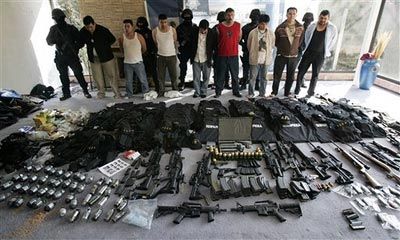 · |