|
#1
●
02-01-2015, 10:47 AM
| ||||||||
 They Lied. There ALL LIES Poster Rank:309 <--We Did It. So Can You Join Date: Mar 2013 Posts: 4,213
Contributions: 48
Mentioned: 23 Post(s) Quoted: 894 Post(s)
| ||||||||
|
Illuminate Experience Apparatus To Rectify Ether Energy
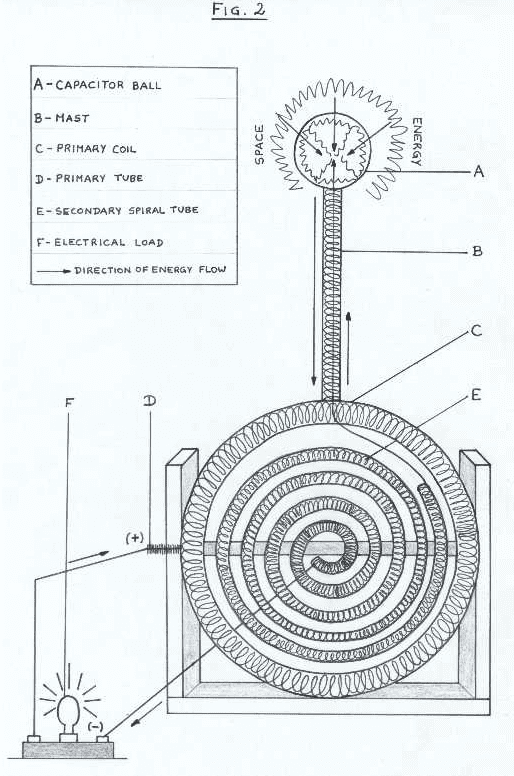 Illuminate Experience Apparatus To Rectify Ether Energy "The Apparatus To Rectify Ether Energy (ATREE) is a machine that is able to transform the energy of the ether into direct current (DC) electricity. In order to accomplish this feat, the instrument takes into account the nature of ether. As many scientists now know, the ether consists of a "compressible fluid" that has a density of 10127 to 1094 wattseconds per cubic centimeter. This high energy density permits a cubic centimeter of ether to be able to provide for the energy needs of a small city. In addition, many scientists have also speculated that the ether may be conducted as a tensor field (motion by compression of the wave) and therefore is a stationary wave. These stationary waves would be able to penetrate and pass through almost all the heavenly bodies known to inhabit the universe. As is the case with radio waves, a particular antenna design would be necessary to efficiently collect and rectify this energy. Since its wavelength is 10-32 centimeters and motion of the wave train is quite similar to that of stationary waves, a specially designed hollow ball construction of a highly conductive metal seems most appropriate for this task. In addition, the induction unit could take advantage of the modified "L" (electric) and "H" (magnetic) fields produced by the ether energy to induct a useful electric current. To convert this energy into electricity, it is essential that a component be provided that can collect and begin the rectification of the ether energy found near the surface of the planet. This part must be able to receive, store and conduct the ether energy to the component of the ATREE that actually rectified the ether into DC electricity. Due to its almost corkscrew motion as well as its high frequency and near electrical properties, ether energy can be collected by a hollow ball whose diameter is approximately one-sixth that of the height of the rectification component. Moreover, the ball should be composed of a very thin (26 gauge or less) metal of high electrical conductivity, such as gold, silver or copper. In our case, a hollow ball composed of copper was employed. In operation, the ether will first collect around the outside of the ball and then easily penetrate the outer surface of the ball and collect in the form of a moving swirl on the inside surface of the ball. To get this pulsating energy to the unit that actually does the rectification, it is necessary to take advantage of the near electrical properties of the ether. At this time, a specially built copper core must be employed. The core of the converter is a copper rod that has the upper 5 % of its length inserted inside the copper collection ball. The top part of this element is needle shaped to permit the swirling ether energy to jump the gap to the tip of the copper core, much in the manner of an electrical spark completing a return to ground through a pointed electrode. This core is tightly wound with 26-gauge copper wire from a point directly beneath the ball down to the opposite end of the copper rod. Also, an outer coil built from insulated #14 household wire is used in the converter. This second coil is attached on one end to the outside of the collection ball and on its opposite end to the working electrical circuit. The conversion of energy resembles in many ways the electromagnetic induction principle discovered in the 19th century. As noted previously, ether possesses two quasi-electromagnetic vectors. The first of these is the quasi-electric one that seems to carry a charge and to flow like electricity through wires. The second vector is a quasi-magnetism that differs only in the fact that the lines of flux are bent in an inward direction instead of the more well-known outward bend of magnetic flux. To induce electricity, the converter employs an unusual phenomenon related to these vectors. In the case of ether, the swirling energy flows into the rod and also into the tightly wound inner coil; however, the difference in rate and distance traveled allows the rod's energy to reach the bottom of this component way before that which goes by way of the inner coil. In doing so, the vectors cross and induce an electrical potential in the wires of the inner coil. To amplify this voltage, the outer coil must be wound counter to the winding of the inner coil. Here, the return circuit through this coil acts in the same manner as the secondary induction coil in a transformer. To summarize the process mentioned above, let us quickly review the entire conversion process. First, the ether jumps to the tip of the converter's core and is conducted toward the opposite end of the rod that is connected to the electrical circuit. Simultaneously, the ether flows through the tightly wound inner coil to the opposite end of the rod. The difference in rate and distance allows the coil and the copper rod to induce an electrical potential that is greater at the bottom of the rod than at its top. Finally, the outer coil wound counter to the inner one acts as an amplifier of the electrical potential and current since its fields (the electrical circuit return to the ball) have the property to amplify the quasi-electricity produced by the induction process in the copper rod and the inner coil. In this fashion, the ATREE is able to convert ether energy into useable DC electricity. To conclude, we have seen how a specially constructed instrument as first conceived and developed by Peter Markovich in the spring of 1977 has been able to conduct and convert ether into DC electricity. As future developments continue, it holds the promise of giving humanity a possible alternative to fossil and nuclear generation of electrical energy." Peter Markovich October 1, 1977 http://www.rexresearch.com/markovic/atree.htm www.illuminateexperience.com |
|
#3
●
02-01-2015, 01:25 PM
| ||||||||
| They Lied. There ALL LIES Poster Rank:309 <--We Did It. So Can You Join Date: Mar 2013 Posts: 4,213
Contributions: 48
Mentioned: 23 Post(s) Quoted: 894 Post(s)
| ||||||||
|
Re: Illuminate Experience Apparatus To Rectify Ether Energy
i dont belive in eternal life. so why the fuck would i want to die like that..... imagain all the shit the W.C. would say!...... NO THANK U! Have Shakey try it
|