|
#1
●
10-30-2011, 12:34 PM
| ||||||||
 My Rank: MAJOR Poster Rank:12 Join Date: Jun 2009 Posts: 93,128
Contributions: 226
Mentioned: 91 Post(s) Quoted: 2009 Post(s)
| ||||||||
|
The Iceman Autopsy
For those only interested in the pictures and brief description scroll down  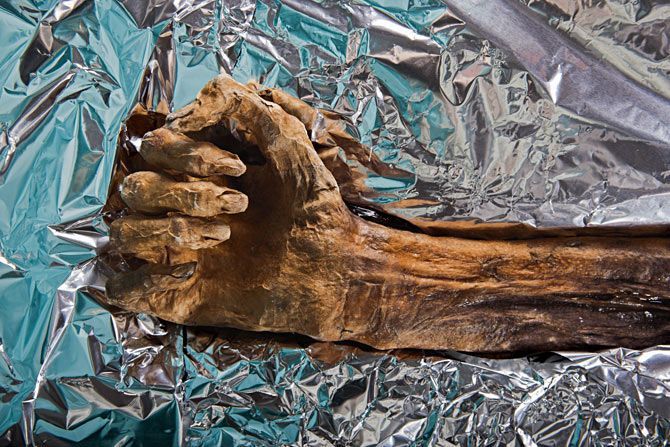 · |
|
#2
●
10-30-2011, 12:53 PM
| ||||||||
| My Rank: MAJOR Poster Rank:12 Join Date: Jun 2009 Posts: 93,128
Contributions: 226
Mentioned: 91 Post(s) Quoted: 2009 Post(s)
| ||||||||
|
Re: The Iceman Autopsy
The Iceman's arm thaws on a sheet of sterilized foil: 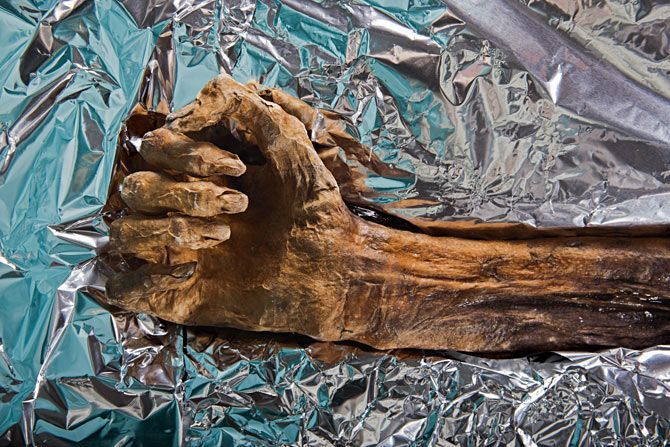 On his last trek he wore hay-and-hide shoes (above, on glass model) held together with bark fibers: 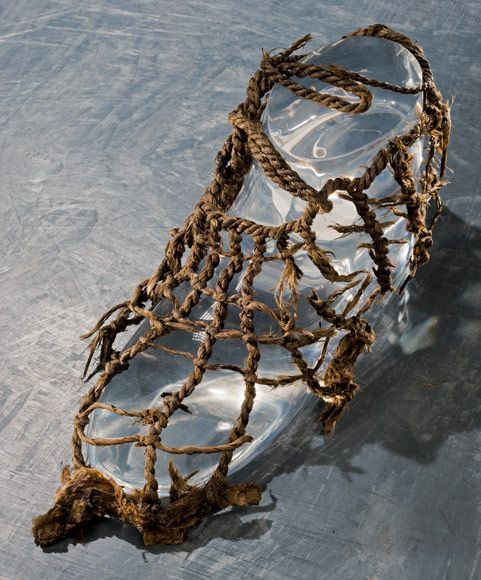 After moving the Iceman into a laboratory, researchers raised the temperature to 64°F to thaw him on a sheet of sterilized aluminum foil in a box custom-made to accommodate his crossed feet and oddly outstretched left arm. The 30 ounces of meltwater collected during the overnight defrosting is being analyzed for cold-adapted bacteria that might hasten the decomposition of the mummy:  After undergoing a nine-hour autopsy at the South Tyrol Museum of Archaeology in Bolzano, Italy, the thawed Iceman is returned to a temperature of 21°F. Then he will be moved to the large glass slab on which he lies for public viewing: 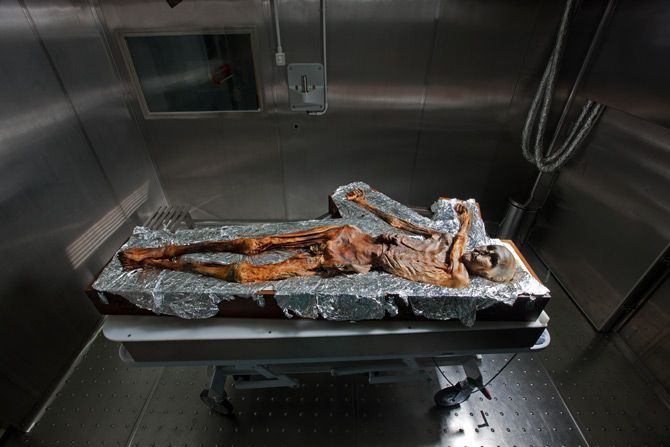 The red arrow shows where hikers found the Iceman's body in 1991, poking out of glacial ice in a shallow bowl of rock at an altitude of about 10,500 feet. A rich assortment of Neolithic artifacts were scattered around the body. The site, in the Italian part of the Ötztal Alps, gave rise to the mummy's nickname: Ötzi: 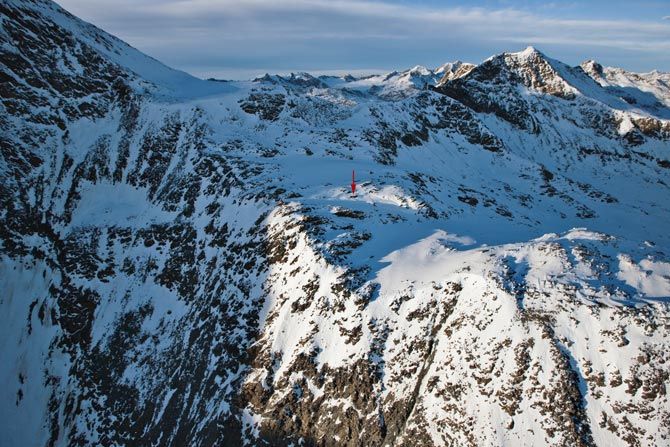 Near the Iceman's knee, a cross-shaped tattoo still stands out on his leathery skin. It may have been a folk remedy for arthritic joint pain: 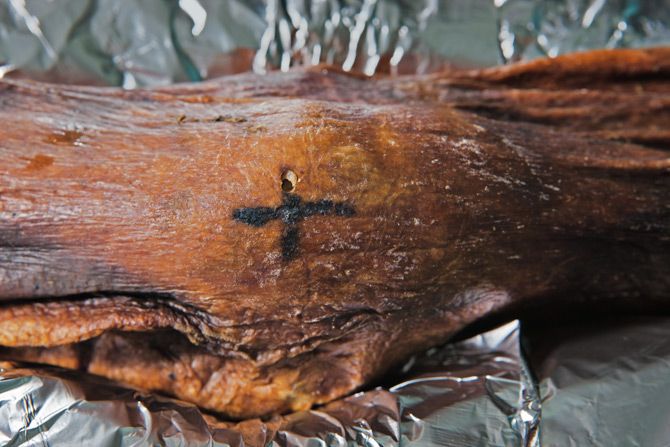 A model depicts the Iceman and the location of several artifacts as they were found. The body is shown near the center. Near the feet, two chunks of birch fungus on leather straps were recovered, along with a flint-bladed dagger and shoes. Not far from the head was a pack containing a maple leaf. Also found were an ax with a copper blade, two arrows, and a tangle of string: 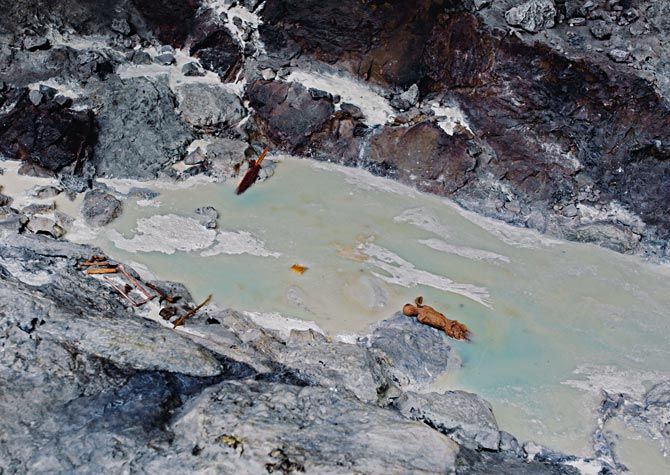 Eduard Egarter Vigl (pointing) and colleagues use an endoscope to try to examine the arrowhead in the Iceman's shoulder. The arrow severed an artery, causing a quick, bloody demise: 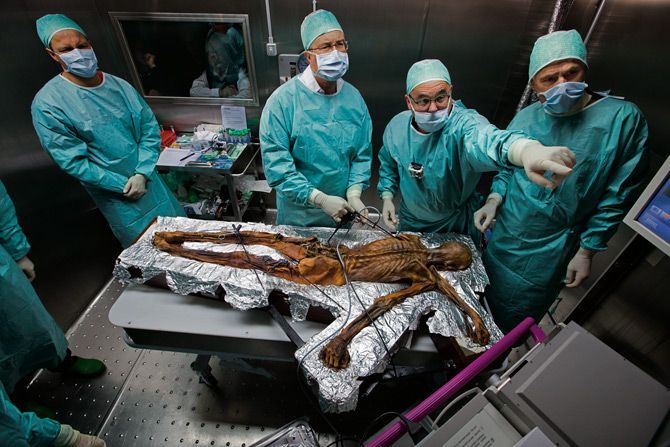 X-rays of the Iceman's left shoulder guided the team in their attempt to find the fatal arrowhead, marked above by a red arrow: 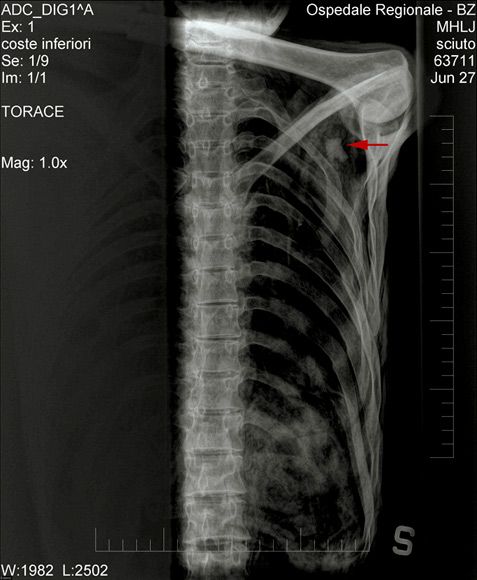 Probing and snipping for nine hours, scientists harvested dozens of biological clues about the life—and death—of the Iceman: 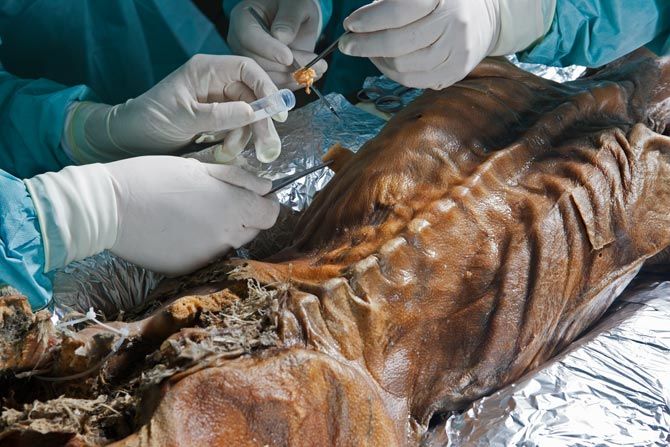 Remnants of the Iceman's stomach and last meal (in test tubes) prompted one doctor to say, "He had a good appetite!": 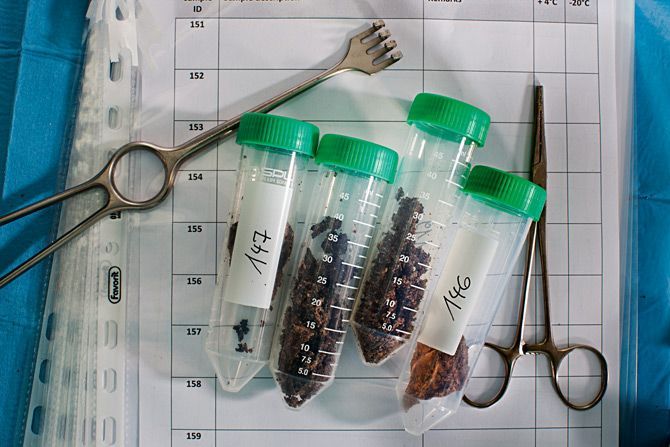 Neurosurgeons retrieved bits of a blood clot, suggesting brain trauma around the time the Iceman died: 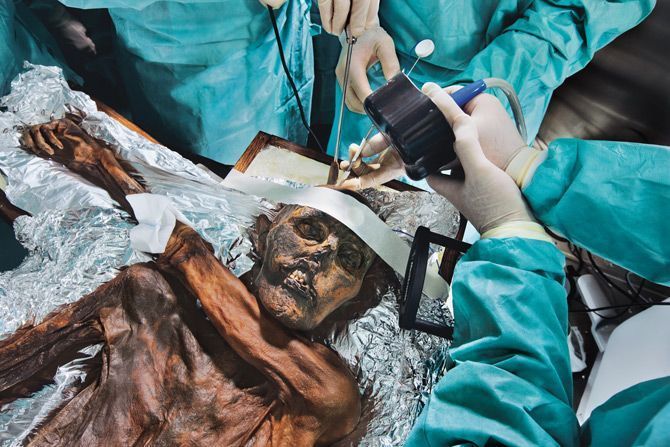 Two chunks of birch fungus on leather straps, possibly used to stanch bleeding and prevent infection, were part of a portable first-aid kit: 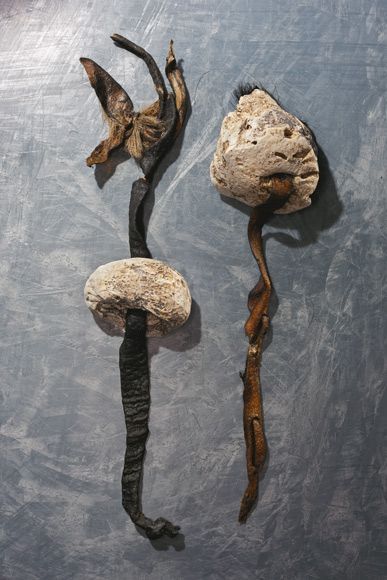 The Iceman's dagger had a flint blade and a sheath: 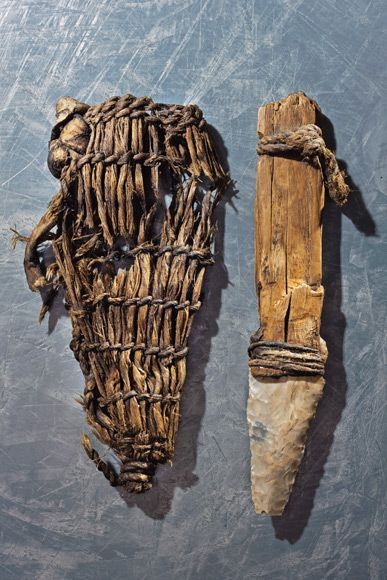 An ax with a blade of rare copper marked the Iceman as a person of status: 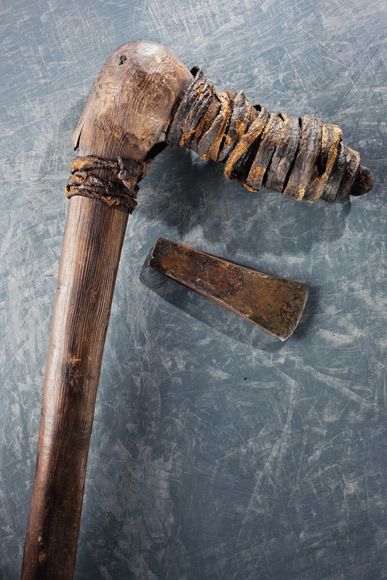 Two arrows served for hunting and self-defense: 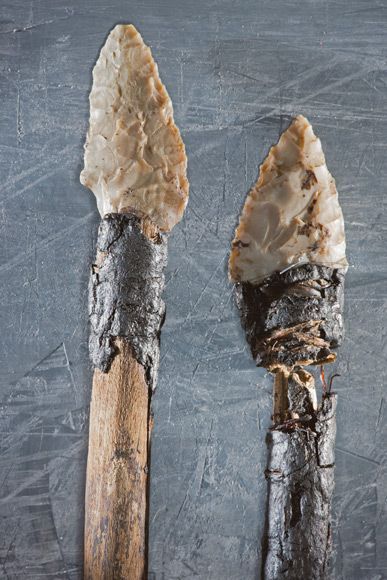 A maple leaf found in the Iceman's pack would have been used to wrap embers; its chlorophyll content indicates the leaf was picked when green—most likely in late spring: 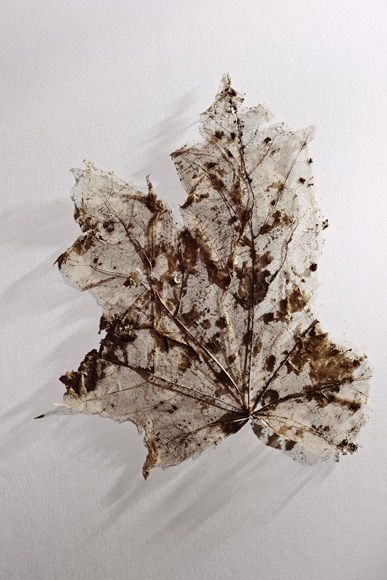 A tangle of string, possibly bowstring, remains a knotty mystery: 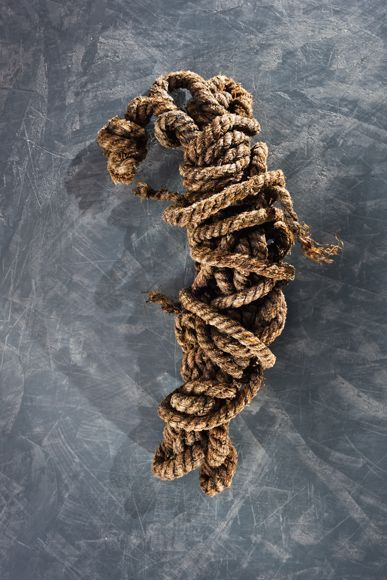 The Iceman's shoes—hay for warmth inside deerskin uppers with bearskin sole—are among the oldest ever found: 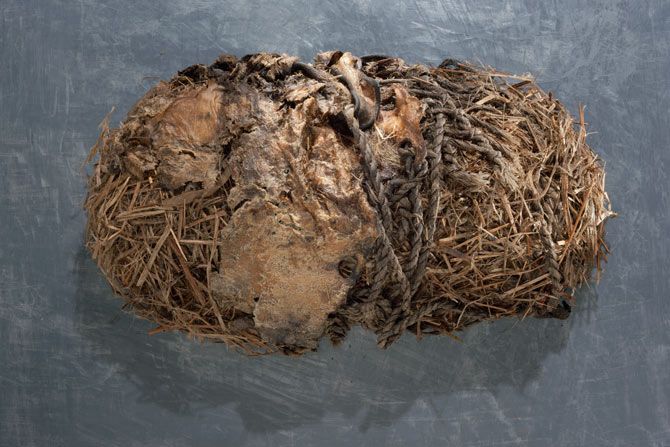 Minutes before putting the Iceman back on display, pathologist Eduard Egarter Vigl coats the mummy with a fine spray of sterilized water, which freezes on contact to form a glistening glaze that protects him from contamination and reduces dehydration: 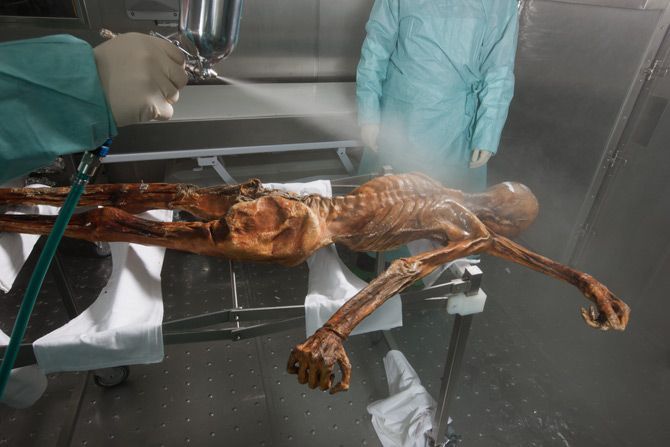 In rigid (and frigid) repose, the Iceman resides in an igloo-like chamber at the South Tyrol Museum of Archaeology in Bolzano, Italy. At 21°F and 98.5 percent relative humidity, it mimics the glacial environment that preserved him for more than five millennia: 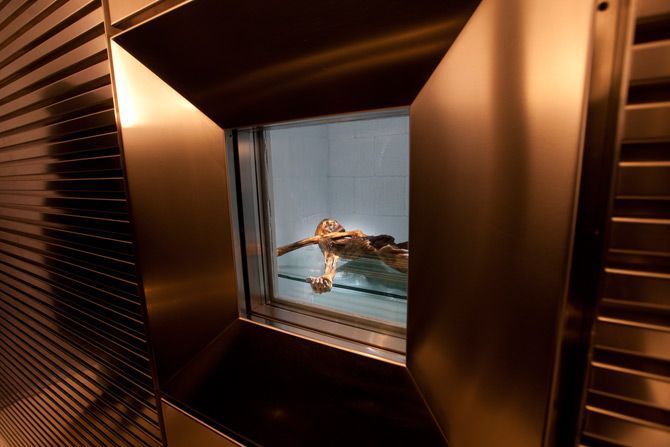 Dutch artists Adrie and Alfons Kennis used 3-D scans of the Iceman's skeleton and other anatomical clues to create a life-size model. Scientists once believed he had blue eyes; his DNA now proves they were brown: 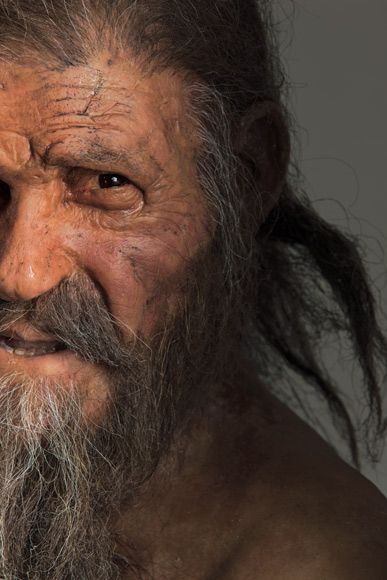 |
|
#4
●
10-30-2011, 12:56 PM
| ||||||||
| My Rank: MAJOR Poster Rank:12 Join Date: Jun 2009 Posts: 93,128
Contributions: 226
Mentioned: 91 Post(s) Quoted: 2009 Post(s)
| ||||||||
|
Re: The Iceman Autopsy
Last Hours of the Iceman Update (September, 2007): Researchers report that head trauma along with uncontrolled bleeding ultimately killed the Iceman. Read more. It was late spring or early summer, when a modest tree called the hop hornbeam unfurls bright yellow clusters of flowers in the steep valleys that run north into the mountains now known as the Italian Alps. The man hurried through a forest he knew well, wincing from the pain in his injured right hand and pausing occasionally to listen for sounds that he was being pursued. As he fled up the slope, the yellow pollen of the hornbeam blossoms fell like an invisible rain, salting the water and food he consumed when he stopped to rest. Five thousand years later, the Neolithic hunter we call the Iceman would still bear traces of this ancient dusting inside his body—a microscopic record of the time of year it was when he passed through this forest and into the nearby mountains, where fate would finally catch up with him. Since hikers discovered his mummified corpse in 1991 in a rocky hollow high in the Ötztal Alps on Italy's border with Austria, scientists have used ever more sophisticated tools and intellectual cunning to reconstruct the life and times of the Iceman (or "Ötzi"), the oldest intact member of the human family. We know that he was a small, sinewy, and, for his times, rather elderly man in his mid-40s. Judging from the precious, copper-bladed ax found with him, we suspect that he was a person of considerable social significance. He set off on his journey wearing three layers of garments and sturdy shoes with bearskin soles. He was well equipped with a flint-tipped dagger, a little fire-starting kit, and a birchbark container holding embers wrapped in maple leaves. Yet he also headed into a harsh wilderness curiously under-armed: The arrows in his deerskin quiver were only half finished, as if he had recently fired all his munitions and was in the process of hastily replenishing them. And he was traveling with a long, roughly shaped stalk of yew—an unfinished longbow, yet to be notched and strung. Why? When it comes to the Iceman, there has never been a shortage of questions, or theories to answer them. During the 16 years that scientists have poked, prodded, incised, and x-rayed his body, they have dressed him up in speculations that have not worn nearly as well as his rustic garments. At one time or another, he has been mistakenly described as a lost shepherd, a shaman, a victim of ritual sacrifice, and even a vegan. But all these theories fade in the face of the most startling new fact scientists have learned about the Iceman. Although we still don't know exactly what happened up there on that alpine ridge, we now know that he was murdered, and died very quickly, in the rocky hollow where his body was found. "Even five years ago, the story was that he fled up there and walked around in the snow and probably died of exposure," said Klaus Oeggl, an archaeobotanist at the University of Innsbruck. "Now it's all changed. It's more like a paleo crime scene." The object of all this intense scientific attention is a freeze-dried slab of human jerky, which since 1998 has resided in a refrigerated, high-tech chamber in the South Tyrol Museum of Archaeology in Bolzano, Italy. The temptation to conduct fresh experiments on the body rises with every new twist of technology, each revealing uncannily precise details about his life. Using a sophisticated analysis of isotopes in one of the Iceman's teeth, for example, scientists led by Wolfgang Muller (now at the Royal Holloway, University of London) have shown that he probably grew up in the Valle Isarco, an extensive north-south valley that includes the modern-day town of Bressanone. Isotope levels in his bones, meanwhile, match those in the soil and water of two alpine valleys farther west, the Val Senales and the Val Venosta. Muller's team has also analyzed microscopic chips of mica recovered from the Iceman's intestines, which were probably ingested accidentally in food made from stone-ground grain; geologic ages of the mica best match a small area limited to the lower Val Venosta. The Iceman probably set off on his final journey from this very area, near where the modern-day Adige and Senales Rivers meet. We also know that he was not in good health when he headed up into the mountains. The one surviving fingernail recovered from his remains suggests that he suffered three episodes of significant disease during the last six months of life, the last bout only two months prior to his death. Doctors inspecting the contents of his intestines have found eggs of the whipworm parasite, so he may well have suffered from stomach distress. But he was not too sick to eat. In 2002, Franco Rollo and colleagues at the University of Camerino in Italy analyzed tiny amounts of food residue from the mummy's intestines. A day or two before his death, the Iceman had eaten a piece of wild goat and some plant food. The same analysis revealed that his very last meal was red deer and some cereals. The archaeobotanist Klaus Oeggl has concluded from bran-like food residues that the Iceman's diet also included the primitive form of wheat known as einkorn as well as barley, found on his garments, indicating that the Neolithic settlements south of the Alps where he lived cultivated these grains. Oeggl has even found that the small size of the wheat fragments in the gut, along with tiny flecks of charcoal, suggest that the grains were ground and then baked as primitive bread in open fires. |
|
#5
●
10-30-2011, 01:19 PM
| ||||||||
 ★Wizard Of Gore★ Poster Rank:2 Join Date: Aug 2009 Posts: 127,786
Contributions: 1
Mentioned: 457 Post(s) Quoted: 30201 Post(s)
| ||||||||
|
Re: The Iceman Autopsy
What a great post, Kelly!!! I watched an interesting documentary about the Iceman not long after he was discovered in the early 1990's. This is just amazing seeing an update on him after such intensive research.  |
|
#9
●
10-31-2011, 12:27 AM
| ||||||||
 My Rank: CORPORAL Poster Rank:1370 Join Date: Jun 2009 Posts: 439 Mentioned: 0 Post(s) Quoted: 16 Post(s)
| ||||||||
|
Re: The Iceman Autopsy
Good post. I read an article on the ice man the same year that he was discovered. At that point they thought he slipped and fell down a slope and died from exposure. Never knew he was murdered.
|