JavaScript and Cookies are required to view this site. Please enable both in your browser settings.
The Iceman Autopsy

The Iceman Autopsy 

Current Rating:

Unlimited Views No Ads No Algorithms Lifetime Account

Documenting Reality

Community Forum · Est. 2006

Join Now
Thread Tools
  #1  
10-30-2011, 12:34 PM
Faline's Avatar
Faline
Offline:
My Rank: MAJOR
Poster Rank:12
Join Date: Jun 2009
Posts: 93,130
Contributions: 226
 
Mentioned: 91 Post(s)
Quoted: 2009 Post(s)
Activity Longevity
0/20 18/20
Today Posts
0/11 ssss93130
The Iceman Autopsy

For those only interested in the pictures and brief description scroll down

Shortly after 6 p.m. on a drizzling, dreary November day in 2010, two men dressed in green surgical scrubs opened the door of the Iceman's chamber in the South Tyrol Museum of Archaeology in Bolzano, Italy. They slid the frozen body onto a stainless steel gurney. One of the men was a young scientist named Marco Samadelli. Normally, it was his job to keep the famous Neolithic mummy frozen under the precise conditions that had preserved it for 5,300 years, following an attack that had left the Iceman dead, high on a nearby mountain. On this day, however, Samadelli had raised the temperature in the museum's tiny laboratory room to 18°C—64°F.

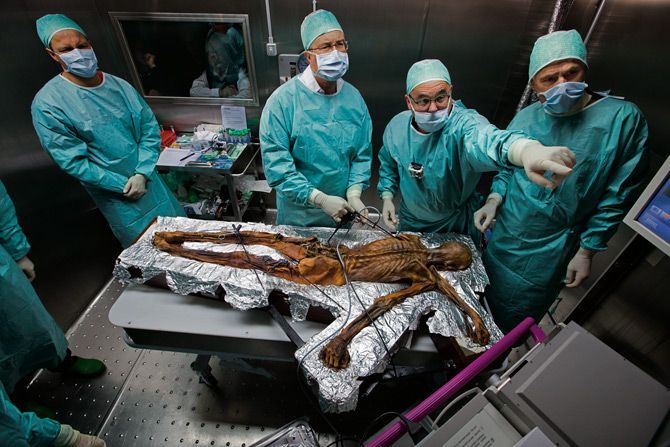
With Samadelli was a local pathologist with a trim mustache named Eduard Egarter Vigl, known informally as the Iceman's "family doctor." While Egarter Vigl poked and prodded the body with knowing, sometimes brusque familiarity, a handful of other scientists and doctors gathered around in the cramped space, preparing to do the unthinkable: defrost the Iceman. The next day, in a burst of hurried surgical interventions as urgent as any operation on a living person, they would perform the first full-scale autopsy on the thawed body, hoping to shed new light on the mystery of who the Iceman really was and how he had died such a violent death.

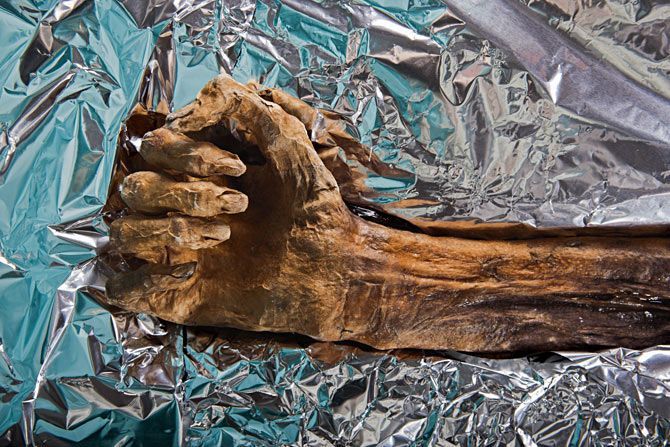
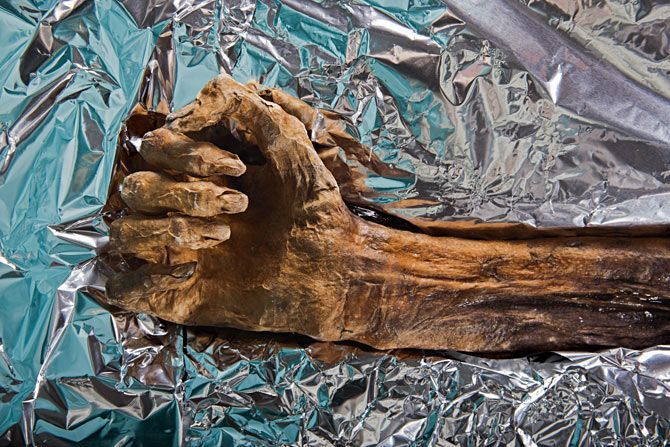
Egarter Vigl and Samadelli carefully transferred the body to a custom-made box lined with sterilized aluminum foil. In its frozen state, the Iceman's deep caramel skin had a dignified luster, reminiscent of a medieval figure painted in egg tempera. With the agonized reach of his rigid left arm and the crucifixate tilt of his crossed feet, the defrosting mummy struck a pose that wouldn't look out of place in a 14th-century altarpiece. Within moments, beads of water, like anxious sweat, began to form on his body. One droplet trickled down his chin with the slow inevitability of a tear.

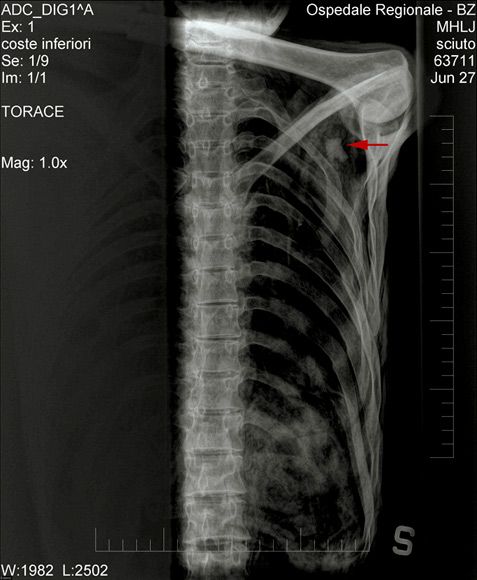
This was not the first time that the Iceman had been subject to intense scientific scrutiny. After Austrian authorities first recovered the mummy in 1991, scientists in Innsbruck cut a large gash across his lower torso as part of their initial investigation, along with other incisions in his back, at the top of the skull, and on his legs. It was later determined that the shallow conch of gray rock where he had been found was on the Italian side of the border with Austria, so the body and the artifacts surrounding it were relocated to Bolzano. Over the years, numerous less invasive explorations of the remains were conducted there, including x-ray and CT scan imaging studies and an analysis of the mummy's mitochondrial DNA. The most astonishing revelation came in 2001, when a local radiologist named Paul Gostner noticed a detail that had been overlooked in the images: an arrowhead buried in the Iceman's left shoulder, indicating that he had been shot from behind. Later work by Gostner and his colleagues with more powerful CT imaging devices revealed that the arrow had pierced a major artery in the thoracic cavity, causing a hemorrhage that would have been almost immediately fatal. The oldest accidentally preserved human ever found was the victim of a brutally efficient murder.

Other scientists filled in biographical details. Analysis of chemical traces in his bones and teeth indicated that Ötzi, as he is also called, grew up northeast of Bolzano, possibly in the Isarco River Valley, and spent his adulthood in the Venosta Valley. Pollen found in his body placed his final hours in the springtime, and his last hike probably along a path up the Senales Valley toward an alpine pass just west of the Similaun Glacier. Close examination of his hand revealed a partially healed injury, suggestive of a defensive wound from an earlier fight. DNA analysis of food remnants found in his intestines—his stomach appeared to be empty—indicated that sometime before he met his demise, he had eaten red meat and some sort of wheat. Putting these facts together, scientists theorized that adversaries had an altercation with the Iceman in the valley south of the pass, chased him, and caught up with him on the mountain, where the body was discovered more than 5,000 years later.

It was a good story that fit the evidence—until Gostner took a closer look at the Iceman's guts. Though he had retired, the radiologist kept studying the CT scans at home as a kind of hobby, and in 2009 he became convinced that scientists had mistaken the Iceman's empty colon for his stomach, which had been pushed up under his rib cage and appeared to Gostner to be full. If he was right, it meant the Iceman had eaten a large, and presumably leisurely, meal minutes before his death—not the sort of thing someone being chased by armed enemies would likely do.

"Gostner came over and told us he thought the stomach was full," said Albert Zink, director of the EURAC Institute for Mummies and the Iceman in Bolzano, who oversaw the autopsy last November. "And we thought, OK, then we have to go inside and sample the stomach." After further thought, Zink and his colleagues drew up a more ambitious plan: a head-to-toe investigation involving seven separate teams of surgeons, pathologists, microbiologists, and technicians. Perhaps most remarkable, this choreographed intervention would be accomplished without making any new incisions in the Iceman's body. Instead, the scientists would enter the body through the "Austrian windows"—their name for the overenthusiastic cuts made by the initial investigators.

"This will happen once," Zink said, "and then never again for many, many years."

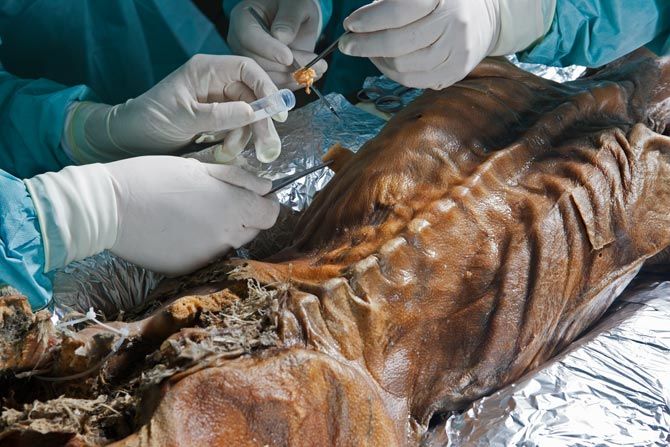
"This is the brain," announced neurosurgeon Andreas Schwarz, as he maneuvered a neurological endoscope into the top of the Iceman's head. Like the other scientists in the room, Schwarz was wearing 3-D glasses, and as he inched the instrument deeper inside the skull, a blurry 3-D image appeared on a computer monitor. It was a little after 1 p.m., and by that point the Iceman had already undergone six hours of poking, probing, gouging, and sample gathering. The surgical teams had taken snippets of muscle and lung. They had bored a hole in his pelvis to collect bone tissue for DNA analysis. They had rummaged around his thorax, trying to get close to the arrowhead and the tissue around it. They had even plucked some of his pubic hair. His skin had lost its luster and had a dull, leathery look, like a chicken wing left in the freezer too long.

Now they were peeking inside his brain to see if a mysterious shadow on a previous CT image might be an internal clot, or hematoma, at the rear of the skull, indicating a blow to the head. But the operation was not going smoothly. Schwarz's endoscope kept bumping into ice crystals that blurred the camera lens. After an hour, the neurosurgery team finished up, not entirely sure whether they had obtained a viable sample.

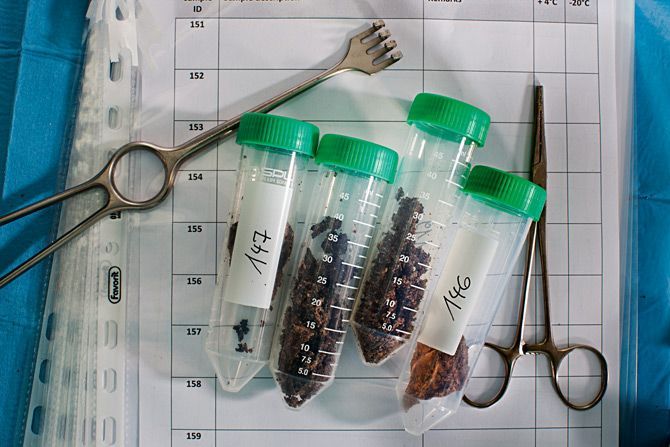
The initial attempts to explore the stomach were also frustrating. Peter Malfertheiner, of the Otto-von-Guericke University of Magdeburg, tried to insinuate an endoscope down the Iceman's throat into the stomach, but five millennia of atrophy and mummification blocked the way. Egarter Vigl stepped in with a less delicate approach. Using the large Austrian window at the lower end of the torso, he stuck a gloved hand into the Iceman's gut. He pulled out two large chunks of undigested food, then switched to a kitchen spoon and scooped several more ounces from the Iceman's very full stomach.

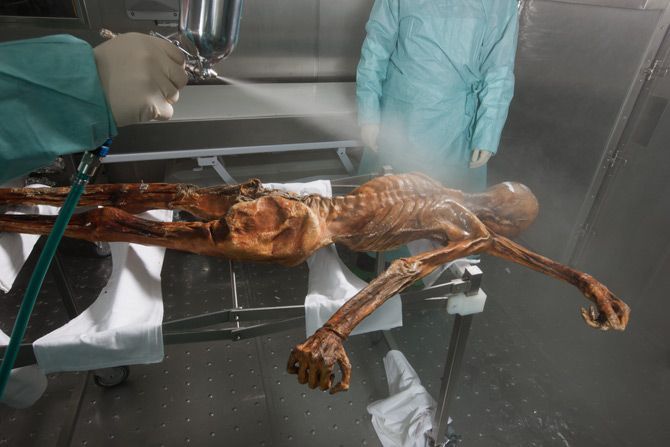
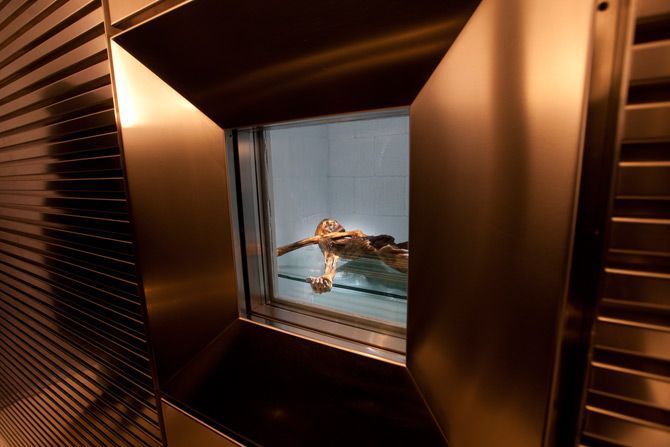
By the end of the day, the laboratory freezer brimmed with 149 biological samples—"enough for about 50 papers," quipped one of the biologists. As soon as the autopsy concluded, Samadelli lowered the temperature in the laboratory below freezing. The next morning he and Egarter Vigl spruced up the body with a fine spray of sterilized water, which froze on contact. Then they slid the Iceman back into his high-tech igloo and closed the door.

The autopsy had taken about nine hours; analysis of the material gleaned will take years. The first revelations were disclosed in June, when Zink and his colleagues presented some of their initial findings at a scientific meeting. Thanks to the DNA in a tiny speck of pelvic bone culled during the autopsy, the Iceman has joined the company of renowned biologists James D. Watson and J. Craig Venter as one of a handful of humans whose genomes have been sequenced in exquisite detail.

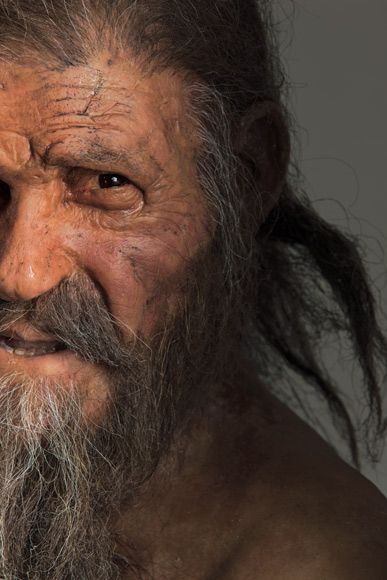
The genetic results add both information and intrigue. From his genes, we now know that the Iceman had brown hair and brown eyes and that he was probably lactose intolerant and thus could not digest milk—somewhat ironic, given theories that he was a shepherd. Not surprisingly, he is more related to people living in southern Europe today than to those in North Africa or the Middle East, with close connections to geographically isolated modern populations in Sardinia, Sicily, and the Iberian Peninsula. The DNA analysis also revealed several genetic variants that placed the Iceman at high risk for hardening of the arteries. ("If he hadn't been shot," Zink remarked, "he probably would have died of a heart attack or stroke in ten years.") Perhaps most surprising, researchers found the genetic footprint of bacteria known as Borrelia burgdorferi in his DNA—making the Iceman the earliest known human infected by the bug that causes Lyme disease.

The autopsy results have also rewritten the story of the Iceman's final moments. The neuroscientists determined that blood had indeed accumulated at the back of the Iceman's brain, suggesting some sort of trauma—either from falling on his face from the force of the arrow, Zink speculated, or perhaps from a coup de grâce administered by his assailant. DNA analysis of the final meal is ongoing, but one thing is already clear: It was greasy. Initial tests indicate the presence of fatty, baconlike meat of a kind of wild goat called an alpine ibex. "He really must have had a heavy meal at the end," Zink said—a fact that undermines the notion that he was fleeing in fear. Instead, it appears he was resting in a spot protected from the wind, tranquilly digesting his meal, unaware of the danger he was in.

And of course, unaware of the intense attention awaiting him far in the future. The Iceman might be the most exposed and invaded person who ever walked the planet. "There were moments yesterday," Zink said in a soft, almost surprised voice, "when you felt sorry for him. He was so … explored. All his secrets—inside him, outside him, all around him—were open to exploration." He paused and added, "Only the arrowhead remains inside him, as if he's saying, This is my last secret."
01-iceman-arm-thaws-670.jpg
93.5 KB ·1233 views
11 Users Say Thank You For This Post:
batlungs, gatagato, kellyhound, Kelseecat65, Kim, Kola925, lkduke3, luciddrmr, rabenson, slapchoppa, Vampyre
▼ PROMO FROM DOCUMENTING REALITY
Your Easiest Financial Decision Today
Join Now
Hidden for upgraded members.
  #2  
10-30-2011, 12:53 PM
Faline's Avatar
Faline
Offline:
My Rank: MAJOR
Poster Rank:12
Join Date: Jun 2009
Posts: 93,130
Contributions: 226
 
Mentioned: 91 Post(s)
Quoted: 2009 Post(s)
Activity Longevity
0/20 18/20
Today Posts
0/11 ssss93130
Re: The Iceman Autopsy

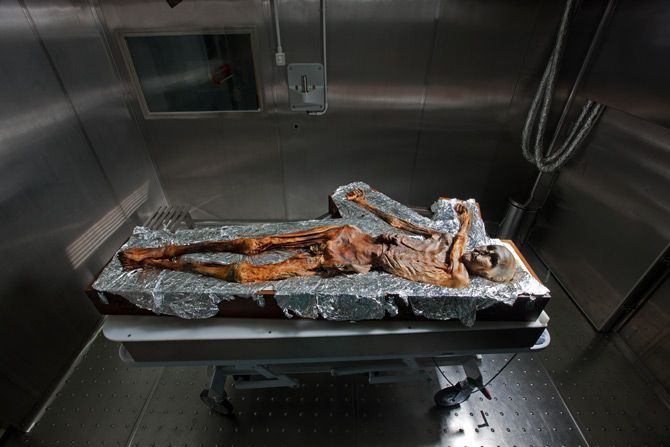
The Iceman's arm thaws on a sheet of sterilized foil:
Click image for larger version

Name:	01-iceman-arm-thaws-670.jpg
Views:	1769
Size:	131.1 KB
ID:	313620

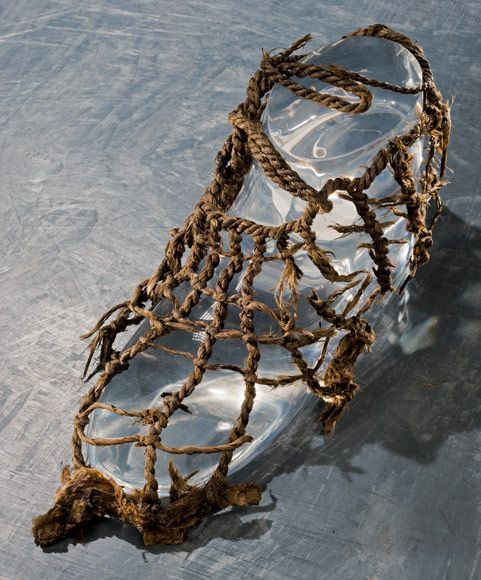
On his last trek he wore hay-and-hide shoes (above, on glass model) held together with bark fibers:
Click image for larger version

Name:	03-hay-and-hide-shoes-670.jpg
Views:	1959
Size:	105.0 KB
ID:	313621

After moving the Iceman into a laboratory, researchers raised the temperature to 64°F to thaw him on a sheet of sterilized aluminum foil in a box custom-made to accommodate his crossed feet and oddly outstretched left arm. The 30 ounces of meltwater collected during the overnight defrosting is being analyzed for cold-adapted bacteria that might hasten the decomposition of the mummy:
Click image for larger version

Name:	04-thawed-iceman-feet-670.jpg
Views:	7548
Size:	163.6 KB
ID:	313622

After undergoing a nine-hour autopsy at the South Tyrol Museum of Archaeology in Bolzano, Italy, the thawed Iceman is returned to a temperature of 21°F. Then he will be moved to the large glass slab on which he lies for public viewing:
Click image for larger version

Name:	05-post-autopsy-icing-670.jpg
Views:	13368
Size:	82.7 KB
ID:	313623

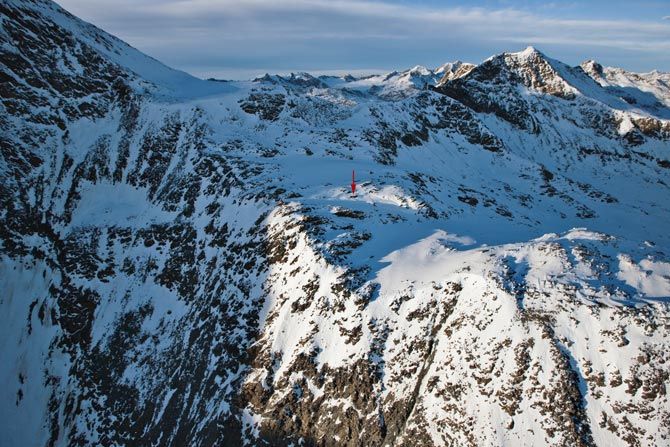
The red arrow shows where hikers found the Iceman's body in 1991, poking out of glacial ice in a shallow bowl of rock at an altitude of about 10,500 feet. A rich assortment of Neolithic artifacts were scattered around the body. The site, in the Italian part of the Ötztal Alps, gave rise to the mummy's nickname: Ötzi:
Click image for larger version

Name:	06-discovery-location-otztal-alps-670.jpg
Views:	3580
Size:	105.1 KB
ID:	313624

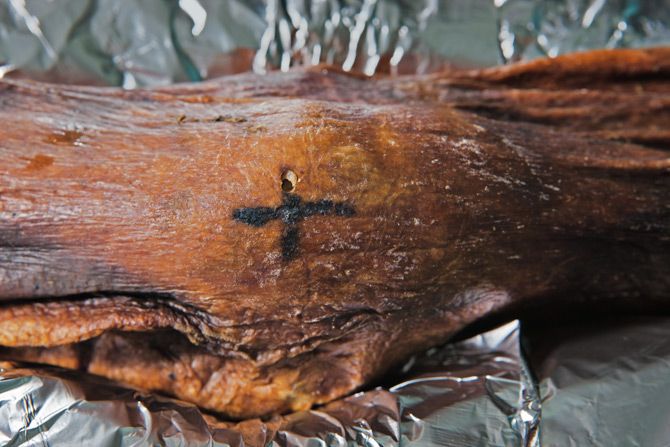
Near the Iceman's knee, a cross-shaped tattoo still stands out on his leathery skin. It may have been a folk remedy for arthritic joint pain:
Click image for larger version

Name:	07-iceman-knee-tatoo-670.jpg
Views:	7428
Size:	123.7 KB
ID:	313625

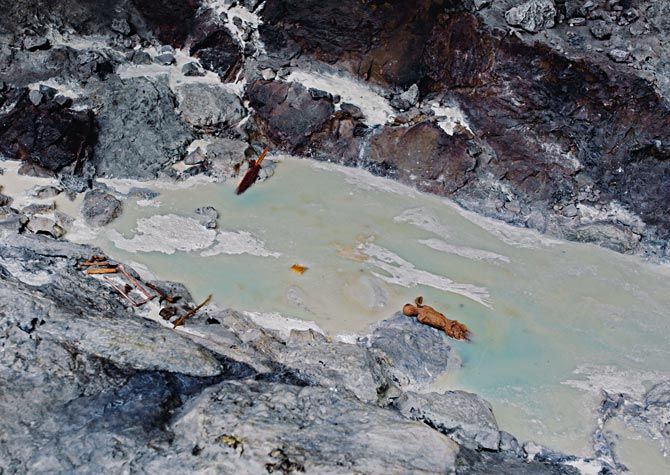
A model depicts the Iceman and the location of several artifacts as they were found. The body is shown near the center. Near the feet, two chunks of birch fungus on leather straps were recovered, along with a flint-bladed dagger and shoes. Not far from the head was a pack containing a maple leaf. Also found were an ax with a copper blade, two arrows, and a tangle of string:
Click image for larger version

Name:	08-iceman-discovery-model-670.jpg
Views:	2153
Size:	90.4 KB
ID:	313626

Eduard Egarter Vigl (pointing) and colleagues use an endoscope to try to examine the arrowhead in the Iceman's shoulder. The arrow severed an artery, causing a quick, bloody demise:
Click image for larger version

Name:	09-examining-arrowhead-in-iceman-670.jpg
Views:	3762
Size:	138.1 KB
ID:	313627


X-rays of the Iceman's left shoulder guided the team in their attempt to find the fatal arrowhead, marked above by a red arrow:
Click image for larger version

Name:	10-left-shoulder-xray-670.jpg
Views:	4242
Size:	80.1 KB
ID:	313628

Probing and snipping for nine hours, scientists harvested dozens of biological clues about the life—and death—of the Iceman:
Click image for larger version

Name:	11-peeling-iceman-back-670.jpg
Views:	8773
Size:	80.1 KB
ID:	313629

Remnants of the Iceman's stomach and last meal (in test tubes) prompted one doctor to say, "He had a good appetite!":
Click image for larger version

Name:	12-last-meal-stomach-remnants-670.jpg
Views:	2728
Size:	125.0 KB
ID:	313630

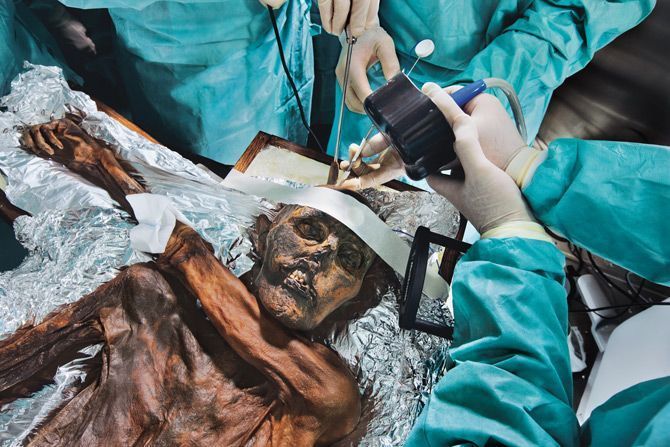
Neurosurgeons retrieved bits of a blood clot, suggesting brain trauma around the time the Iceman died:
Click image for larger version

Name:	13-blood-clot-suggests-brain-trauma-670.jpg
Views:	4159
Size:	158.0 KB
ID:	313631


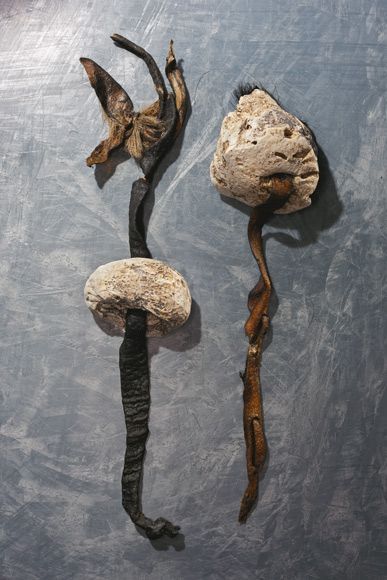
Two chunks of birch fungus on leather straps, possibly used to stanch bleeding and prevent infection, were part of a portable first-aid kit:
Click image for larger version

Name:	14-birch-fungus-first-aid-kit-670.jpg
Views:	8179
Size:	95.6 KB
ID:	313632

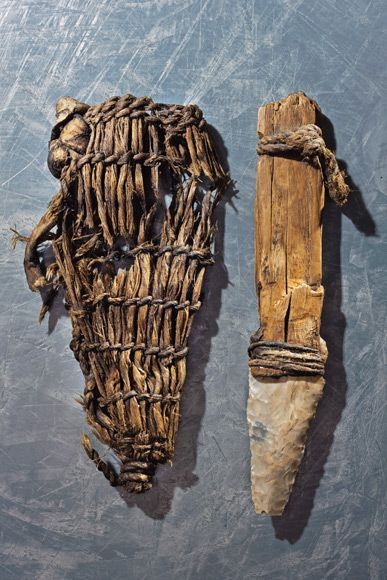
The Iceman's dagger had a flint blade and a sheath:
Click image for larger version

Name:	15-dagger-and-sheath-670.jpg
Views:	4328
Size:	119.4 KB
ID:	313633

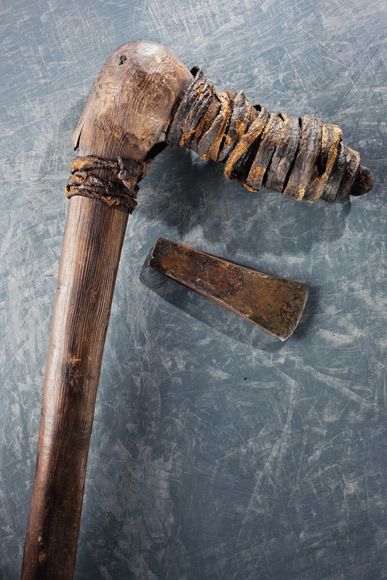
An ax with a blade of rare copper marked the Iceman as a person of status:
Click image for larger version

Name:	16-rare-copper-ax-670.jpg
Views:	1730
Size:	99.8 KB
ID:	313634

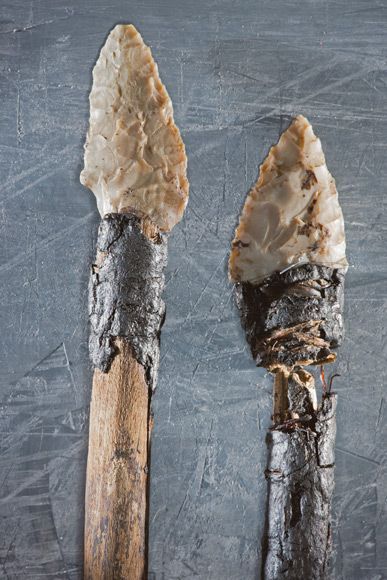
Two arrows served for hunting and self-defense:
Click image for larger version

Name:	17-hunting-arrows-670.jpg
Views:	2887
Size:	107.2 KB
ID:	313635

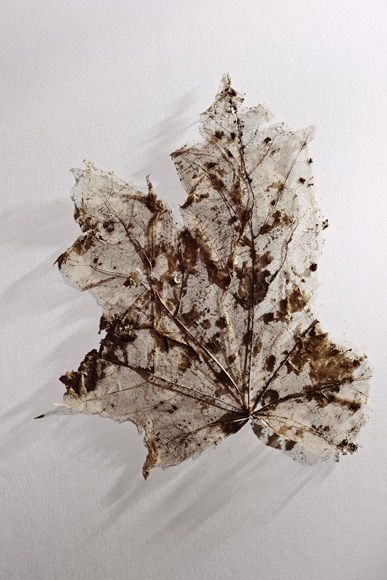
A maple leaf found in the Iceman's pack would have been used to wrap embers; its chlorophyll content indicates the leaf was picked when green—most likely in late spring:
Click image for larger version

Name:	18-maple-leaf-to-wrap-embers-670.jpg
Views:	2023
Size:	85.2 KB
ID:	313636

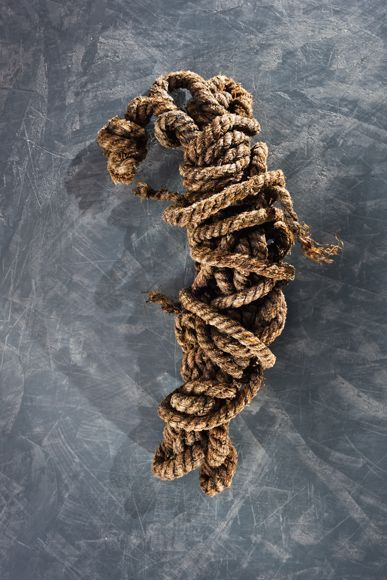
A tangle of string, possibly bowstring, remains a knotty mystery:
Click image for larger version

Name:	19-mysterious-tangled-string-670.jpg
Views:	1943
Size:	167.6 KB
ID:	313637

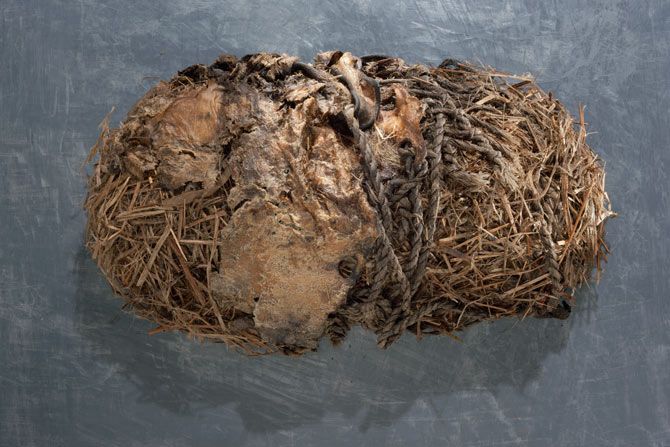
The Iceman's shoes—hay for warmth inside deerskin uppers with bearskin sole—are among the oldest ever found:
Click image for larger version

Name:	20-icemans-shoe-deerskin-interior-670.jpg
Views:	2829
Size:	85.3 KB
ID:	313638


Minutes before putting the Iceman back on display, pathologist Eduard Egarter Vigl coats the mummy with a fine spray of sterilized water, which freezes on contact to form a glistening glaze that protects him from contamination and reduces dehydration:
Click image for larger version

Name:	21-protection-coating-sterilized-water-670.jpg
Views:	2296
Size:	86.6 KB
ID:	313639


In rigid (and frigid) repose, the Iceman resides in an igloo-like chamber at the South Tyrol Museum of Archaeology in Bolzano, Italy. At 21°F and 98.5 percent relative humidity, it mimics the glacial environment that preserved him for more than five millennia:
Click image for larger version

Name:	22-iceman-igloo-like-chamber-670.jpg
Views:	1705
Size:	86.0 KB
ID:	313640

Dutch artists Adrie and Alfons Kennis used 3-D scans of the Iceman's skeleton and other anatomical clues to create a life-size model. Scientists once believed he had blue eyes; his DNA now proves they were brown:
Click image for larger version

Name:	02-life-sized-iceman-model-670.jpg
Views:	2104
Size:	85.2 KB
ID:	313641
27 Users Say Thank You For This Post:
AnneLea, Arsedestroyer, Bobv9999, ChemJoe, ernyzaz, Flaka, gatagato, gorelover, HTP, Illusion, johnleeknoefler, kellyhound, Kelseecat65, Kerri, khathryn, lkduke3, luciddrmr, morbidinterested, Pyramid_Head, rabenson, rkv, SimoneFlen', slapchoppa, SweetPeach, Vapeitup, Wren, xXRockerGuyXx
  #3  
10-30-2011, 12:55 PM
Faline's Avatar
Faline
Offline:
My Rank: MAJOR
Poster Rank:12
Join Date: Jun 2009
Posts: 93,130
Contributions: 226
 
Mentioned: 91 Post(s)
Quoted: 2009 Post(s)
Activity Longevity
0/20 18/20
Today Posts
0/11 ssss93130
Re: The Iceman Autopsy

Vid
5 Users Say Thank You For This Post:
ernyzaz, Illusion, kellyhound, rabenson, Sterlig
  #4  
10-30-2011, 12:56 PM
Faline's Avatar
Faline
Offline:
My Rank: MAJOR
Poster Rank:12
Join Date: Jun 2009
Posts: 93,130
Contributions: 226
 
Mentioned: 91 Post(s)
Quoted: 2009 Post(s)
Activity Longevity
0/20 18/20
Today Posts
0/11 ssss93130
Re: The Iceman Autopsy

Last Hours of the Iceman


Update (September, 2007): Researchers report that head trauma along with uncontrolled bleeding ultimately killed the Iceman. Read more.
It was late spring or early summer, when a modest tree called the hop hornbeam unfurls bright yellow clusters of flowers in the steep valleys that run north into the mountains now known as the Italian Alps. The man hurried through a forest he knew well, wincing from the pain in his injured right hand and pausing occasionally to listen for sounds that he was being pursued. As he fled up the slope, the yellow pollen of the hornbeam blossoms fell like an invisible rain, salting the water and food he consumed when he stopped to rest. Five thousand years later, the Neolithic hunter we call the Iceman would still bear traces of this ancient dusting inside his body—a microscopic record of the time of year it was when he passed through this forest and into the nearby mountains, where fate would finally catch up with him.

Since hikers discovered his mummified corpse in 1991 in a rocky hollow high in the Ötztal Alps on Italy's border with Austria, scientists have used ever more sophisticated tools and intellectual cunning to reconstruct the life and times of the Iceman (or "Ötzi"), the oldest intact member of the human family. We know that he was a small, sinewy, and, for his times, rather elderly man in his mid-40s. Judging from the precious, copper-bladed ax found with him, we suspect that he was a person of considerable social significance. He set off on his journey wearing three layers of garments and sturdy shoes with bearskin soles. He was well equipped with a flint-tipped dagger, a little fire-starting kit, and a birchbark container holding embers wrapped in maple leaves. Yet he also headed into a harsh wilderness curiously under-armed: The arrows in his deerskin quiver were only half finished, as if he had recently fired all his munitions and was in the process of hastily replenishing them. And he was traveling with a long, roughly shaped stalk of yew—an unfinished longbow, yet to be notched and strung. Why?

When it comes to the Iceman, there has never been a shortage of questions, or theories to answer them. During the 16 years that scientists have poked, prodded, incised, and x-rayed his body, they have dressed him up in speculations that have not worn nearly as well as his rustic garments. At one time or another, he has been mistakenly described as a lost shepherd, a shaman, a victim of ritual sacrifice, and even a vegan. But all these theories fade in the face of the most startling new fact scientists have learned about the Iceman. Although we still don't know exactly what happened up there on that alpine ridge, we now know that he was murdered, and died very quickly, in the rocky hollow where his body was found.

"Even five years ago, the story was that he fled up there and walked around in the snow and probably died of exposure," said Klaus Oeggl, an archaeobotanist at the University of Innsbruck. "Now it's all changed. It's more like a paleo crime scene."

The object of all this intense scientific attention is a freeze-dried slab of human jerky, which since 1998 has resided in a refrigerated, high-tech chamber in the South Tyrol Museum of Archaeology in Bolzano, Italy. The temptation to conduct fresh experiments on the body rises with every new twist of technology, each revealing uncannily precise details about his life. Using a sophisticated analysis of isotopes in one of the Iceman's teeth, for example, scientists led by Wolfgang Muller (now at the Royal Holloway, University of London) have shown that he probably grew up in the Valle Isarco, an extensive north-south valley that includes the modern-day town of Bressanone. Isotope levels in his bones, meanwhile, match those in the soil and water of two alpine valleys farther west, the Val Senales and the Val Venosta. Muller's team has also analyzed microscopic chips of mica recovered from the Iceman's intestines, which were probably ingested accidentally in food made from stone-ground grain; geologic ages of the mica best match a small area limited to the lower Val Venosta. The Iceman probably set off on his final journey from this very area, near where the modern-day Adige and Senales Rivers meet.

We also know that he was not in good health when he headed up into the mountains. The one surviving fingernail recovered from his remains suggests that he suffered three episodes of significant disease during the last six months of life, the last bout only two months prior to his death. Doctors inspecting the contents of his intestines have found eggs of the whipworm parasite, so he may well have suffered from stomach distress. But he was not too sick to eat. In 2002, Franco Rollo and colleagues at the University of Camerino in Italy analyzed tiny amounts of food residue from the mummy's intestines. A day or two before his death, the Iceman had eaten a piece of wild goat and some plant food. The same analysis revealed that his very last meal was red deer and some cereals. The archaeobotanist Klaus Oeggl has concluded from bran-like food residues that the Iceman's diet also included the primitive form of wheat known as einkorn as well as barley, found on his garments, indicating that the Neolithic settlements south of the Alps where he lived cultivated these grains. Oeggl has even found that the small size of the wheat fragments in the gut, along with tiny flecks of charcoal, suggest that the grains were ground and then baked as primitive bread in open fires.
9 Users Say Thank You For This Post:
gatagato, kellyhound, Kelseecat65, Kerri, lkduke3, luciddrmr, Seven Of Nine, slapchoppa, Steve
  #5  
10-30-2011, 01:19 PM
Viking64's Avatar
Viking64
Offline:
★Wizard Of Gore★
Poster Rank:2
Join Date: Aug 2009
Posts: 127,069
Contributions: 1
 
Mentioned: 450 Post(s)
Quoted: 30201 Post(s)
Activity Longevity
17/20 17/20
Today Posts
5/11 sss127069
Re: The Iceman Autopsy

What a great post, Kelly!!! I watched an interesting documentary about the Iceman not long after he was discovered in the early 1990's. This is just amazing seeing an update on him after such intensive research.
2 Users Say Thank You For This Post:
Faline, Zahir82
  #6  
10-30-2011, 02:46 PM
kellyhound's Avatar
kellyhound
Online
✝Mudderator from Hell✝
Poster Rank:11
e-mail
Join Date: Oct 2006
Posts: 95,737
Contributions: 817
 
Mentioned: 473 Post(s)
Quoted: 10203 Post(s)
Activity Longevity
18/20 20/20
Today Posts
9/11 ssss95737
Re: The Iceman Autopsy

awesome trip back into time
This User Says Thank You For This Post:
Kelseecat65
  #7  
10-30-2011, 03:11 PM
Arkoquisa's Avatar
Arkoquisa
Offline:
King of East Texas
Poster Rank:356
3 legs
Join Date: Dec 2010
Posts: 3,445
Contributions: 1
 
Mentioned: 13 Post(s)
Quoted: 915 Post(s)
Activity Longevity
0/20 16/20
Today Posts
0/11 sssss3445
Re: The Iceman Autopsy

mega post!
  #8  
10-30-2011, 05:09 PM
NEVERBACKZ's Avatar
NEVERBACKZ
Offline:
★ Legacy Member ★
Poster Rank:384
male
Join Date: Jan 2010
Posts: 3,087
 
Mentioned: 0 Post(s)
Quoted: 147 Post(s)
Activity Longevity
1/20 17/20
Today Posts
0/11 sssss3087
Re: The Iceman Autopsy

Absolutely facinating
  #9  
10-31-2011, 12:27 AM
FuckYourAccount's Avatar
FuckYourAccount
Offline:
My Rank: CORPORAL
Poster Rank:1362
Join Date: Jun 2009
Posts: 439
 
Mentioned: 0 Post(s)
Quoted: 16 Post(s)
Activity Longevity
0/20 18/20
Today Posts
0/11 ssssss439
Re: The Iceman Autopsy

Good post. I read an article on the ice man the same year that he was discovered. At that point they thought he slipped and fell down a slope and died from exposure. Never knew he was murdered.
  #10  
10-31-2011, 09:48 AM
collaredgirl65's Avatar
collaredgirl65
Offline:
Smartest Retard
Poster Rank:188
Female
Join Date: Feb 2010
Posts: 8,011
 
Mentioned: 1 Post(s)
Quoted: 34 Post(s)
Activity Longevity
0/20 17/20
Today Posts
0/11 sssss8011
Re: The Iceman Autopsy

Good info and post.


Powered by vBulletin Copyright 2000-2010 Jelsoft Enterprises Limited.

Search Engine Friendly URLs by vBSEO