JavaScript and Cookies are required to view this site. Please enable both in your browser settings.
Hubble Space Telescope Advent Calendar 2008 (25 Pix) - Section 2

Hubble Space Telescope Advent Calendar 2008 (25 Pix) 

Current Rating:

Unlimited Views No Ads No Algorithms Lifetime Account

Documenting Reality

Community Forum · Est. 2006

Join Now
Thread Tools
  #11  
04-04-2010, 12:58 AM
güttsfükk's Avatar
güttsfükk
Offline:
Super *********
Poster Rank:88
Join Date: Nov 2008
Posts: 17,426
 
Mentioned: 5 Post(s)
Quoted: 99 Post(s)
Activity Longevity
0/20 18/20
Today Posts
0/11 ssss17426
Re: Hubble Space Telescope Advent Calendar 2008 (25 Pix)

This is the sharpest image ever made of the large "grand design" spiral galaxy M81, or Bode's Galaxy made with Hubble data acquired over a two-year period. A spiral-shaped system of stars, dust, and gas clouds, the galaxy's arms wind all the way down into the nucleus. Though the galaxy is located 11.6 million light-years away, the Hubble Space Telescope's view is so sharp that it can resolve individual stars, along with open star clusters, globular star clusters, and even glowing regions of fluorescent gas. Bode's galaxy is about 70,000 light-years across - slightly smaller than our own Milky Way, estimated to be 100,000 light-years in diameter.
11_0710a.jpg
166.5 KB ·66 views
2 Users Say Thank You For This Post:
Beard, Nve
▼ PROMO FROM DOCUMENTING REALITY
Still cheaper than whatever Carl just offered
Join Now
Hidden for upgraded members.
  #12  
04-04-2010, 12:58 AM
güttsfükk's Avatar
güttsfükk
Offline:
Super *********
Poster Rank:88
Join Date: Nov 2008
Posts: 17,426
 
Mentioned: 5 Post(s)
Quoted: 99 Post(s)
Activity Longevity
0/20 18/20
Today Posts
0/11 ssss17426
Re: Hubble Space Telescope Advent Calendar 2008 (25 Pix)

The "Retina Nebula" is in fact, a dying star named IC 4406. The left and right halves of the Hubble image are nearly mirror images of the other. If we could fly around IC 4406 in a starship, we would see that the gas and dust form a vast donut of material streaming outward from the dying star. From Earth, we are viewing the donut from the side. This side view allows us to see the intricate tendrils of dust that have been compared to the eye's retina. Gas on the inside of the donut is ionized by light from the central star and glows brightly. Light from oxygen atoms is rendered blue in this image; hydrogen is shown as green, and nitrogen as red. One of the most interesting features here is the irregular lattice of dark lanes that criss-cross the center of the nebula. These lanes are about 24 billion kilometers wide, and are like an open mesh veil that has been wrapped around the bright donut.
12_0214.jpg
73.8 KB ·57 views
3 Users Say Thank You For This Post:
Beard, Creepy, Nve
  #13  
04-04-2010, 12:59 AM
güttsfükk's Avatar
güttsfükk
Offline:
Super *********
Poster Rank:88
Join Date: Nov 2008
Posts: 17,426
 
Mentioned: 5 Post(s)
Quoted: 99 Post(s)
Activity Longevity
0/20 18/20
Today Posts
0/11 ssss17426
Re: Hubble Space Telescope Advent Calendar 2008 (25 Pix)

This image shows a handful of Bok globules (dark clouds of dense dust and gas) within a larger mosaic image of the Carina Nebula assembled in April of 2007. The clumps of dark clouds are nodules of dust and gas that have resisted being completely photoionized by the strong ultraviolet radiation of nearby young, bright stars. The globule at right is nicknamed "the caterpillar" - its glowing edge indicating that it is in the process of photoionization by the hottest stars in the cluster. the Carina nebula lies some 7,500 light-years away from Earth.
13_200716.jpg
112.4 KB ·51 views
This User Says Thank You For This Post:
Nve
  #14  
04-04-2010, 01:00 AM
güttsfükk's Avatar
güttsfükk
Offline:
Super *********
Poster Rank:88
Join Date: Nov 2008
Posts: 17,426
 
Mentioned: 5 Post(s)
Quoted: 99 Post(s)
Activity Longevity
0/20 18/20
Today Posts
0/11 ssss17426
Re: Hubble Space Telescope Advent Calendar 2008 (25 Pix)

Resembling a rippling pool illuminated by underwater lights, the Egg Nebula offers astronomers a special look at the normally invisible dust shells swaddling an aging star. These dust layers, extending over one-tenth of a light-year from the star, have an onionskin structure that forms concentric rings around the star. A thicker dust belt, running almost vertically through the image, blocks off light from the central star. Twin beams of light radiate from the hidden star and illuminate the pitch-black dust, like a shining flashlight in a smoky room. The Egg Nebula is located 3,000 light-years away in the constellation Cygnus. This image was taken with Hubble's Advanced Camera for Surveys in September and October 2002.
14_0309.jpg
170.0 KB ·48 views
2 Users Say Thank You For This Post:
Beard, Nve
  #15  
04-04-2010, 01:00 AM
güttsfükk's Avatar
güttsfükk
Offline:
Super *********
Poster Rank:88
Join Date: Nov 2008
Posts: 17,426
 
Mentioned: 5 Post(s)
Quoted: 99 Post(s)
Activity Longevity
0/20 18/20
Today Posts
0/11 ssss17426
Re: Hubble Space Telescope Advent Calendar 2008 (25 Pix)

The gas giant Saturn, seen at full-tilt in November of 1999. Saturn's orbit lies some 1.2 billion kilometers (about 67 light-minutes) away from earth. The planet itself is roughly 9.5 times wider than Earth and its rings - composed of 93 percent water ice - extend out to 120,000 km above its equator, averaging approximately 20 meters in thickness.
15_200115.jpg
55.3 KB ·62 views
This User Says Thank You For This Post:
Nve
  #16  
04-04-2010, 01:01 AM
güttsfükk's Avatar
güttsfükk
Offline:
Super *********
Poster Rank:88
Join Date: Nov 2008
Posts: 17,426
 
Mentioned: 5 Post(s)
Quoted: 99 Post(s)
Activity Longevity
0/20 18/20
Today Posts
0/11 ssss17426
Re: Hubble Space Telescope Advent Calendar 2008 (25 Pix)

The tattered remains of a supernova explosion known as Cassiopeia A (Cas A), the youngest known remnant from a supernova explosion in the Milky Way. This composite image shows the Cas A remnant as a broken ring of bright filamentary and clumpy stellar ejecta. These huge swirls of debris glow with the heat generated by the passage of a shockwave from the supernova blast. The various colours of the gaseous shards indicate differences in chemical composition. Bright green filaments are rich in oxygen, red and purple are sulphur, and blue are composed mostly of hydrogen and nitrogen. Cas A is located ten thousand light-years away from Earth in the constellation of Cassiopeia.
16_200630.jpg
236.7 KB ·52 views
2 Users Say Thank You For This Post:
Beard, Nve
  #17  
04-04-2010, 01:01 AM
güttsfükk's Avatar
güttsfükk
Offline:
Super *********
Poster Rank:88
Join Date: Nov 2008
Posts: 17,426
 
Mentioned: 5 Post(s)
Quoted: 99 Post(s)
Activity Longevity
0/20 18/20
Today Posts
0/11 ssss17426
Re: Hubble Space Telescope Advent Calendar 2008 (25 Pix)

"The Grasshopper", or UGC 4881, is a stunning system consisting of two colliding galaxies. It has a bright curly tail containing a remarkable number of star clusters. The galaxies are thought to be halfway through a merger - the cores of the parent galaxies are still clearly separated, but their discs are overlapping. A supernova exploded in this system in 1999 and astronomers believe that a vigorous burst of star formation may have just started. This notable object is located in the constellation of Lynx, some 500 million light-years away from Earth. UGC 4881 is the 55th galaxy in Arp's Atlas of Peculiar Galaxies. This image is part of a large collection of 59 images of merging galaxies taken by the Hubble Space Telescope and released on the occasion of its 18th anniversary on April 24th, 2008.
17_0810.jpg
133.1 KB ·58 views
2 Users Say Thank You For This Post:
Beard, Nve
  #18  
04-04-2010, 01:02 AM
güttsfükk's Avatar
güttsfükk
Offline:
Super *********
Poster Rank:88
Join Date: Nov 2008
Posts: 17,426
 
Mentioned: 5 Post(s)
Quoted: 99 Post(s)
Activity Longevity
0/20 18/20
Today Posts
0/11 ssss17426
Re: Hubble Space Telescope Advent Calendar 2008 (25 Pix)

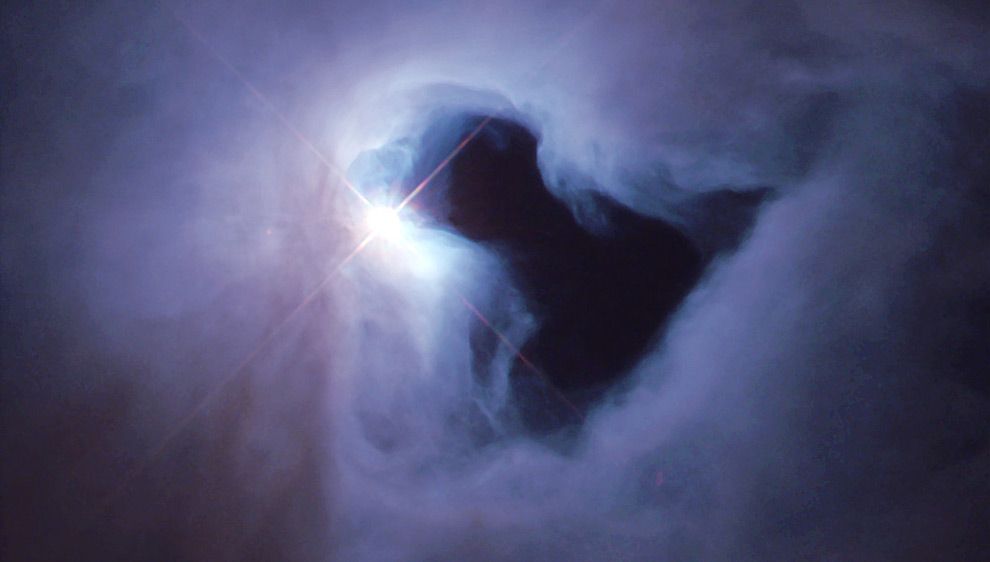
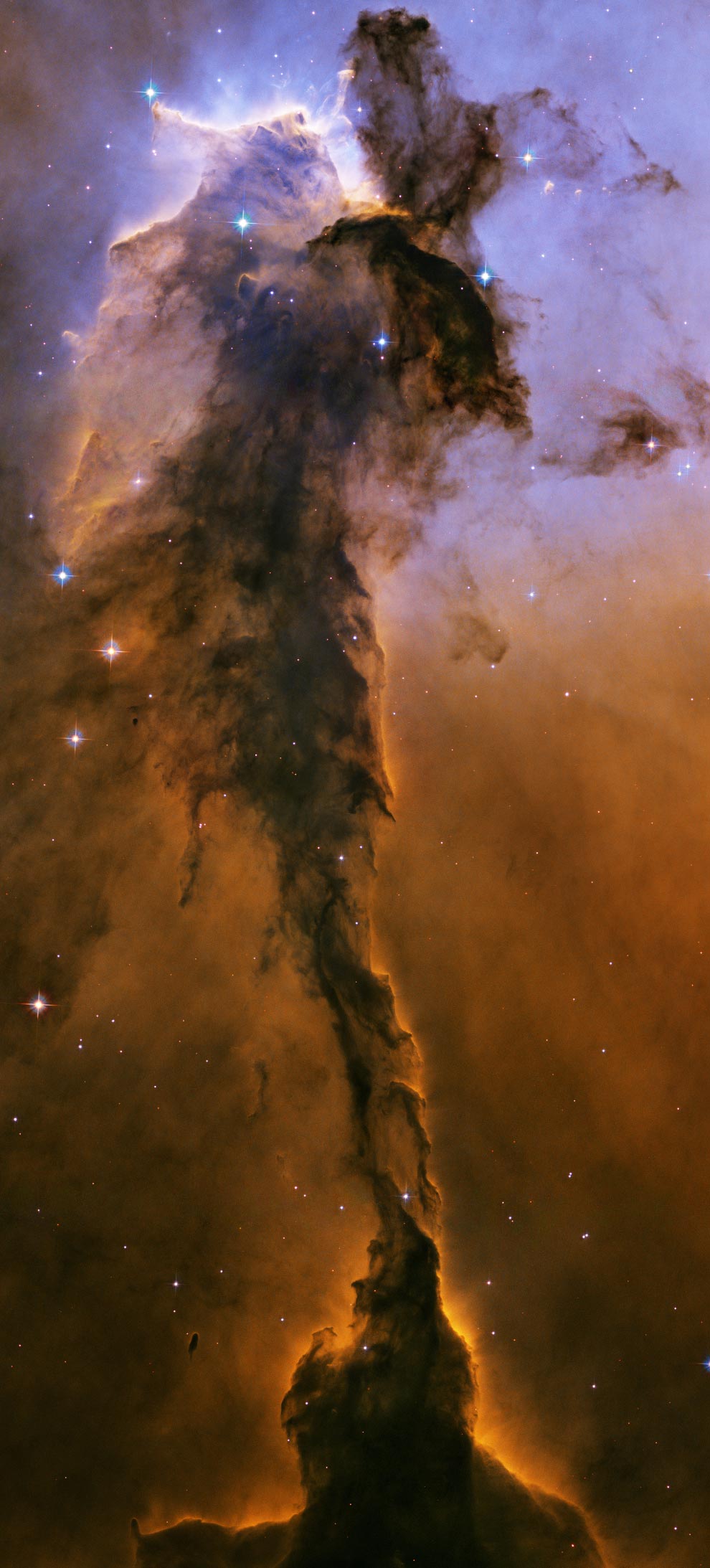
Part of the famous "Pillars of Creation" formation in the Eagle Nebula, this eerie, dark structure, resembling an imaginary sea serpent's head, is a column of cool molecular hydrogen gas (two atoms of hydrogen in each molecule) and dust that is an incubator for new stars. The stars are embedded inside finger-like protrusions extending from the top of the nebula. Each 'fingertip' is somewhat larger than our own solar system. The Eagle Nebula is 7,000 light-years distant from Earth
18_9544.jpg
282.3 KB ·50 views
2 Users Say Thank You For This Post:
Beard, Nve
  #19  
04-04-2010, 01:02 AM
güttsfükk's Avatar
güttsfükk
Offline:
Super *********
Poster Rank:88
Join Date: Nov 2008
Posts: 17,426
 
Mentioned: 5 Post(s)
Quoted: 99 Post(s)
Activity Longevity
0/20 18/20
Today Posts
0/11 ssss17426
Re: Hubble Space Telescope Advent Calendar 2008 (25 Pix)

Tightly wound, almost concentric, arms of dark dust encircle the bright nucleus of the otherwise nondescript galaxy, NGC 2787, in this image created by the Hubble Heritage team. Astronomer Marcella Carollo (Swiss Federal Institute of Technology, Zurich) and collaborators used Hubble's Wide Field Planetary Camera 2 to collect the data in January 1999.
19_0207.jpg
168.7 KB ·50 views
2 Users Say Thank You For This Post:
Beard, Nve
  #20  
04-04-2010, 01:03 AM
güttsfükk's Avatar
güttsfükk
Offline:
Super *********
Poster Rank:88
Join Date: Nov 2008
Posts: 17,426
 
Mentioned: 5 Post(s)
Quoted: 99 Post(s)
Activity Longevity
0/20 18/20
Today Posts
0/11 ssss17426
Re: Hubble Space Telescope Advent Calendar 2008 (25 Pix)

This object, nicknamed Gomez's Hamburger, is a sun-like star about 6,500 light-years away that is nearing the end of its life. The "hamburger buns" are light reflecting off dust and the "patty" is actually the shadow of a thick disk around the central star, which is seen edge-on from Earth. The star itself, with a surface temperature of approximately 18,000 degrees Fahrenheit (10,000 degrees Celsius), is hidden within this disk. However, light from the star does emerge in the directions perpendicular to the disk and illuminates dust above and below it.
20_200219.jpg
128.1 KB ·48 views
2 Users Say Thank You For This Post:
Beard, Nve


Powered by vBulletin Copyright 2000-2010 Jelsoft Enterprises Limited.

Search Engine Friendly URLs by vBSEO