|
#1
●
01-20-2014, 10:08 PM
| ||||||||
 They Lied. There ALL LIES Poster Rank:309 <--We Did It. So Can You Join Date: Mar 2013 Posts: 4,213
Contributions: 48
Mentioned: 23 Post(s) Quoted: 894 Post(s)
| ||||||||
|
How Far Can the Eye See?
sorta depends on how u think about site!! 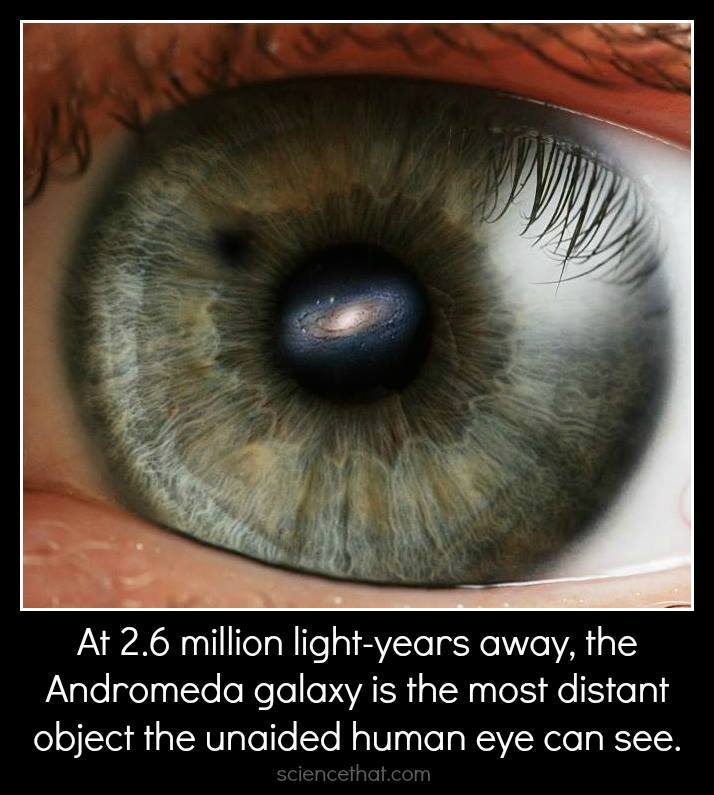 The curvature of the Earth limits the amount of things we can see to its horizon. However, the human eye is sensitive enough that our ability to see extends beyond the horizon. If the Earth was flat, the human eye could detect bright lights that are miles distant. You could even see a candle flickering at 30 miles (48 km) distant! The distance at which an object can be seen depends on the amount of photons the object emits. Hence, the most distant object the unaided human eye can see is the Andromeda galaxy, at 2.6 million light-years away. For some perspective (if that's even possible), 2.6 million light years translates to about 2.5*10^19 km, or 1.5*10^19 miles... WOW! Andromeda contains about 1 trillion stars that collectively emit enough light that several thousand photons per square centimeter hit the Earth per second, making it detectable to the human eye. At a magnitude of 3.44, the Andromeda galaxy is readily visible to the unaided eye by ANYONE under decent conditions. The Triangulum galaxy, on the other hand, has a magnitude of 5.72, thus it is significantly dimmer than Andromeda. While extremely dim, it just scrapes within the threshold of naked eye visibility (the maximum magnitude visible to the naked eye is 6). Still, there are other factors to consider. For one, the Triangulum galaxy has a very low surface brightness, and thus would be extremely difficult to spot. Another issue is that the absolute darkest skies would be required if one is to hope to spot this galaxy with the naked eye. Even then, it would be extremely difficult to spot due to its magnitude and low surface brightness. A problem with viewing a galaxy of such magnitude and low surface brightness as the Triangulum galaxy with the unaided eye is that it would require a lot of experience, like knowing exactly where to look and HOW to look. Andromeda, on the other hand, is readily visible to ANYONE with the naked eye, providing that skies are relatively dark. Yet another thing that plays an important role is that different people have different eyes, thus some may be capable of detecting dimmer objects while the bulk of others may not. Overall, while a few people MAY be able to spot the Triangulum galaxy, most will likely not be able to spot it. Thus, the most distant object visible to ALL with the unaided eye is Andromeda. |
|
#3
●
01-21-2014, 10:03 AM
| ||||||||
 ★ Legacy Member ★ Poster Rank:644 Female Join Date: Nov 2013 Posts: 1,392
Contributions: 1
Mentioned: 8 Post(s) Quoted: 159 Post(s)
| ||||||||
|
Re: How Far Can the Eye See?
I sorta got lost in all the information [I know absolutely nothing about the galaxy] the only star I know is a shooting one that you make a wish on. However thanks for the info I did learn something.Quote; You could even see a candle flickering at 30 miles (48 km) distant!  |