|
#1
●
07-08-2013, 06:19 PM
| ||||||||
 ✖ The Antique Christ ✖ Poster Rank:106 Gonzo Punk Join Date: Jan 2009 Posts: 15,488
Contributions: 58
Mentioned: 23 Post(s) Quoted: 2046 Post(s)
| ||||||||
|
Horticultural Hate: The Mystery of the Forest Swastikas
Over 20 years ago, a landscaper in eastern Germany discovered a formation of trees in a forest in the shape of a swastika. Since then, a number of other forest swastikas have been found in Germany and beyond, but the mystery of their origins persist. Blame it on the larches. Brandenburg native Günter Reschke was the first one to notice their unique formation, according to a 2002 article in the Süddeutsche Zeitung newspaper. To be more precise, however, it was the new intern at Reschke's landscaping company, Ökoland Dederow, who discovered the trees in 1992 as he was completing a typically thankless intern task: searching aerial photographs for irrigation lines. Instead, he found a small group of 140 larches standing in the middle of dense forest, surrounded by hundreds of other trees. But there was a crucial difference: all the others were pine trees. The larches, unlike the pines, changed color in the fall, first to yellow, then brown. And when they were seen from a certain height, it wasn't difficult to recognize the pattern they formed. It was quite striking, in fact. As he was dutifully accomplishing the task he had been given, the intern suddenly stopped and stared, dumbfounded, at the picture in his hand. It was an aerial view of Kutzerower Heath at Zernikow -- photo number 106/88. He showed it to Reschke: "Do you see what this is?" But the 60-by-60 meter (200-by-200 foot) design that stood out sharply from the forest was obvious to all: a swastika. Reschke is actually a fan of his native Uckermark region of northeastern Germany, extolling its gently rolling hills, lakes and woods, as the "Tuscany of the north." But what the two men discovered in 1992 in that aerial photograph thrust this natural idyll into the center of a scandal. A Swastika as a Birthday Gift? Reschke chartered a plane to fly over the area, and indeed, a neatly delineated swastika was clearly visible. The local forester, Klaus Göricke, set out to uncover the origin of the troubling larch formation, and he found out that the trees had been there for a long time. By measuring the trees, he came to the conclusion they had been planted in the late 1930s. That means that for decades, during every spring and autumn, a massive swastika took shape in the Kutzerower Heath -- surviving the Russian occupation, Communist rule in East Germany and the fall of the Berlin Wall without ever attracting notice. The fact that it went undiscovered for so long was in part due to the short period of time each year that it was visible. Furthermore, it could only be seen from a certain altitude, and the airplanes that headed north out of Berlin were already much too high for passengers to see the swastika in the forest. Private planes, on the other hand, were forbidden in East Germany. It didn't take long for rumors to spread about how the swastika got there in the first place. A local farmer claimed that he had planted the trees as a child, with a forester paying him a few cents for each seedling he put in the ground. Others reported that it was put there as a sign of loyalty after a nearby villager had been taken to the Sachsenhausen concentration camp by the Nazis because he had secretly been listening to the BBC. Still another version holds that a local Nazi leader ordered the trees planted on the occasion of Hitler's birthday. Finally, the Berliner Zeitung newspaper reported that it was planted in gratitude to the Reich Labor Service for building a street in Zernikow. Whatever the truth may be, the story began to make waves well beyond the region. French reporters suddenly appeared in Zernikow, eager to fly over the heath to see the swastika for themselves. The daily Le Figaro published an article on the forest formation that reportedly led then-French President François Mitterand to call his German counterpart, Roman Herzog. Soon thereafter, the German president began pressuring the local forestry office to get rid of the offensive symbol. A Scramble to Remove Trees The effects were immediate. In 1995, forestry workers armed with chainsaws made their way to the copse of larches and cut down 40 trees. They reported back to their supervisors that the symbol was now unrecognizable, and the commotion surrounding the Kutzerower Heath quickly subsided. But the forestry workers were badly mistaken. It took five years before their error was discovered, but in 2000, the news agency Reuters published photos of a bright yellow and clearly visible swastika in the forest near Zernikow -- even if the edges were a bit frayed. And the media response was once again immense. Even the Chicago Tribune wrote about it, noting that the swastika forest was not helpful for a region that had already become notorious for racist violence. In fact, officials started becoming increasingly worried that the place could become a pilgrimage site for neo-Nazis. This prompted the Agriculture Ministry of the eastern state of Brandenburg to plan drastic measures. In 2000, Jens-Uwe Schade, a ministry spokesman, told Reuters that the intention had been to cut down all the trees in the area. But the BVVG, the federal office in charge of property management, blocked the plan because ownership of some of the property was in dispute and only gave the green light for state forestry officials to cut down 25 of the trees. This was done on the morning of Dec. 4, 2000. Forestry workers had to be very careful about choosing which trees to cut down and about making sure that the swastika was no longer visible. They also had to cut the stumps just a few centimeters above the ground so that they could no longer be viewed from the air. Fads and Fables However, planting swastikas in forests wasn't something that only happened in the Uckermark. As Jens-Uwe Schade already explained in 2000, this had become "a fad among National Socialist foresters" during the Nazi period. For example, already in the early 1970s, US soldiers complained to the government of the state of Hesse after finding not only a huge swastika on the southern slope of a spruce forest near a place called Asterode, but also the year "1933" formed by larches. A similar symbol reportedly caused a major stir in Jesberg, in northern Hesse, when it was discovered in the 1980s. And, in 2000, a professor of folklore found a swastika of evergreen Douglas firs planted backwards in a deciduous forest in Wiesbaden. In fact, reports soon started emerging about tree swastikas all over Germany. In Sept. 2006, the New York Times also reported on a complete forest near the remote village of Tash-Bashat, in Kyrgystan, shaped as a swastika. The origins of this swastika in reverse measuring some 180 meters (600 feet) across were also shrouded in legend and uncertainty. One villager claimed that an ethnic German forest supervisor, who had been exiled to the east but was a Nazi sympathizer, directed the planting of the forest in the 1940s. Another reported that the trees had been planted by a mysterious "professor" in the 1960s before he was taken away by the KGB. A local guide said the trees had been planted in the late 1930s as a sign of German-Russian friendship when Hitler and Stalin signed the Molotov-Ribbentrop non-aggression pact. Reporter C.J. Chivers also found legends the forest had been planted by German POWs pressed into forestry duty. He never did track down its true origins, but he wrote that, if it really really was planted by German prisoners, the "symmetry in the tree line … may be the Third Reich's only practical joke." Source  For decade, this swastika of larch trees stood undiscovered in the middle of dense pine forest near the village of Zernikow, about 110 kilometers (68 miles) northeast of Berlin. After the Nazi symbol was discovered in an aerial photograph in 1992, a scandal broke out that did serious damage to the area's reputation.  A forestry worker cuts down one of the larch trees in December 2000 after the swastika formation had drawn international outrage for a second time. The felling of the formation, which is 60 meters (197 feet) on each end, was only approved by the owners after much wrangling.  The planting of swastika formations, like this one near the town of Asterode in the western state of Hesse, was popular among foresters throughout various regions of Nazi Germany. There were many swastikas in the forests surrounding Berlin until they were removed under Soviet occupation.  In this same wooded area of Asterode in Hesse, the numbers "1933," the year Hitler came to power, were spelled out in larch trees across a backdrop of pine forest, bursting into color in autumn. The eyesores remained for a long time, until the early 1960s, when American occupying forces discovered the trees during an aerial reconnaissance flight and complained to the local government.  Not only the swastika was immortalized with trees. This small forest in Bavaria was planted in the form of an iron cross in 1920, as this Google Earth shot from Jan. 1, 2008 reveals. Still today, a nearby plaques advertises the "Iron Cross Natural Monument."  With the help of Google Earth, numerous online forums are devoted to identifying Nazi symbols that are visible only from the air. In 2005, a user of the online form bunker-nrw.de noticed this swastika in a pine forest in North Rhine-Westphalia and marked it with arrows.  In 2006, the New York Times reported the discovery of a swastika-shaped forest in Kyrgyzstan. But the mysterious horticultural formation only resembled the Nazi symbol when viewed from the nearby village of Tash-Bashat at a very specific angle. From the air, the woods, here in the center of a Google Earth shot from June 18, 2006, look more like the letter "k."  While most German forest swastikas were created by card-carrying Nazis in the 1930s, the symbol has also occurred more recently. It's still unknown who trampled this swastika into a Bavarian corn field in August of 2010.  In the 1930s, Nazis constructed the entire South Hessian village of Hessenaue in the shape of a swastika. After the fall of the Third Reich, the village tried to get rid of the shape -- and yet its basic features can still be spotted on aerial photographs.  This village to the east of Jena was supposedly built in the shape of a huge imperial eagle.  Not every Nazi symbol in an aerial photo was intentional. For decades, no one noticed the insidious form of this naval base in San Diego. But in 2007, with the help of Google Earth, the swastika shape was discovered and citizens demanded the building be torn down.  The Wesley Acres retirement home in Decatur, Alabama is another accidental swastika. In 2008, the building's shape came to the attention of a Jewish activist group, which successfully lobbied to have the government-funded building altered. |
|
#3
●
07-21-2013, 10:11 AM
| ||||||||
 ✝Mudderator from Hell✝ Poster Rank:10 e-mail Join Date: Oct 2006 Posts: 96,557
Contributions: 817
Mentioned: 476 Post(s) Quoted: 10338 Post(s)
| ||||||||
|
Re: Horticultural Hate: The Mystery of the Forest Swastikas
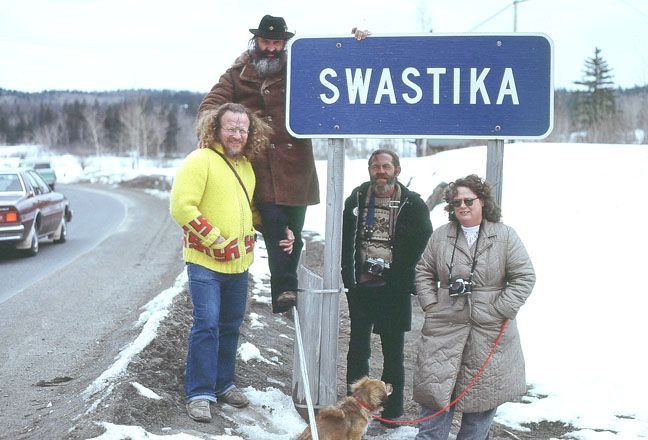 ·  · |
|
#4
●
07-21-2013, 12:53 PM
| ||||||||
 You holdin....? Poster Rank:14 Join Date: May 2010 Posts: 69,999
Contributions: 23
Mentioned: 263 Post(s) Quoted: 25273 Post(s)
| ||||||||
|
Re: Horticultural Hate: The Mystery of the Forest Swastikas
it's funny that it offends so many people.... we have a few of them in my house but they are on Buddhist things since they use it too  |
|
#5
●
07-22-2013, 08:17 PM
| ||||||||
 My Rank: GUNNERY SERGEANT Poster Rank:661 Female Join Date: Aug 2010 Posts: 1,322 Mentioned: 3 Post(s) Quoted: 481 Post(s)
| ||||||||
|
Re: Horticultural Hate: The Mystery of the Forest Swastikas
In Nepal you see the swastika everywhere. I even met a kid named Swastik. Fucking Nazis ruinin shit. |
|
#6
●
07-25-2013, 11:38 AM
| ||||||||
 ♚ Legacy Gold Member ♚ Poster Rank:35 Female Join Date: Nov 2008 Posts: 43,394
Contributions: 204
Mentioned: 95 Post(s) Quoted: 2282 Post(s)
| ||||||||
|
Re: Horticultural Hate: The Mystery of the Forest Swastikas
That forest pic is pretty cool tbh  Swastikas have never offended me due to exactly that. Just a pity the Nazis tarnished such an iconic symbol  |
|
#8
●
07-25-2013, 11:58 AM
| ||||||||
 My Rank: CORPORAL Poster Rank:1592 Join Date: Jan 2010 Posts: 352 Mentioned: 1 Post(s) Quoted: 14 Post(s)
| ||||||||
|
Re: Horticultural Hate: The Mystery of the Forest Swastikas
I went to India when I was a child, I was surprised to see there were swastikas everywhere. (My favorite were the cow dung swastikas on the walls of some temple. I kinda get the ideology behind it, but as a child I still though poop swastikas were hilarious.  ) )It's a shame that the nazis turned a harmless symbol into what it is now. |
|
#9
●
09-03-2013, 09:02 AM
| ||||||||
 My Rank: SERGEANT Poster Rank:1195 Male Join Date: May 2013 Posts: 534 Mentioned: 0 Post(s) Quoted: 57 Post(s)
| ||||||||
|
Re: Horticultural Hate: The Mystery of the Forest Swastikas
So much time and resource put to obliterating any swastika, accidental or otherwise. Just wonder if there are better things out there we could be doing.
|