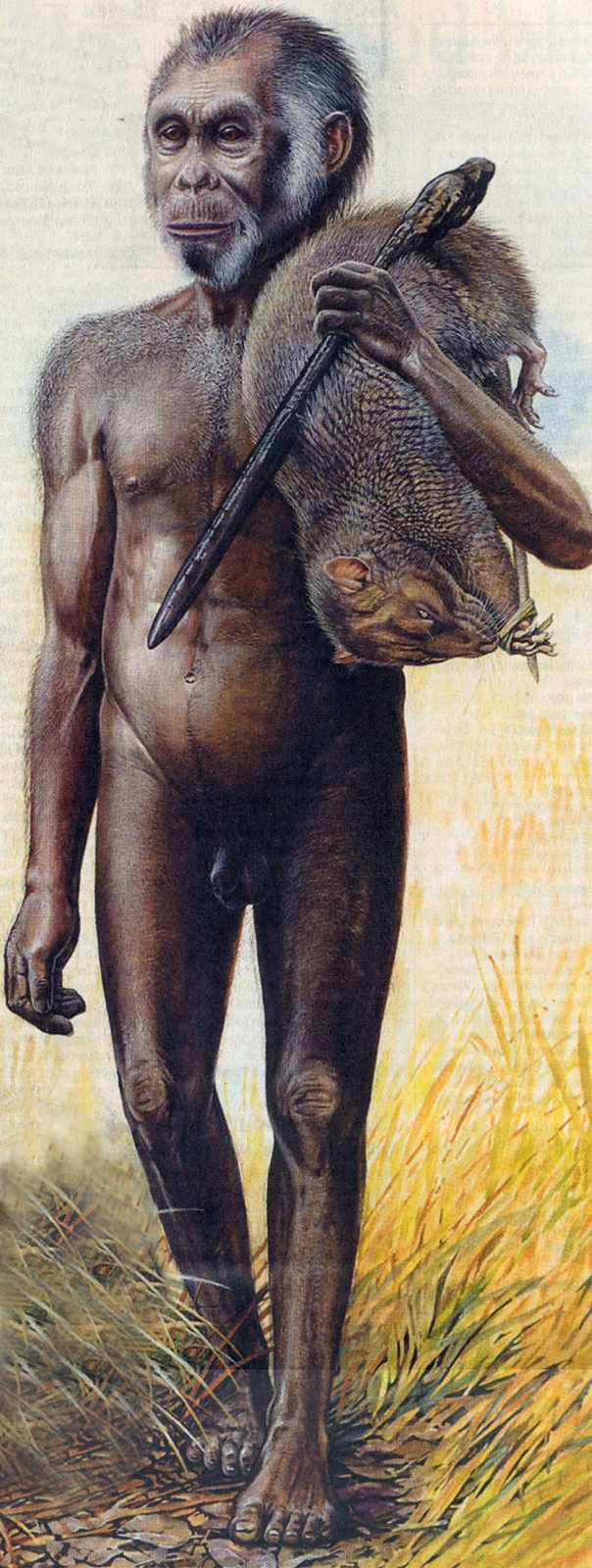
Homo floresiensis ("Man of Flores", nicknamed Hobbit) is a possible species in the genus Homo, remarkable for its small body and brain, and survival until relatively recent times. It was named after the Indonesian island of Flores on which the remains were found. One largely complete subfossil skeleton (named LB1, because it was the first specimen found in the Liang Bua cave) and a complete jawbone from a second individual (LB2), dated at 18,000 years old, were discovered in deposits in Liang Bua Cave on Flores in 2003. Parts of seven other individuals (LB3 – LB9, the most complete being LB6), all diminutive, have been recovered as well as similarly small stone tools from horizons ranging from 94,000 to 13,000 years ago. The first of these remains was unearthed in 2003 and the publication date of the original description is October 2004.
The discoverers, anthropologists Peter Brown, Michael Morwood and their colleagues have argued that a variety of features, both primitive and derived, identified the skeleton of LB1 as that of a new species of hominin, H. floresiensis. They argued that it was contemporaneous with modern humans (Homo sapiens) on Flores.
Doubts that the discoveries constitute a new species were soon voiced by the Indonesian anthropologist Teuku Jacob, who suggested that the skull of LB1 was a microcephalic modern human. A controversy developed, leading to the publication of a number of studies which supported or rejected claims for species status. In March 2005 scientists who published details of the brain of Flores Man in Science supported species status. Several researchers, including one scientist who worked on the initial study, have disputed the 2005 study, supporting the conclusion that the skull is microcephalic. The original discoverers have argued against these interpretations and maintain that H. floresiensis is a distinct species. This is supported by the most recent study that disputes the possibility of microcephaly published by paleoneurologist Dean Falk comparing the H. floresiensis brain to ten microcephalic brains revealing distinct differences that have so far gone unanswered by critics. In addition, a 2007 study of carpal bones of H. floresiensis found similarities to those of a chimpanzee or early hominin such as Australopithecus and were significantly different from the bones of modern humans. Studies of the bones and joints of the arm and shoulder have also suggested that H. floresiensis was more similar to early humans and apes than modern humans. However, critics of the claim to species status continue to suggest alternative explanations. The most recent hypothesis to be published is that the individuals were born without a functioning thyroid, resulting from a type of endemic cretinism (myxoedematous, ME). This idea has been dismissed by members of the original discovery team as based on a misinterpretation of the data. To date, the only complete cranium is that of LB1.