| |
✝Mudderator from Hell✝ Poster Rank:10 e-mail Join Date: Oct 2006 Posts: 96,580
Contributions: 817
Mentioned: 476 Post(s) Quoted: 10339 Post(s) |
|
Fossils of Collinsium Ciliosum Found That Lived During the Cambrian Period
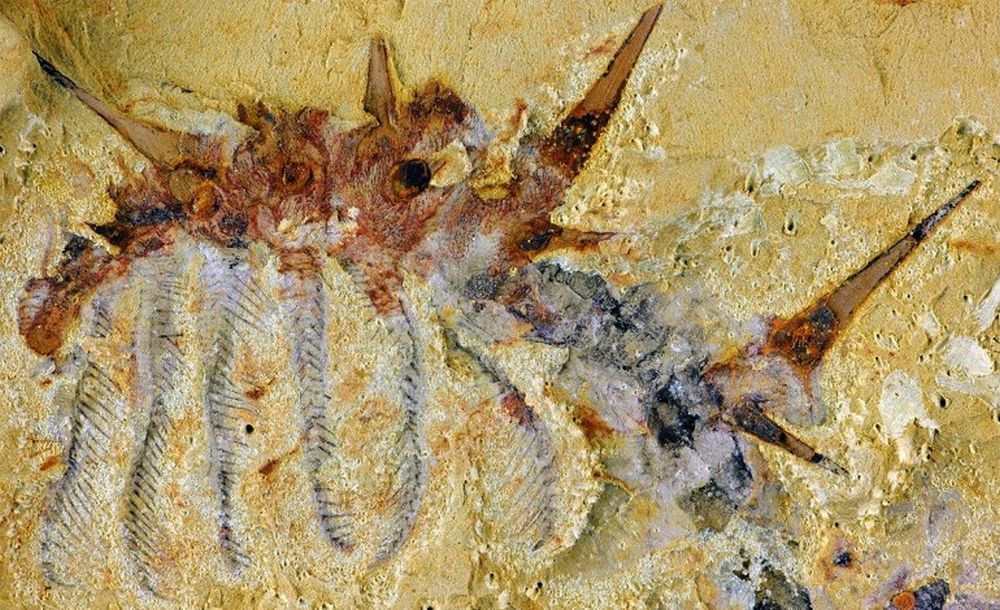
More than half a billion years ago, a peculiar little creature with rows of spikes on its back and delicate, feather-like front limbs to strain bits of food from the water thrived in the primordial seas of what is now China.
Scientists have announced the discovery in Yunnan Province of beautifully preserved fossils of one of the stranger animals ever to call Earth home. The creature, Collinsium ciliosum, lived during the Cambrian Period, a time of remarkable evolutionary experimentation when many unusual animals appeared and vanished.
“Collinsium is definitely an odd-looking animal, and if one were to bump into one of these during a snorkeling or diving trip nowadays it would be quite shocking,” says University of Cambridge paleobiologist Javier Ortega-Hernández, whose research appears in the Proceedings of the National Academy of Sciences on June 29.
Despite its startling appearance, some people “may like it and regard it as a ‘handsome beast,'” adds paleontologist Xi-Guang Zhang of Yunnan University in Kunming, China.
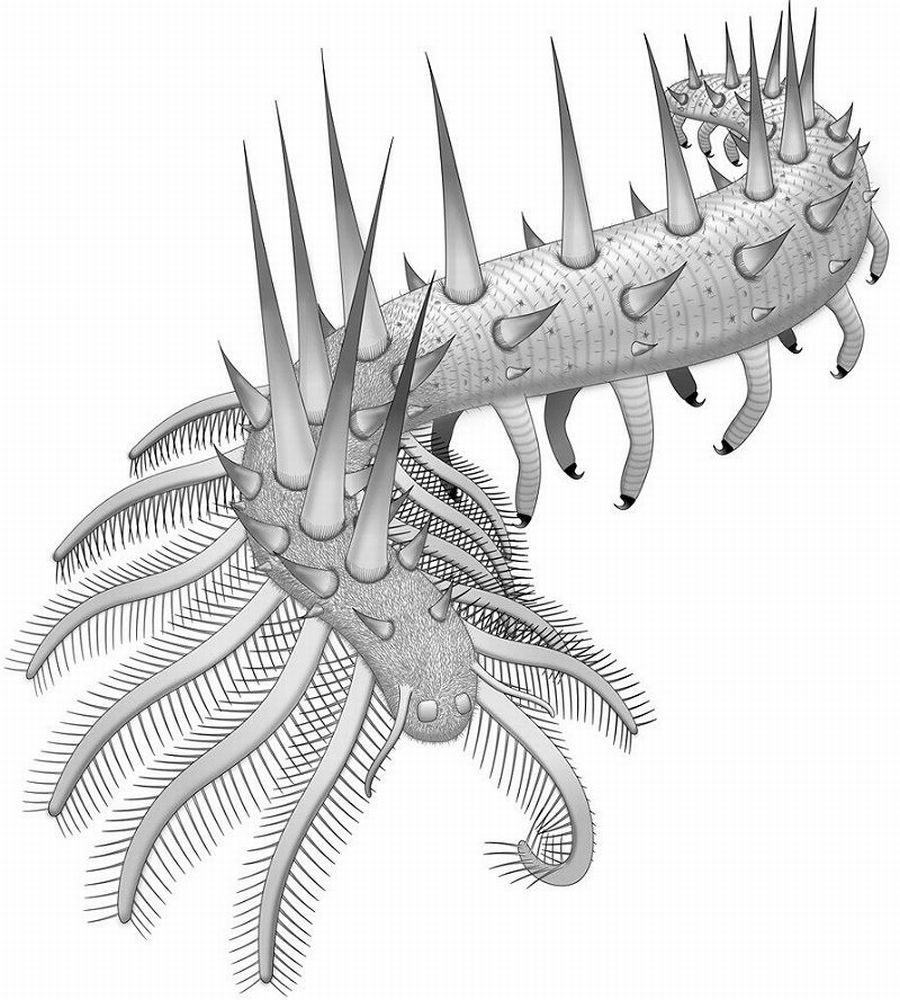
Its name means “hairy Collins monster,” recognising its bizarre appearance and the coat of hair-like structures on the front of the animal while honouring Canadian paleontologist Desmond Collins, who decades ago conceptualised a similar creature.
Ortega-Hernández says Collinsium, which lived between 515 and 518 million years ago, is a distant ancestor of today’s velvet worms, a group resembling legged worms residing in the world’s tropical forests.
Collinsium, reaching up to 10cm long, boasted 72 sharp spikes on its back to ward off predators. It was one of the earliest soft-bodied animals with armor. It had a sausage-shaped body, six pairs of feather-like front legs, nine pairs of rear legs with claws, a bulbous head and downward-facing mouth. It got its dinner by extending its feathery front legs to form feeding basket to capture food particles.
Collinsium was a close cousin of another spiky Cambrian creature called Hallucigenia.
University of Cambridge paleontologist Martin Smith, whose study offering the most detailed account ever of Hallucigenia in the journal Nature, says even oddballs like Hallucigenia and Collinsium would have plenty of competition in a “Cambrian weirdest creature contest.”
“Their compatriots included such beasts as Wiwaxia, a slug covered in leaf-like scales and towering spines; Anomalocaris, resembling a cross between a lobster and a can-opener; Nectocaris, a boggle-eyed two-armed squid, and Opabinia, which looks like a shrimp that swallowed a vacuum cleaner,” Smith said. ... |
▲ 5 Users Say Thank You For This Post:
CrunchyCripple, knuggy, MesaGrande, raygun56, spudigitti