Extreme Weather Photos
Enjoy


Volcano Lightning, Iceland
Photograph by Sigurdur H. Stefnisson, National Geographic
Lightning cracks during an eruption of Iceland’s Eyjafjallajökull volcano in 2010.
The eruption’s ash clouds delayed European air travel for nearly a week.
Storms over volcanoes contain the same ingredients as storms over your hometown—water droplets, ice, and occasionally hail. The interaction of all of these elements creates an electrical charge that sparks lightning. Active craters add ash to the mix.

Volcano and Waterspout, Hawaii
Photograph by Steve and Donna O’Meara, National Geographic
The eruption of Hawaii’s Kilauea volcano inspires the formation of a waterspout in this undated photo.
Waterspouts can emerge the way traditional tornadoes do, but not always. Many are created when near-surface winds suddenly change direction under a cloud that is producing a growing updraft. Unlike a tornado, a waterspout vortex and funnel cloud are created from the ground, or water, up.

Frozen Lighthouse, Michigan
Photograph by Mike Gatch, Your Shot
A Lake Michigan lighthouse takes the brunt of a frigid winter in Saint Joseph, Michigan.
The southeastern shores of all of the Great Lakes often experience lake-effect snow. When strong winds blow across an unfrozen and relatively warm lake, the moist air coming off the water encounters cooler temperatures over land and lake water becomes precipitation, or ice.

Twister, Wyoming
Photograph by Peter Willing, National Geographic
A funnel cloud rips through a trailer park near Cheyenne, Wyoming, in this undated photo. The photographer snapped this shot from a quarter mile away before taking cover in his basement.
These violent twisters form when the updrafts of air that supply storms with warm, humid air become a vortex, or high-speed whirlwind. Funnel clouds become tornadoes once they touch the ground.
Getting caught in one is probably no fun, but it is flying debris that is the main cause of injuries and deaths in tornadoes.

Flooding, China
Photograph from China Daily/Reuters
A man walks a handrail in Chongqing, China, to avoid a torrent of muddy floodwater during the soggy summer of 2007.
Flooding and subsequent landslides in the southwestern part of the country were deadly, taking at least 60 lives, according to local news reports.

Surf’s Up, Hawaii
Photograph by Eugene Tanner, AP
Surfers ride a huge wave at Waimea Bay, Hawaii, during the 2009 Eddie Aikau memorial surf contest.
To honor its fearless namesake, the competition is held only in extreme conditions. Contestants had been waiting five years for the surf to pound Oahu’s North Shore this aggressively.

Waterspout and Lightning, Florida
Photograph by Fred K. Smith, National Geographic
A waterspout parallels a lightning strike over Lake Okeechobee in Florida. A sister of the tornado, waterspouts are generally less powerful.

Waves, Cape Town
Photograph by Michael McSweeney, Your Shot
A huge wave crashes over a sea wall during a storm in Cape Town, South Africa. Waves are the result of wind traveling across water. As it moves, wind energy is transferred to lakes and oceans and manifests in ripples and swells.
A tsunami is a series of waves typically caused by large undersea earthquakes, landslides, or volcanic eruptions that displace the water.

Approaching Storm, Kansas
Photograph by Joel Sartore, National Geographic
A thunderstorm appears to be on a collision course with a crescent moon in this photo of the Kansas sky .
The ancient Greek god Zeus was said to control lightning, but today we know lightning comes from a difference in electrical charge between clouds and the ground or among clouds.

Softball-Size Hail, Missouri
Photograph from Weatherstock/Corbis
Adding insult to injury, this dangerously large hail rode in on the coattails of a tornado that hit Joplin, Missouri, in 2011.
Hail emerges from storm clouds only after repeatedly tumbling up and down within the cloud. The stronger the updraft in the cumulonimbus, the more layers of ice will form around a single frozen raindrop, until it becomes too heavy and falls to the ground.

Tornado, Colorado
Photograph by Ron Gravelle, Your Shot
A tornado heads toward two cars on a country road near Campo, Colorado.
Technically considered a part of thunderstorms, tornadoes can cover tens of miles of ground. Their winds have been recorded at nearly 300 miles per hour.

Ice Cap, Patagonia
Photograph by Borge Ousland, National Geographic
Intrepid travelers make their way through a snowstorm while crossing the Patagonia Ice Cap, also called Patagonia’s Southern Ice Field.
According to the American Alpine Institute this sprawling expanse of snow and ice in southern Chile is one of the “least explored mountain areas in the world.”
The glaciers there—a total of 48—are remnants from a much larger ice sheet that began its retreat about 12,000 years ago. With accelerated warming from human-induced climate change, 46 of those glaciers continue to disappear at what some say is an alarming rate.

Heavy Rain, Guatemala
Photograph by Rodrigo Abd, AP
Water tops a dam in Cuilapa, Guatemala, after heavy rains in October 2011.
The San Juan River consumed cars, homes, and several lives as it swelled with rainwater.
One of the consequences of accelerated climate change is an increasing number of intense storms.

Shelf Cloud and Lightning, Wisconsin
Photograph by Jennifer Brindley, Your Shot
In a dramatic display of summer atmospheric conditions, lightning marks the end of an impressively long shelf cloud in the Midwestern U.S.
Shelf clouds show us where incoming air first condenses into clouds.

Double Rainbow, Chile
Photograph by Craig Lovell, Corbis
Rain brings a double rainbow to the town to Puerto Natales in southern Chile.
Rainbows are a simple, ordered display of visible light reflected off of water droplets in the atmosphere. Double arcs happen when light is reflected more than once.

Incoming Storm, Grand Cayman Island
Photograph by David Doubilet, National Geographic
Dark clouds loom over a beach on Grand Cayman Island.
Identified as stratocumulus by the photographer, these cloud formations are a common indicator of moisture in the lower atmosphere.

Drake Passage
Photograph by Ralph Lee Hopkins, National Geographic
A vessel makes its way across Drake Passage in what some scientists call the Southern Ocean between South America and Antarctica.
The passage, which takes shipping vessels around Cape Horn at the tip of Chile and Argentina, is one of the most dangerous in the world. Near constant gale-force winds regularly fuel up to hundred-foot waves.

Landslide, India
Photograph by Channi Anand, AP
Landslide rubble buries a car in northern India’s Doda district in 2011. The devastating erosion was the result of a downpour that washed soil, rocks, and other debris onto the Doda-Batote highway.

Tornado, South Dakota
Photograph by Carsten Peter, National Geographic
National Geographic photographer Carsten Peter shot this tornado in South Dakota. In his own words, Peter “specializes in going to extremes: scuba diving in a glacier on Mont Blanc, crossing the Sahara on a camel, caving in Borneo.”
He has won a World Press award for his tornado chasing work in the U.S.
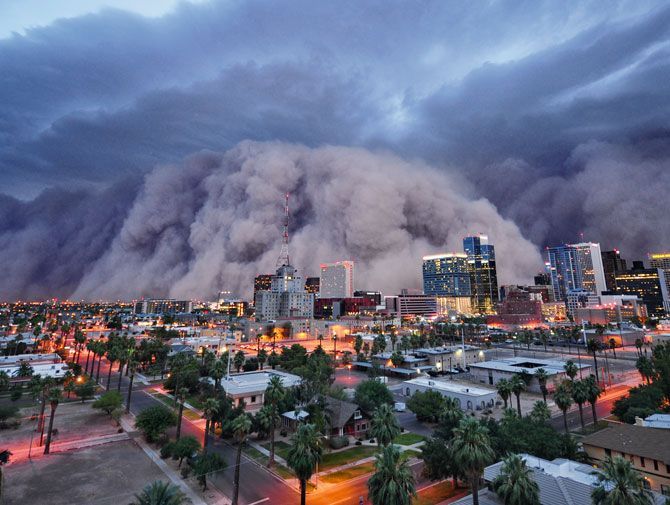
Photograph by Daniel Bryant
ARIZONA
The biggest dust storm in living memory rolls into Phoenix on July 5, 2011, reducing visibility to zero. Desert thunderstorms kicked up the mile-high wall of dust and sand.