|
#1
●
05-17-2012, 07:17 PM
| ||||||||
 Meh Poster Rank:381 Join Date: Jul 2011 Posts: 3,123 Mentioned: 7 Post(s) Quoted: 94 Post(s)
| ||||||||
|
El Niño Southern Oscillation (ENSO)
For anyone who is curious about the processes behind the El Niño Southern Oscillation (ENSO): El Niño-Southern Oscillation In equatorial regions, the trade winds induce a zonal transport from the East to the West Pacific that is responsible for warm sea surface temperatures and a relatively deep thermocline there. The thermocline is higher in the East Pacific. As a consequence, the equatorial upwelling (also caused by the trade winds) transports cold deep water more efficiently to the surface in the East Pacific, leading to a large cooling in this region (see section 1.3.2 and Fig. 5.2). 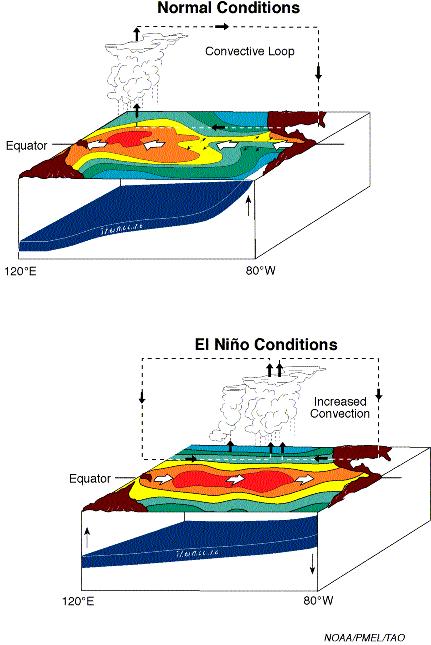 Because of those differences in sea surface temperatures (SSTs), atmospheric convection and ascendant air motion are observed over the West Pacific while subsidence occurs over the East Pacific. The circulation is closed by an eastward movement in the upper troposphere and westward atmospheric flow in the lower layers (Fig. 5.2). The resulting zonal overturning circulation, referred to as the Walker circulation, thus reinforces the easterlies that are the zonal mean in this latitude band (see section 1.2.2). Consequently, the Walker circulation is associated with a positive feedback, called the Bjerknes feedback (Fig. 5.3), in which the easterly surface wind stress enhances the zonal SST gradient which in turns amplifies the wind stress. 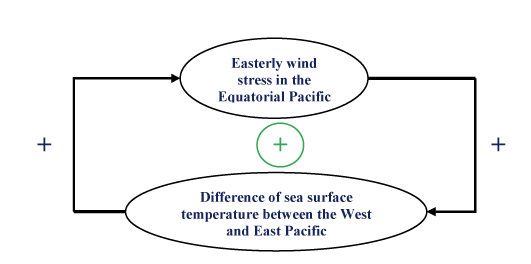 The Walker circulation exhibits irregular oscillations (Fig. 5.4). They are characterised by a see-saw in sea level pressure (SLP) between East and West Pacific that drives the surface easterlies (Fig. 5.5). Classically, the magnitude of this mode is measured by the Southern Oscillation Index (SOI): See link for formula: http://www.elic.ucl.ac.be/textbook/chapter5_node4.xml 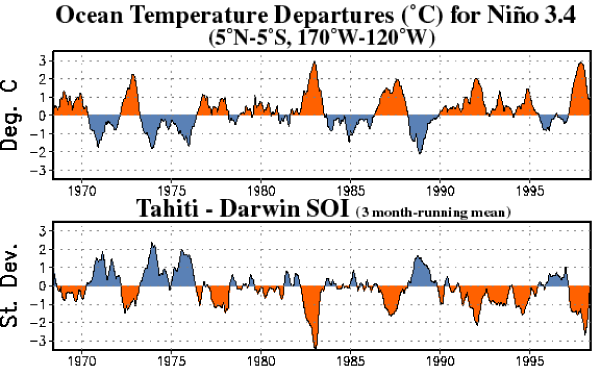 When the SOI is low, the long term mean gradient between the East and West Pacific decreases, leading to weaker easterlies. Prolonged negative values of the SOI are thus associated with reduced upwelling and weaker westward oceanic currents. This induces a smaller east-west tilt of the thermocline and abnormally warm surface temperatures in the East Equatorial Pacific (Figs. 5.2 and 5.4). The temperature anomaly can reach 5oC locally. The associated warming close to the coast of Peru was originally referred to as El Niño, but the term is now used to describe all the oceanic changes that occur when temperature is high in the East Pacific Ocean. The opposite condition, corresponding to colder temperatures in the East Pacific, an increased tilt in the ocean thermocline, and warm surface water restricted to the West Pacific are called, by analogy, La Niña conditions. Because of the strong interactions between oceanic and atmospheric changes, the Southern Oscillation and the El Niño phenomenon are strongly coupled (see Figure 5.4). This has led to the choice of the acronym ENSO (El Niño Southern Oscillation) to refer to the whole process. Indeed, because of the Bjerknes feedback, a decrease in zonal SST gradient, caused for instance by a relaxation of the tilt of the thermocline, implies a reduction of the zonal wind stress that will amplify the initial perturbation. The anomalies then grow until negative feedbacks, mainly related to oceanic processes (in particular the adjustment of the thermocline depth) overwhelm the positive feedbacks. Those negative feedbacks are characterised by a delayed response compared to the SST and wind stress initial perturbation, allowing the development of the irregular oscillation described in Fig. 5.4. 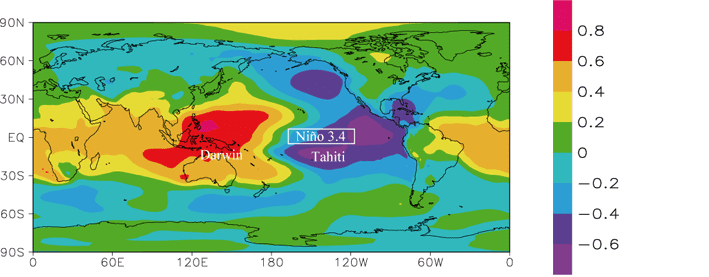 In addition to their effect on the wind stress, the SST anomalies related to the ENSO in the Pacific induce an eastward migration of the atmospheric convection (Fig. 5.2) causing higher precipitation in the central Pacific and dry conditions over Indonesia and Northern Australia. ENSO is also associated with perturbations outside the tropical Pacific as it produces anomalies of the atmospheric circulation across nearly the whole world (Fig. 5.5). For instance, El Niño years tend to be much drier and warmer in Mozambique while the western USA tends to be wetter. Because of those global teleconnections, ENSO is probably the internal mode of variability which has the greatest impact on human activities. As a consequence, forecasting its development a few months in advance is an intense area of research. http://www.elic.ucl.ac.be/textbook/chapter5_node4.xml |
|
#2
●
05-17-2012, 07:25 PM
| ||||||||
 Ja sam Ja Poster Rank:89 female Join Date: Jul 2010 Posts: 17,552 Mentioned: 57 Post(s) Quoted: 7269 Post(s)
| ||||||||
|
Re: El Niño Southern Oscillation (ENSO)
I like when you talking dirt...ahem...scientific  Interesting stuff  |
|
#5
●
05-18-2012, 11:58 AM
| ||||||||
 facta non verba Poster Rank:66 Join Date: Feb 2012 Posts: 23,919
Contributions: 73
Mentioned: 37 Post(s) Quoted: 8498 Post(s)
| ||||||||
|
Re: El Niño Southern Oscillation (ENSO)
Really interesting read! Thank you :)
__________________ Run, rabbit run Dig that hole, forget the sun |