|
#1
●
05-06-2010, 11:33 AM
|
 My Rank: MAJOR Poster Rank:12 Join Date: Jun 2009 Posts: 93,062
Contributions: 239
93,062Posts 137,687Thanked 2,009Quoted 91Mentioned 239Contrib. |
|
The Discovery of Eris, Largest Known Dwarf Planet
Eris (was called 2003 UB313 before naming) the largest dwarf planet known, was discovered in an ongoing survey at Palomar Observatory's Samuel Oschin telescope by astronomers Mike Brown (Caltech), Chad Trujillo (Gemini Observatory), and David Rabinowitz (Yale University). They officially suggested the name on 6 September 2006, and it was accepted and announced on 13 September 2006. 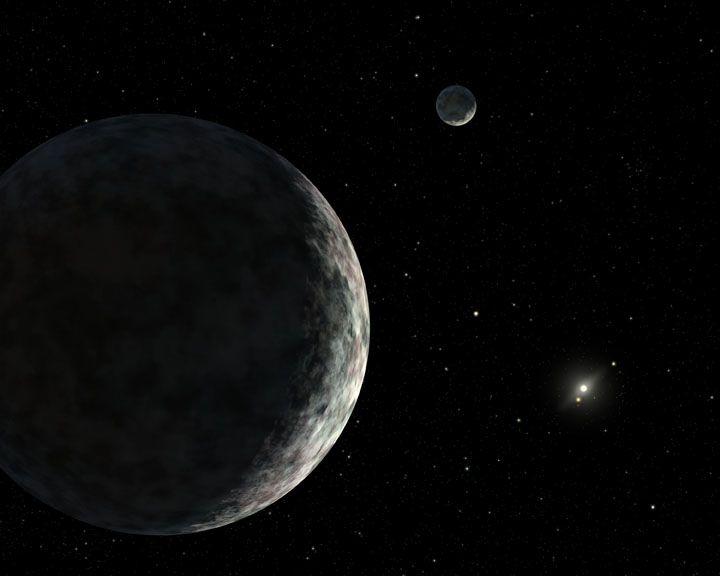 In Greek mythology, Eris is the goddess of warfare and strife. She stirs up jealousy and envy to cause fighting and anger among men. At the wedding of Peleus and Thetis, the parents of the Greek hero Achilles, all the gods with the exception of Eris were invited, and, enraged at her exclusion, she spitefully caused a quarrel among the goddesses that led to the Trojan war. In the astronomical world, Eris stirred up a great deal of trouble among the international astronomical community when the question of its proper designation led to a raucous meeting of the IAU in Prague. At the end of the conference, IAU members voted to demote Pluto and Eris to dwarf-planet status, leaving the solar system with only eight planets. Eris is 27% more massive than pluto The dwarf planet is the most distant object ever seen in orbit around the sun, even more distant than Sedna, the planetoid discovered almost 2 years ago. It is almost 10 billion miles from the sun and more than 3 times more distant than the next closest planet, Pluto and takes more than twice as long to orbit the sun as Pluto. 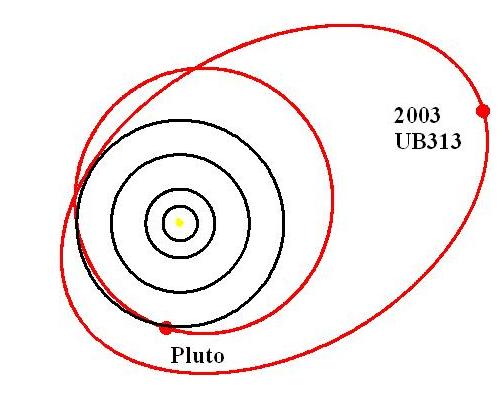 Size While for most telescopes the planet is too small to be seen as anything other than a dot of light, HST can (just barely) directly measure how big across it is. The measurement is extremely hard, however, even for HST, because even HST distorts light a little bit as it goes through the telescope, and we needed to be sure that we were measuring the actual size of the planet, rather than being fooled by distortion. So we waited until Eris was very close to a star and then snapped a series of 28 pictures and carefully went back and forth comparing the star and the planet. In the end, we determined that Eris t is 2400 +/- 100 km across. The best ever picture from the Hubble Space Telescope, as unimpressive as it is (since Eris is so so so so so far away) looks like this 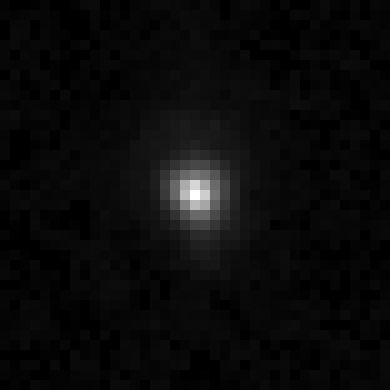 Surface of Eris We study the composition of distant objects by looking at sunlight reflected off of them. The sunlight reflected off the surface of the earth, for example, shows distinct signatures of the oxygen in earth's atmosphere, of photosynthetic plants, and of abundant water, among other things. Using the Gemini Observatory on Mauna Kea, Hawaii to study the light reflected from the surface of Eris, and have found that the dwarf planet looks remarkably similar to Pluto. A comparison of the two, where we show the amount of sunlight reflected in near infrared light. This type of light, just beyond what is visible to the human eye, is most sensitive to the types of ices expected on surfaces in the outer solar system. 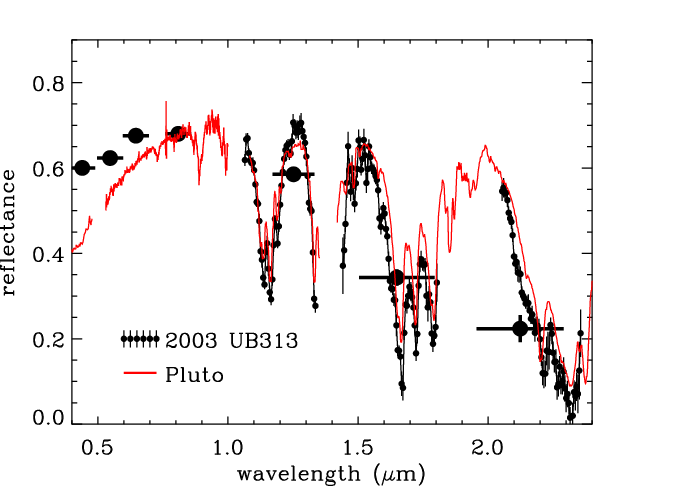 The plot above compares the amount of infrared sunlight of different colors ("wavelength") reflected from the new planet with the amount of sunlight reflected from Pluto. The dips in the amount of sunlight at 1.15, 1.35, 1.7, and 2.3 um are a characteristic signature of a surface covered with solid frozen methane (natural gas). Both Pluto and Eris show these signatures. At the very low temperatures of Pluto and Eris, methane, which is in gaseous form on the earth, is frozen solid. The interior of Eris, like the interior of Pluto, is likely a mixture of rock and ice. What is Eris made out of While we can only see the surface of the dwarf planet, we have some educated guesses about the interior. Pluto, we know, has a density about midway between ice and rock, thus we think that it is made of about half and half ice and rock on the inside. The new planet, being about the same size and the same surface composition as Pluto, is probably close to the same. We used to suspect that all objects out in the Kuiper belt are the same on the inside but recent measurements suggest a very wide variety! For this reason, we are quite anxious to measure the actual density of the planet itself. Such a measurement is possible by measuring the mass of the planet by looking at the way its moon goes around it and then dividing this mass by the volume (which we know because we know the size). We need more observations of the moon to accurately determine its orbit, however, so we don't think we will know the answer for some time. |
|
#2
●
05-06-2010, 11:36 AM
|
 Server Supporter Poster Rank:196 Male Join Date: Feb 2010 Posts: 7,788 7,788Posts 3,825Thanked 230Quoted 1Mentioned 0Contrib. |
|
Re: The Discovery of Eris, Largest Known Dwarf Planet
Interesting read, I've got no idea how astronomy works but I wonder if they'll be adding the planet into our Solar System.
|
|
#3
●
05-06-2010, 11:37 AM
|
| My Rank: MAJOR Poster Rank:12 Join Date: Jun 2009 Posts: 93,062
Contributions: 239
93,062Posts 137,687Thanked 2,009Quoted 91Mentioned 239Contrib. |
|
Re: The Discovery of Eris, Largest Known Dwarf Planet
Apparently it was gonna be the 10th planet but they dropped it and Pluto..leaving only 8 planets now in the solar system. They call them both dwarf planets. |
|
#4
●
05-06-2010, 11:38 AM
|
| Server Supporter Poster Rank:196 Male Join Date: Feb 2010 Posts: 7,788 7,788Posts 3,825Thanked 230Quoted 1Mentioned 0Contrib. |
|
Re: The Discovery of Eris, Largest Known Dwarf Planet
Well, I guess I should pay more attention then :\. I didn't realize that was what they classified Pluto as, and thought that this was a different type. Oh well. Thanks for the info Kelly. |
|
#6
●
05-06-2010, 12:07 PM
|
 TROLLBEGONE!!!!! Poster Rank:23 female Join Date: Feb 2009 Posts: 59,614 59,614Posts 34,256Thanked 10,860Quoted 70Mentioned 0Contrib. |
|
Re: The Discovery of Eris, Largest Known Dwarf Planet
thank You, Kelly. I se that since the qualifications for being full-blown planet have changed, nothing the size of pluto (maybe even a bit larger) and definitely smaller will be classified as bona fide planets. Either way, it is good that we know what is actually orbiting our sun, and the orbital paths. This could one day prove to be important when calculating paths of rogue bodies that may or may not collide with this and other planets. |
|
#7
●
05-07-2010, 11:20 AM
|
 My Rank: MAJOR Poster Rank:164 Female Join Date: Dec 2009 Posts: 9,804 9,804Posts 5,206Thanked 7Quoted 0Mentioned 0Contrib. |
|
Re: The Discovery of Eris, Largest Known Dwarf Planet
Kallisti! "she wanders about, at first small and insignificant, but she soon raises her head up to heaven " |
|
#8
●
05-07-2010, 01:43 PM
|
 KING OF DROOL Poster Rank:3 Bloke Join Date: Nov 2009 Posts: 123,458 123,458Posts 71,387Thanked 38,163Quoted 197Mentioned 0Contrib. |
|
Re: The Discovery of Eris, Largest Known Dwarf Planet
Superb post Kelly,im into all this stuff.  Incidentally we're having a cold spell apparently because of low sunspot activity. Lets hope we don't catch a super flare. |