|
#1
●
08-07-2014, 04:37 PM
| ||||||||
 They Lied. There ALL LIES Poster Rank:309 <--We Did It. So Can You Join Date: Mar 2013 Posts: 4,213
Contributions: 48
Mentioned: 23 Post(s) Quoted: 894 Post(s)
| ||||||||
|
Dancing Mania
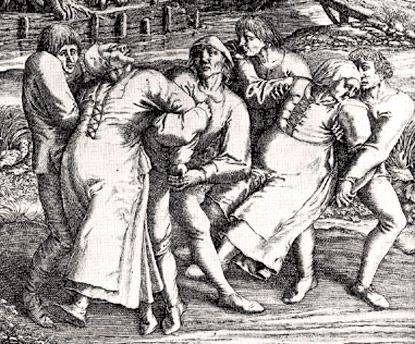
In July of 1518, a woman referred to as Frau Troffea stepped into a narrow street in Strasbourg, France and began a fervent dancing vigil that lasted between four and six days. By the end of the week, 34 others had joined her and, within a month, the crowd of dancing, hopping and leaping individuals had swelled to 400. Authorities prescribed "more dancing" to cure the tormented movers but, by summer's end, dozens in the Alsatian city had died of heart attacks, strokes and sheer exhaustion due to nonstop dancing.
Dancing mania (also known as dancing plague, choreomania, St John's Dance and, historically, St. Vitus' Dance) was a social phenomenon that occurred primarily in mainland Europe between the 14th and 17th centuries. It involved groups of people dancing erratically, sometimes thousands at a time. The mania affected men, women, and children, who danced until they collapsed from exhaustion. One of the first major outbreaks was in Aachen, Germany, in 1374, and it quickly spread throughout Europe; one particularly notable outbreak occurred in Strasbourg in 1518. Affecting thousands of people across several centuries, dancing mania was not an isolated event, and was well documented in contemporary reports. It was nevertheless poorly understood, and remedies were based on guesswork. Generally, musicians accompanied dancers, to help ward off the mania, but this tactic sometimes backfired by encouraging more to join in. There is no consensus among modern-day scholars as to the cause of dancing mania. The several theories proposed range from religious cults being behind the processions to people dancing to relieve themselves of stress and put the poverty of the period out of their minds. It is, however, thought to be as a mass psychogenic illness in which the occurrence of similar physical symptoms, with no known physical cause, affect a large group of people as a form of social influence |