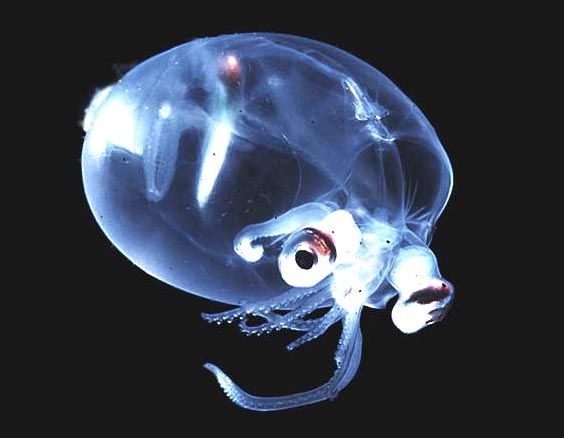
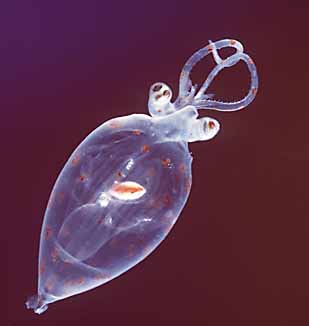
The family Cranchiidae comprises the approximately 60 species of glass squid, also known as cranchiid or cranch squid. Cranchiid squid occur in surface and midwater depths of open oceans around the world. They range in mantle length from 10 centimetres (3.9 in) to over 3 metres (9.8 ft), in the case of the Colossal Squid. The common name, glass squid, derives from the transparent nature of most species. Cranchiid squid spend much of their lives in partially sunlit shallow waters where their transparency provides camouflage. They are characterised by a swollen body and short arms, which bear two rows of suckers or hooks. The third arm pair is often enlarged. Many species are bioluminescent organisms and possess light organs on the undersides of their eyes, used to cancel their shadow. Eye morphology varies widely, ranging from large and circular to telescopic and stalked. A large fluid-filled chamber containing ammonia solution is used to aid buoyancy. Often the only organ that is visible through the transparent tissues is a cigar-shaped digestive gland, which is the cephalopod equivalent of a mammalian liver. This is usually held in a vertical position to reduce its silhouette and a light organ is sometimes present on the lower tip to further minimise its appearance in the water.


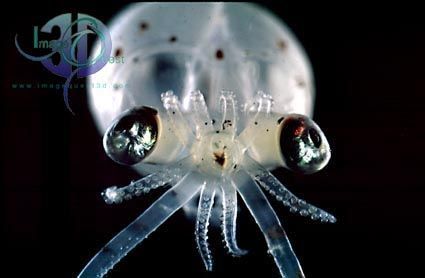



 you're right, especially the 2nd pic with those beady eyes


