|
#1
●
11-02-2012, 06:32 PM
| ||||||||
 My Rank: MAJOR Poster Rank:12 Join Date: Jun 2009 Posts: 93,128
Contributions: 226
Mentioned: 91 Post(s) Quoted: 2009 Post(s)
| ||||||||
|
Colourful Tarantulas Found
Typhochlaena Costae Seemingly spray-painted, this new tarantula, Typhochlaena costae, is one of nine colorful—and rare—tree-dwelling tarantulas recently discovered in Brazil, a new study says. Tree-dwelling tarantulas typically have a lithe build, with thinner bodies and longer legs than other tarantulas. This makes them more agile and thus better suited for stalking prey in trees. The ends of their legs also have unusually large tips, helping them climb a variety of surfaces. Tree-dwelling spiders lurk in the tropics of Asia, Africa, South and Central America, and the Caribbean. This species was discovered in the Brazilian cerrado, a savanna-like environment. Like the other new vibrant species, T. costa loses its bright coloration as it grows. "Brazil is the country with the richest tarantula fauna in the world," said study leader Rogério Bertani, a tarantula specialist at the Instituto Butantan in São Paulo, Brazil. "Tarantulas are wonderful spiders, but they are poorly studied in many aspects," Bertani said. 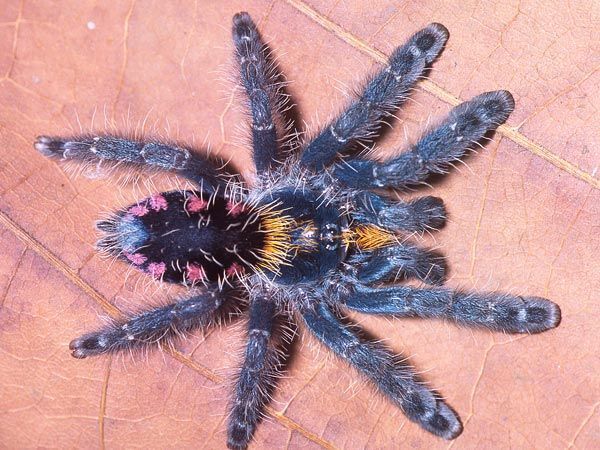 _________________________________________ Typhochlaena amma The pink-hued Typhochlaena amma is one of five recently discovered tarantula species belonging to the genus Typhochlaena. The newfound species are the smallest tree-dwelling tarantulas so far discovered, at only 2 to 3 centimeters (20 to 30 millimeters) long, Bertani said. A lone specimen of the genus Typhochlaena was first found in 1841, but it was later dismissed as a juvenile of another genus, Avicularia, which is very common in the Amazon Basin. Recently Bertani was given a specimen of Typhochlaena amma that, while small, was clearly a mature adult. After inspecting other scientific collections of spiders, Bertani and his collaborators have now resurrected Typhochlaena as a group in its own right. "From a dubious species from 1841, we have now five species," Bertani said. 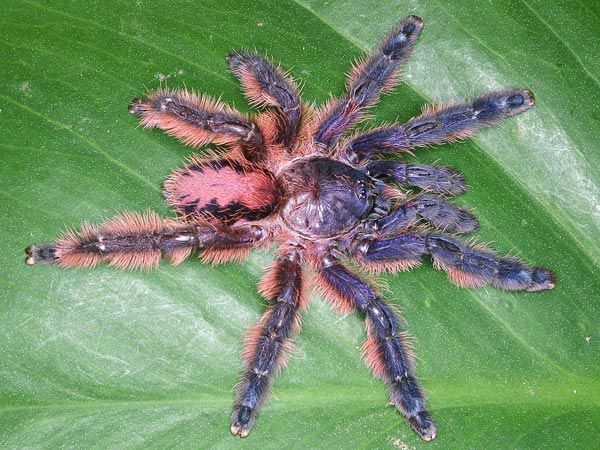 _________________________________________ Iridopelma katiae This newfound tree-dwelling tarantula, Iridopelma katiae, was discovered on a Brazilian mesa that has rocky soil and few trees. Bertani said, "I did not expect to find any species of a [tree-dwelling] genus" on the mesa—until he found a "beautiful black tarantula with a vivid reddish abdomen" and another one of the same species, a mother with her spiderlings. The spiders were discovered inside a bromeliad, a type of pineapple relative that, by providing tarantulas water and shade, serve as oases in otherwise inhospitable terrain. 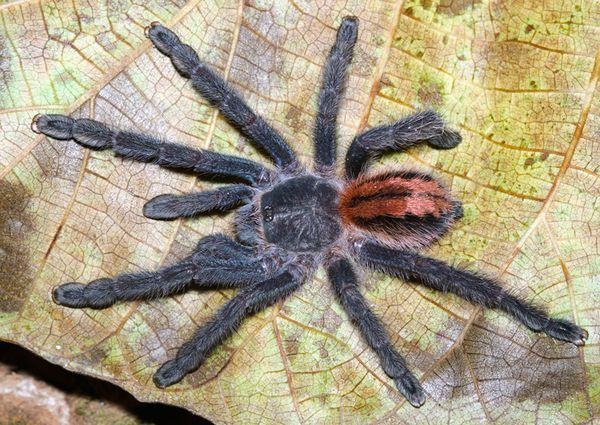 _________________________________________ Pachistopelma bromelicola Looking more Brillo pad than arachnid, Pachistopelma bromelicola, is the second known species of tarantula to live exclusively inside bromeliad plants, of which some species attach themselves to trees and rocks. Tree-dwelling tarantulas' attractive colors might have a dark side: Scientists are concerned the newfound tarantulas could be tempting targets for the pet trade. 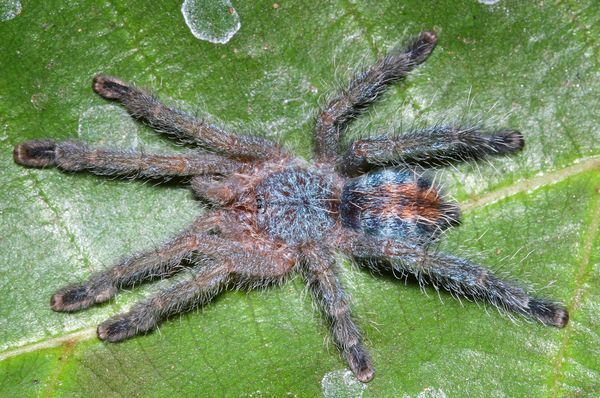 _________________________________________ Iridopelma marcoi Most tree-dwelling tarantulas are found in Amazon, but the newfound tarantulas—including Iridopelma marcoi —were unexpectedly discovered in the Brazilian savanna. The discoveries illustrate how much might remain to be discovered in the wild, noted Bertani, whose study was published online October 30 in the journal ZooKeys. 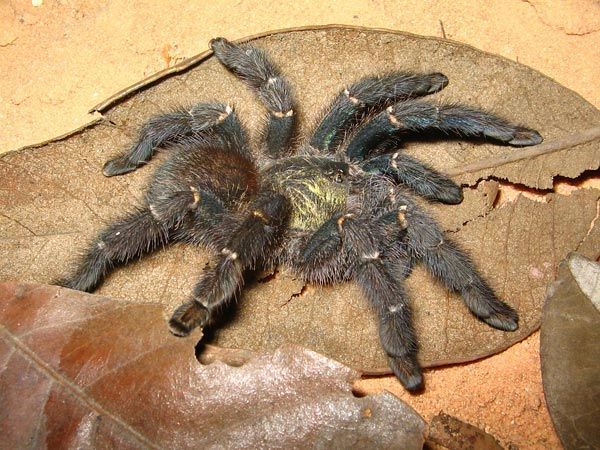 |
|
#2
●
11-03-2012, 05:18 PM
| ||||||||
 on the outside looking in Poster Rank:332 male Join Date: Jun 2011 Posts: 3,895 Mentioned: 1 Post(s) Quoted: 39 Post(s)
| ||||||||
|
Re: Colourful Tarantulas Found
I like that they were "unexpectedly discovered". I imagine lots of screaming involved.  Great post.  |
|
#4
●
11-04-2012, 02:58 AM
| ||||||||
 My Rank: MASTER SERGEANT Poster Rank:505 Join Date: Oct 2011 Posts: 2,079
Contributions: 1
Mentioned: 0 Post(s) Quoted: 149 Post(s)
| ||||||||
|
Re: Colourful Tarantulas Found
Definitely lots of screaming involved. I have one that's escaped before and while I love them, finding it in the shower or in my underwear drawer is something I never get used to.  |
|
#5
●
11-04-2012, 09:12 AM
| ||||||||
 ♚ Legacy Gold Member ♚ Poster Rank:35 Female Join Date: Nov 2008 Posts: 43,394
Contributions: 204
Mentioned: 95 Post(s) Quoted: 2282 Post(s)
| ||||||||
|
Re: Colourful Tarantulas Found
Coming soon to local pet stores and Cambodian deep fat fryers... Amazing creatures, hope they are left in peace and not exploited. |
|
#7
●
11-07-2012, 05:01 PM
| ||||||||
 My Rank: FIRST SERGEANT Poster Rank:399 Join Date: Apr 2011 Posts: 3,054 Mentioned: 2 Post(s) Quoted: 276 Post(s)
| ||||||||
|
Re: Colourful Tarantulas Found
I'm a huge fan of tarantulas so this post definitely made my evening How can we even have such gorgeous creatures on Earth?
|