|
#1
●
09-03-2013, 11:45 PM
| ||||||||
 My Rank: MAJOR Poster Rank:203 Join Date: Jan 2010 Posts: 7,658
Contributions: 5
Mentioned: 22 Post(s) Quoted: 2389 Post(s)
| ||||||||
|
Blue Alien Planet Has Molten Glass Rain & Unusual Atmosphere
Interesting stuff. There's a "blue marble" alien planet just 63 light-years from Earth, but the world is anything but friendly to life. Researchers say the blue color in the atmosphere likely comes from a rain of molten glass. This super-hot glass rain is just one consequence of the close proximity between the gas giant alien planet HD189733b and its sun. which causes daytime temperatures to soar as high as 1,700 degrees Fahrenheit (930 degrees Celsius), scientists said. A fresh set of observations of the planet in X-rays also suggest HD189733b has an outer atmosphere that is far larger than expected. [See more images of the blue alien planet HD 189733b] These surprise finds are all signals that so-called hot Jupiter alien planets are worthy of study on their own, even though they are hostile planets to life, researchers said. Rewriting planetary formation Hot Jupiters are large, roughly Jupiter-sized planets that become very hot by circling tight around their stars. These worlds have been described as planetary daredevils because they orbit so close to their parent stars that they risk being consumed. Often, one side of the planet is tidally locked to the star, exposing that side to scorching hot temperatures, while leaving the other side permanently turned away. Hot Jupiters are easy to spot from a distance because as they pass in front of a star, their disc blots out a large portion of the star's light; HD189733b causes a three per cent drop in its star's light, for example. The planets' gravitational pull often causes their parent stars to wobble, too. While common in the universe, however, Hot Jupiters are totally different than what denizens of Earth's solar system encounter. In our case, small, rocky planets orbit close to the star and the gas giants are much farther out. The latest observations of HD189733b are challenging some theories of planetary formation and are just one of the reasons Hot Jupiters are earning more attention from astronomers these days. "At first considered to be the 'chaff' researchers would have to wade through to get to the fainter Earth-like worlds, hot Jupiters are now attracting their own attention," NASA scientists wrote in a recent Science@NASA post about these planets. Boiling atmosphere New attention came to HD189733b, which was discovered in 2005, after two X-ray observatories watched the blue planet pass across the face of its star. Both NASA's Chandra X-Ray Observatory and ESA's XMM Newton saw a drop in X-rays from the star that was three times more than that observed in optical light. This means the planetary atmosphere is much larger than previously thought. It's also bleeding quickly. HD189733b's atmosphere is fleeing the planet at a rate of 220 million pounds (100 million kilograms) to 1.3 billion pounds (600 million kg) a second, a new study estimated. "The extended atmosphere of this planet makes it a bigger target for high-energy radiation from its star, so more evaporation occurs," Scott Wolk, an astronomer at the Harvard-Smithsonian Center for Astrophysics, said in a statement. HD189733b could also have bright planet-wide auroras due to the extensive stellar radiation hitting it, but that's speculation at this point, the study authors said. The study has been accepted for publication in the Astrophysical Journal, and is available now on the prepublishing site Arxiv. Artist conception of planet and infographic of known type of alien worlds. 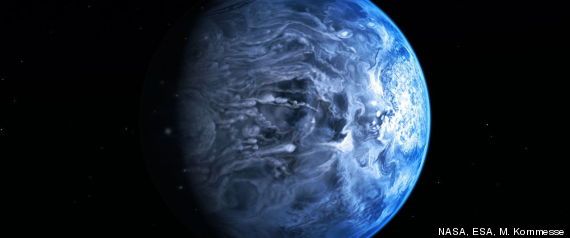 · 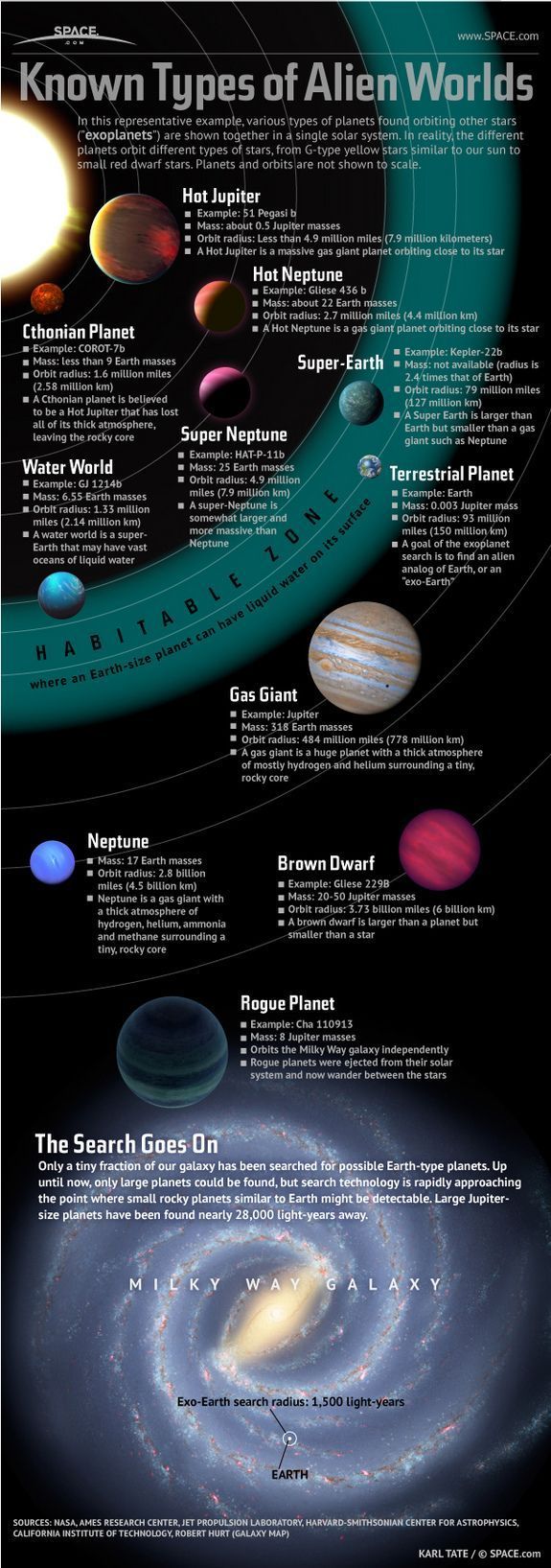 · |