|
#1
●
03-03-2011, 10:01 AM
| ||||||||
 ★ Legacy Member ★ Poster Rank:751 Male Join Date: Jan 2009 Posts: 1,086 Mentioned: 0 Post(s) Quoted: 9 Post(s)
| ||||||||
|
Astronauts’ Occupational Hazard: Falling-Off Fingernails
Its called fingernail delamination although I've never heard of this, it is sort of interesting. Astronauts may lose their fingernails during spacewalks due to pressure and bulky gloves, so a few astronauts have removed their fingernails before going into space to avoid all the trouble, says Popular Science. Dava Newman, director of MIT’s technology and policy program, says that some astronauts figure removing their fingernails before going into orbit is a better alternative to losing them "inside chafing, unwieldy spacesuit gloves." In a new study, Newman will claim that astronauts with big hands suffer the most when it comes to fingernails in space. At least 22 fingernail losses were reported in a recent study. Fingernail loss, called fingernail delamination, may be avoided in the future with the use of better custom-fitted gloves. 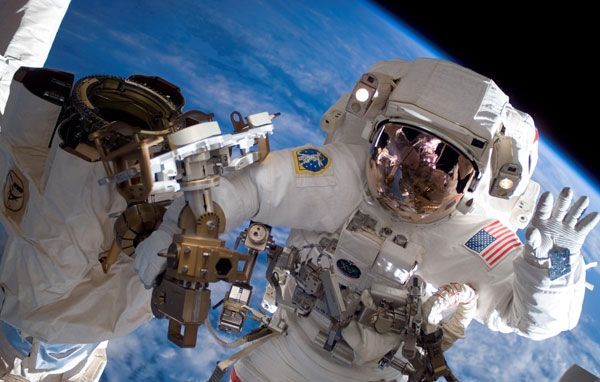 · |
|
#4
●
03-03-2011, 03:37 PM
| ||||||||
 ★ Legacy Member ★ Poster Rank:79 Male Join Date: Nov 2009 Posts: 19,417
Contributions: 1
Mentioned: 7 Post(s) Quoted: 717 Post(s)
| ||||||||
|
Re: Astronauts’ Occupational Hazard: Falling-Off Fingernails
My Body in Space – Bugs In My Glove The Physics and Mechanics of EVA Gloves In the vacuum of space an astronaut's hands are his connection to the outside world. To move around on the outside of the International Space Station, to operate tools, to maneuver equipment and to adjust panels and trusses, an astronaut uses his hands. The astronaut's gloves must not only have enough flexibility to provide this capability but they must also be tough enough to resist damage from the rigors of working in space. The slightest rip or tear could have disastrous results.  Canadian Astronaut Dr. Dave Williams demonstrating power tools used in the construction of the International Space Station. Notice the very large EVA gloves. Background Working in space is a difficult task. The EVA astronaut works in a free-fall environment which can be somewhat disorienting and can be quite uncomfortable due to extremes in temperature. The EVA suit is bulky and lacks the flexibility of ordinary clothing. The gloves are thick, and have somewhat limited flexibility. The finger tips of the glove deprive the astronaut of almost all tactile sense. Since most work is done with the hands, the gloves are a critical element of the EVA space suit. The Geometry of a Glove The basic design of a glove is a closed leather, rubber, or fabric covering for the hand such that each finger and the thumb are individually enclosed. Unlike a mitten, which encloses the entire hand, a glove allows enough individual finger movement to perform complex grasping tasks. To understand the mechanics of glove design we can make the (quite accurate) approximation that a glove is simply a system of interconnected cylindrical tubes, as shown in the diagram below.  Bending Cylindrical Tubes (which are pressurized) Whenever you attempt to bend a rigid tube there are two things that you will likely notice. If the tube is exceptionally brittle it will usually break. However, if the tube is slightly ductile, it will stretch on the outer edge of the bend and buckle on the inner edge of the bend. This is because the outer radius of curvature is larger than the inner radius of curvature, resulting in a longer arc on the outer edge. There are several ways to observe this effect in detail.
 Generally the best way to build tubes that will undergo a significant amount of bending is to use soft flexible materials such as cloth or rubber. This allows the radius of curvature on the inside and outside of the bend to change easily. Examine the skin in the top of your index finger as you curl it toward your palm and then as you point your finger straight out. Notice that the skin folds and stretches to accommodate the changing radius of curvature required as you bend your finger.  However the situation changes dramatically if the inside of the tube is under pressure as it is in an EVA glove. Recall that pressure is defined as "force per unit area". When the force is measured in newtons, and the area in square metres, the pressure is measured in pascals. The mathematical definition of pressure is generally written as: P = F/A i.e. 1 pascal = 1 newton/square metre; (1Pa=1N/m<sup>2</sup>) therefore the total force F (N) acting on a net surface of area A (m<sup>2</sup>) when the gauge <sup>1</sup> pressure is P (Pa) is given by; F = PA In the case of a pressurized tube the net force on the inner curve (because of its smaller area<sup>2</sup>) is less than on the outer side of the tube. The result is to generate a net force that tends to straighten out the curve into a cylindrical tube. Furthermore, the net force attempting to straighten out the tube is proportional to the applied internal pressure.  Summary Whenever internal pressure is applied to a tube of uniform wall thickness and cross-section, the tube will resist bending with a force that is proportional to the internal pressure and the degree of the bending. Stress in the Walls of Pressurized Cylinders For simple analysis purposes, the individual fingers of the space glove can be thought of as pressurized cylinders or tubes. The pressure within the space glove exerts both longitudinal stress, S<sub>L</sub>, and circumferential stress S<sub>C</sub> on the walls of the cylinders (fingers). For wall thickness t, internal pressure P and cross-sectional radius r, these stresses are S<sub>L</sub>= Pr/2t S<sub>C</sub>= Pr/t  Note that the circumferential stress is twice the longitudinal stress. This is why wieners or sausages (which are basically tubes whose contents are pressurized as we heat them) generally break open along a longitudinal axis (end to end) when we heat them rapidly. The overall result of these two stresses is that they significantly stiffen the tube so that it resists both compression and deflection (bending). Note also that these stresses are directly proportional to the internal pressure of the tube. Forces on Fingers The constant flexing of the fingers due to the "grasp and release" motion of the hands can result in a mild trauma to the finger nails in which the nails tend to pull away from the underlying finger. The effect is commonly experienced by children who spend a day at the beach digging in the sand with their hands. In space however, astronauts' work schedules may not provide them with the option of stopping work if this condition should occur. Furthermore, the warm, moist environment inside an astronaut's glove is highly conducive to the growth of bacteria. Bacteria which live on our skin are highly opportunistic and will rapidly spread the moment favourable conditions for their growth are available.  Improving the Mechanical Strength of the Fingernail In order to prevent the delamination of the fingernail from the finger, some astronauts have tried using clear nail hardener (see item a below) to bond the nail more securely to the finger and to seal the edges against the possible intrusion of unwanted bacteria.  Notice the nail on Canadian astronaut Dr. Dave Williams' finger in photo b(above) . The portion of the nail within the highlighted circle has become delaminated from the underlying finger. Is it possible to design EVA gloves that don't contribute to this painful condition? » Student Investigation  Footnotes <sup>1</sup> We define "gauge" pressure as the difference in pressure between the inside and outside of the pressure vessel under investigation. This is to distinguish if from "absolute" pressure, which is the pressure within the vessel compared to a vacuum. <sup> </sup> <sup>2</sup> Recall that the net force depends only on the projected area upon which the pressure is applied, not on the total surface area of the material. In other words, a surface that is highly convoluted expresses exactly the same force as a perfectly smooth surface of the same projected area. Consider the following diagram.  In this diagram we see two sheets, S<sub>1</sub> and S<sub>2</sub>. The total surface area of sheet S<sub>2</sub> is greater than that of sheet S<sub>1</sub>. This is because S<sub>2</sub> is convoluted (wrinkled). However, the projected areas of the two sheets are identical. That is, A<sub>1</sub> is exactly equal to A<sub>2</sub> If the two sheets are subjected to a uniform pressure field P, then the net downward force on each sheet will be identical! Source: Canadian Space agency |