|
#1
●
04-01-2012, 01:28 PM
|
 My Rank: MASTER SERGEANT Poster Rank:424 Join Date: Jun 2011 Posts: 2,766
Contributions: 2
2,766Posts 5,805Thanked 471Quoted 13Mentioned 2Contrib. |
|
The Aldo Moro Kidnapping & Murder (March-May 1978)
for more threads like this one : http://www.documentingreality.com/fo...me-line-45276/  Aldo Moro (September 23, 1916 – May 9, 1978) was an Italian politician and the 39th Prime Minister of Italy, from 1963 to 1968, and then from 1974 to 1976. He was one of Italy's longest-serving post-war Prime Ministers, holding power for a combined total of more than six years. A leader of Democrazia Cristiana (Christian Democracy, DC), Moro was considered an intellectual and a patient mediator, especially in the internal life of his party. He was kidnapped on March 16, 1978, by the left-wing Red Brigades (BR), and killed after 55 days of captivity. Kidnapping On March 16, 1978, on Via Fani, a street in Rome, a unit of the militant communist organisation known as the Red Brigades (Italian: Brigate Rosse) blocked the two-car convoy transporting Moro and kidnapped him, executing in cold blood his five bodyguards. At the time, all of the founding members of the Red Brigades were in jail; the organisation led by Mario Moretti that kidnapped Moro, therefore, is said to be the "Second Red Brigades." On the day of his kidnapping, Moro was on his way to a session of the House of Representatives, where a discussion was to take place regarding a vote of confidence for a new government led by Giulio Andreotti (DC) that would have, for the first time, the support of the Communist Party. It was to be the first implementation of Moro's strategic political vision as defined by the Compromesso storico (historic compromise). In the following days, trade unions called for a general strike, while security forces made hundreds of raids in Rome, Milan, Turin and other cities searching for Moro's location. Held for two months, he was allowed to send letters to his family and politicians. The government refused to negotiate, despite demands by family, friends and Pope Paul VI In fact, Paul VI "offered himself in exchange … for Aldo Moro …" During the investigation of Moro's kidnapping, General Carlo Alberto Dalla Chiesa reportedly responded to a member of the security services who suggested torturing a suspected brigatista, "Italy can survive the loss of Aldo Moro. It would not survive the introduction of torture." The Red Brigades initiated a secret trial where Moro was found guilty and sentenced to death. Then they sent demands to the Italian authorities, stating that unless 16 Red Guard prisoners were released, Moro would be executed. The Italian authorities responded with a large-scale manhunt.        Negotiations The Red Brigades (BR) proposed to exchange Moro's life for the freedom of several imprisoned terrorists. There has been speculation that during his detention many knew where he was (in an apartment in Rome). When Moro was abducted, the government immediately took a hard line position: the "State must not bend" on terrorist demands. Some contrasted this with the kidnapping of Ciro Cirillo in 1981, a minor political figure for whom the government negotiated. However, Cirillo was released for a monetary ransom, rather than the release of imprisoned terrorists. Romano Prodi, Mario Baldassarri, and Alberto Clò, of the faculty of the University of Bologna passed on a tip about a safe-house where the BR might have been holding Moro on April 2. Prodi claimed he had been given the tip by the founders of the Christian Democrats, from beyond the grave in a séance and a Ouija board, which gave the names of Viterbo, Bolsena and Gradoli. Captivity letters During this period, Moro wrote several letters to the leaders of the Christian Democrats and to Pope Paul VI (who later personally officiated in Moro's Funeral Mass). Those letters, at times very critical of Andreotti, were kept secret for more than a decade, and published only in the early 1990s. In his letters, Moro said that the state's primary objective should be saving lives, and that the government should comply with his kidnappers' demands. Most of the Christian Democrat leaders argued that the letters did not express Moro's genuine wishes, claiming they were written under duress, and thus refused all negotiation. This was in stark contrast to the requests of Moro's family. In his appeal to the terrorists, Pope Paul asked them to release Moro "without conditions". It has been conjectured that Moro used these letters to send cryptic messages to his family and colleagues. Doubts have been advanced about the completeness of these letters; Carabinieri General Carlo Alberto Dalla Chiesa (later killed by the Mafia) found copies of the letters in a house that terrorists used in Milan, and for some reason this was not publicly known until many years later 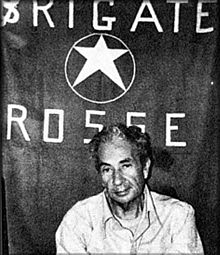 Murder When the Red Brigades decided to kill Moro, they placed him in a car and told him to cover himself with a blanket saying that they were going to transport him to another location. After Moro was covered, they shot ten rounds into him, killing him: according to the official reconstruction after a series of trials, the killer was Mario Moretti. Moro's body was left in the trunk of a red Renault 4 in Via Michelangelo Caetani. Despite the common interpretation, the location was not midway between the national seats of DC and of the Italian Communist Party (PCI) in Rome (in this case to symbolize the end of the Historic Compromise, the alliance between DC and PCI sought by Moro), but towards the Tiber River, near the Ghetto. After the recovery of Moro's body, the Minister of the Interior Francesco Cossiga resigned, gaining trust from the Communist party, which would later make him the first President of the Italian Republic.  Alternative points of view about Moro's death Many other points of views have been advanced about Moro's death. The "Gladio network", directed by NATO, has also been accused. Historian Sergio Flamigni, member of the Communist Refoundation Party, believes Moretti was used by Gladio in Italy to take over the Red Brigades and pursue a strategy of tension. In BR member Alberto Franceschini's book, Aldo Moro is described as one of Gladio's founders. Evidence has emerged to support this view of American involvement in overarching the strategy of tension and of known strong American foreign policies against the then looming historic (unprecedented in post war times) coalition that would have admitted the eurocommunist PCI into a government of national unity, the fear on the US side being that Italy thereafter might withdraw from NATO and that the US would then lose access to vital Mediterranean ports. Moro's widow later recounted Moro's meeting with U.S. President Nixon's advisor, Henry Kissinger, and an unidentified American intelligence official, who warned him not to pursue the strategy of bringing the Communist Party into his cabinet, telling him "You must abandon your policy of bringing all the political forces in your country into direct collaboration...or you will pay dearly for it." Moro was allegedly so shaken by the comment that he became ill and threatened to quit politics. But finally Aldo Moro did not quit politics; in the month following the Kissinger/Moro meeting, Aldo Moro was heading to the Italian Parliament for the crucial vote Moro had proposed when Moro was kidnapped and subsequently murdered. Mino Pecorelli's May 1978 article Investigative journalist Mino Pecorelli thought that Aldo Moro's kidnapping had been organised by a "lucid superpower" and was inspired by the "logic of Yalta". He painted the figure of General Carlo Alberto Dalla Chiesa as "general Amen", explaining in his review, the Osservatorio politico, in an article titled Vergogna, buffoni! (Shame on you, buffoons!), that it was Dalla Chiesa that, during Aldo Moro's kidnapping, had informed the then Interior Minister Francesco Cossiga of the location of the cave where Moro was detained. But he would have been ordered not to act on his information because of the opposition of a "lodge of the Christ in Paradise", referring to Propaganda Due masonic lodge. Pecorelli then wrote that Dalla Chiesa was also in danger and would be assassinated (Dalla Chiesa was murdered four years later). After Aldo Moro's assassination, Mino Pecorelli published some confidential documents, mainly Moro's letters to his family. In a cryptic article published in May 1978 Pecorelli drew a connection between Moro's death and Gladio, NATO's stay-behind anti-communist organisation whose existence was publicly acknowledged by Prime Minister Giulio Andreotti only in October 1990.] During his interrogation, Aldo Moro had referred to "NATO's anti-guerrilla activities." Mino Pecorelli, who was on Licio Gelli's list of P2 members discovered in 1980, was assassinated on March 20, 1979. The ammunitions used for Pecorelli's assassination, a very rare type, were the same as those discovered in the Banda della Magliana 's weapons stock hidden in the Health Minister's basement. Pecorelli's assassination has been thought to be directly related to Giulio Andreotti, who was first condemned to 24 years of prison for homicide in 2002 and finally acquitted by the Supreme Court of Cassation in 2003.   Carlos "the Jackal"'s declarations In a 2008 interview with the Italian news network ANSA (news agency), Venezuelan terrorist Carlos the Jackal stated from his cell in the prison at Poissy that there had been a deal to exchange Aldo Moro for several imprisoned members of the Red Brigades. Under the terms of the deal struck with "patriotic" members of the Italian military intelligence agency SISMI (Carlos' words), several Italian servicemen and members of a Palestinian resistance group would escort the prisoners to an Arab country. The deal fell through while the plane sat on a runway in Beirut, perhaps because a PLO official's loose tongue alarmed a "pro-NATO" faction within SISMI. (Carlos maintains that NATO wanted Moro dead, while the Soviets wanted him alive.) The officials in charge of the operation were subsequently purged or forced to resign. Carlos also claimed that the plotters originally planned to kidnap, along with Moro, the industrialist Gianni Agnelli and a judge of the Italian Supreme Court. He expressed surprise to learn that the Catholic Church was ready to pay a huge ransom for Moro's release. Steve Pieczenik, a former member of the U.S. State Department sent by President Jimmy Carter as a "psychological expert" to integrate the Interior Minister Francesco Cossiga's "crisis committee", was interviewed by Emmanuel Amara in his 2006 documentary Les derniers jours d'Aldo Moro ("The Last Days of Aldo Moro"), in which he alleged that: "We had to sacrifice Aldo Moro to maintain the stability of Italy." He alleged that the U.S. had to "instrumentalize the Red Brigades," and that the decision to have him killed was taken during the fourth week of Moro's detention, when he started revealing state secrets through his letters (allegedly the existence of Gladio). Francesco Cossiga also said the "crisis committee" also leaked a false statement, attributed to the Red Brigades, saying that Moro was dead. 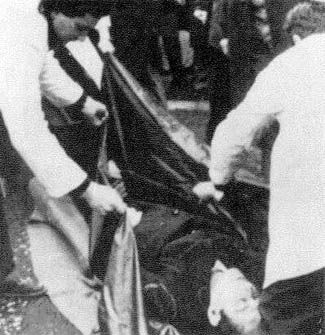 · |