| |
♚ Legacy Gold Member ♚ Poster Rank:35 Female Join Date: Nov 2008 Posts: 43,394
Contributions: 204
Mentioned: 95 Post(s) Quoted: 2282 Post(s) |
|
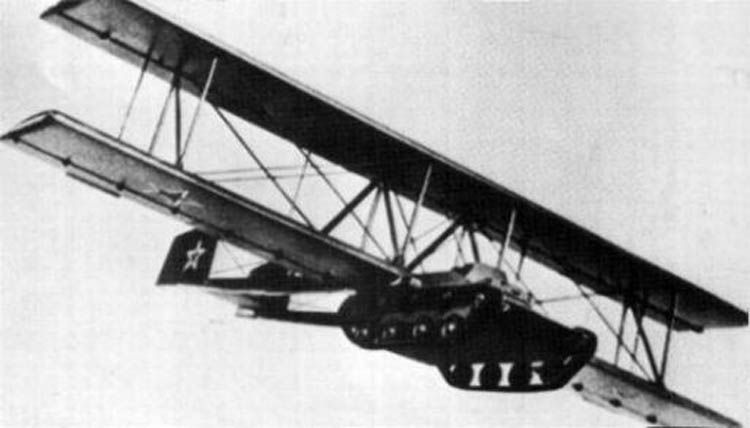
A40 Kryla Tanka ("Tank Wings")
The Antonov A-40 Krylya Tanka (Russian: крылья танка, meaning "tank wings") was a Soviet attempt to allow a tank to glide into a battlefield after being towed aloft by an airplane, to support airborne forces or partisans. A prototype was built and tested in 1942, but was found to be unworkable.
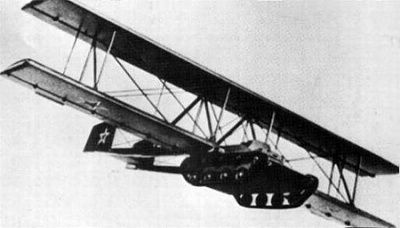
A-40 Kryla Tanka (only photograph in existence)
Instead of loading light tanks onto gliders, as other nations had done, Soviet airborne forces had strapped T-27 tankettes underneath heavy bombers and landed them on airfields. In the 1930s there were experimental efforts to parachute tanks or simply drop them into water.
During the 1940 occupation of Bessarabia (Eastern Europe), light tanks may have been dropped from a few metres by TB-3 bombers, allowing them to roll to a stop with the gearbox in neutral.
The biggest problem with air-dropping vehicles is that their crews drop separately, and may be delayed or prevented from bringing them into action. Gliders allow crews to arrive at the drop zone along with their vehicles. They also minimize exposure of the valuable towing aircraft, which needn't appear over the battlefield. So the Soviet Air Force ordered Oleg Antonov to design a glider for landing tanks.
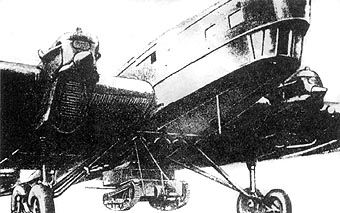
TB-3 bomber carrying a T-27 tankette, 1935
Antonov was more ambitious and instead of building a glider, he added a detachable cradle to a T-60 light tank bearing large wood and fabric biplane wings and twin tail. Such a tank could glide into the battlefield, drop its wings, and be ready to fight within minutes.
One T-60 was converted into a glider in 1942, intended to be towed by a Petlyakov Pe-8 or Tupolev TB-3. The tank was lightened for air use by removing armament, ammunition and headlights, and leaving a very limited amount of fuel. Even with the modifications, the TB-3 bomber had to ditch the glider during its only flight, on September 2, 1942, to avoid crashing, due to the T-60's extreme drag (although the tank reportedly glided smoothly). The A-40 was piloted by the famous Soviet experimental glider pilot Sergei Anokhin. The T-60 landed on a field near the airdrome, and after dropping the glider wings and tail, the driver returned it to its base. Due to the lack of sufficiently-powerful aircraft to tow it at the required 160 km/h (99 mph), the project was abandoned.
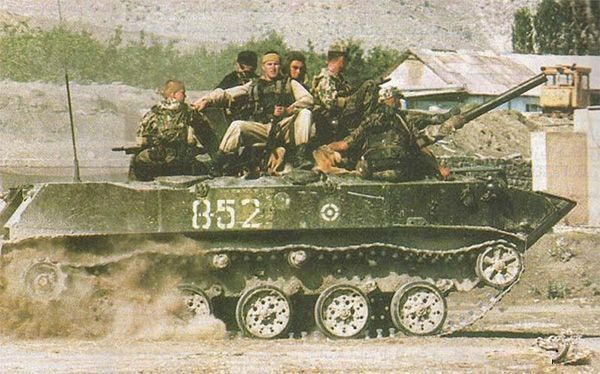
The Soviet Union continued to develop methods to efficiently deploy airborne vehicles. By the mid-1970s they were able to para-drop BMD-1 fighting vehicles with crew members aboard.
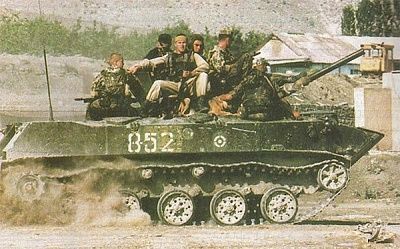
BMD-1 fighting vehicle ... |
▲ This User Says Thank You For This Post:
260RS