|
#21
●
01-23-2015, 04:03 PM
| ||||||||
 My Rank: FIRST LIEUTENANT Poster Rank:242 Male Join Date: Aug 2009 Posts: 5,695 Mentioned: 15 Post(s) Quoted: 1530 Post(s)
| ||||||||
|
Re: 2015 Executions in the USA
" The Legal Differences between Murder and Homicide The terms murder and homicide are frequently interchanged; however, there is a difference between the two. Homicide is the killing of one person by another. Murder is a form of criminal homicide, where the perpetrator intended to kill the other person, sometimes with premeditation (a plan to kill). Manslaughter is another type of criminal homicide. Homicides are criminal, excusable, or justifiable. A criminal homicide is unjustifiable, with consequences being severe. An excusable or justifiable homicide is one without criminal intent to kill someone. Examples of excusable or justifiable homicide would be someone killing someone else as a means of self defense, or defending another person, or law enforcement who kills someone in the line of duty." But you're right about one thing, dead is dead. |
|
#22
●
01-23-2015, 06:54 PM
| ||||||||
 ★ Legacy Member ★ Poster Rank:100 Join Date: May 2009 Posts: 16,280 Mentioned: 62 Post(s) Quoted: 8638 Post(s)
| ||||||||
|
Re: 2015 Executions in the USA
So really the only difference lies in the laws of the land. Other than that there is no difference between Capitol punishment and pre meditated murder. |
|
#23
●
01-24-2015, 09:38 PM
| ||||||||
| My Rank: FIRST LIEUTENANT Poster Rank:242 Male Join Date: Aug 2009 Posts: 5,695 Mentioned: 15 Post(s) Quoted: 1530 Post(s)
| ||||||||
|
Re: 2015 Executions in the USA
The difference may seem esoteric, but the difference comes down to intent and justice. But without the initial killing, the second one doesn't happen.
|
|
#24
●
01-25-2015, 07:13 AM
| ||||||||
 facta non verba Poster Rank:65 Join Date: Feb 2012 Posts: 23,922
Contributions: 56
Mentioned: 37 Post(s) Quoted: 8496 Post(s)
| ||||||||
|
Re: 2015 Executions in the USA
EXECUTION STAYED Name: Marcellus WILLIAMS 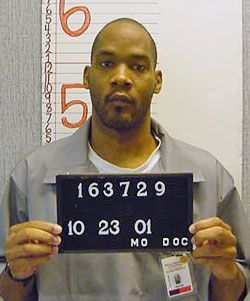 Date of birth: December 30, 1968 Stayed execution date: 12:01 am CST, on Wednesday, January 28, 2015 State: Missouri Classification: Murderer Characteristics: Robbery Method of murder: Stabbing with a large butcher knife 43 times Race of Murderer: Black Race of Victim: White Victim: (1) Felicia "Lisha" GAYLE, 42  Date of murder: August 11, 1998 Date of arrest: November 1999 Location of offence: St. Louis City, Missouri, USA Status: Sentenced to death on March 31, 2000 Case Facts: On August 11, 1998, Williams drove his grandfather’s Buick LeSabre to a bus stop and caught a bus to University City. Once there, he began looking for a house to break into. Williams came across the home of Felicia Gayle. He knocked on the front door but no one answered. Williams then knocked out a window pane near the door, reached in, unlocked the door, and entered Gayle’s home. He went to the second floor and heard water running in the shower. It was Gayle. Williams went back downstairs, rummaged through the kitchen, found a large butcher knife, and waited. Gayle left the shower and called out, asking if anyone was there. She came down the stairs. Williams attacked, stabbing and cutting Gayle forty-three times, inflicting seven fatal wounds. Afterwards, Williams went to an upstairs bathroom and washed off. He took a jacket and put it on to conceal the blood on his shirt. Before leaving, Williams placed Gayle’s purse and her husband’s laptop computer and black carrying case in his backpack. The purse contained, among other things, a St. Louis Post-Dispatch ruler and a calculator. Williams left out the front door and caught a bus back to the Buick. After returning to the car, Williams picked up his girlfriend, Laura Asaro. Asaro noticed that, despite the summer heat, Williams was wearing a jacket. When he removed the jacket, Asaro noticed that Williams’ shirt was bloody and that he had scratches on his neck. Williams claimed he had been in a fight. Later in the day, Williams put his bloody clothes in his backpack and threw them into a sewer drain, claiming he no longer wanted them. Asaro also saw a laptop computer in the car. A day or two after the murder, Williams sold the laptop to Glenn Roberts. The next day, Asaro went to retrieve some clothes from the trunk of the car. Williams did not want her to look in the trunk and tried to push her away. Before he could, Asaro snatched a purse from the trunk. She looked inside and found Gayle’s Missouri state identification card and a black coin purse. Asaro demanded that Williams explain why he had Gayle’s purse. Williams then confessed that the purse belonged to a woman he had killed. He explained in detail how he went into the kitchen, found a butcher knife, and waited for the woman to get out of the shower. He further explained that when the woman came downstairs from the shower, he stabbed her in the arm and then put his hand over her mouth and stabbed her in the neck, twisting the knife as he went. After relaying the details of the murder, Williams grabbed Asaro by the throat and threatened to kill her, her children and her mother if she told anyone. On August 31, 1998, Williams was arrested on unrelated charges and incarcerated at the St. Louis City workhouse. From April until June 1999, Williams shared a room with Henry Cole. One evening in May, Cole and Williams were watching television and saw a news report about Gayle’s murder. Shortly after the news report, Williams told Cole that he had committed the crime. Over the next few weeks, Cole and Williams had several conversations about the murder. As he had done with Laura Asaro, Williams went into considerable detail about how he broke into the house and killed Gayle. After Cole was released from jail in June 1999, he went to the University City police and told them about Williams’ involvement in Gayle’s murder. He reported details of the crime that had never been publicly reported. In November of 1999, University City police approached Asaro to speak with her about the murder. Asaro told the police that Williams admitted to her that he had killed Gayle. The next day, the police searched the Buick LeSabre and found the Post-Dispatch ruler and calculator belonging to Gayle. The police also recovered the laptop computer from Glenn Roberts. The laptop was identified as the one stolen from Gayle’s residence. Williams was tried for Gayle’s murder and convicted. ***** Supreme Court stays execution for man convicted of fatally stabbing former Post-Dispatch reporter Click to view source The Missouri Supreme Court issued on Thursday a stay of execution for Marcellus Williams, who had been scheduled to die on Wednesday for the fatal stabbing of former Post-Dispatch reporter Lisha Gayle at her home in University City in 1998. Williams had argued that he was entitled to additional DNA testing. Although the state’s high court did not say why the execution was delayed, it could provide more time for courts to consider his claim. Williams was convicted of killing Gayle, 42, at her home in the gated Ames Place neighborhood on Aug. 11, 1998. The prosecution said Williams was burglarizing the home when Gayle, who had been taking a shower, surprised him. She fought for her life as she was stabbed repeatedly. A jury convicted Williams at a trial in 2001. He was sentenced to death by St. Louis County Circuit Judge Emmett M. O’Brien. The judge also ordered Williams to serve consecutive terms of life in prison for robbery, 30 years for burglary and 30 years each for two weapons violations. Before sentencing, Williams told the judge he lacked jurisdiction — that only God had that authority. Gayle was a Post-Dispatch reporter from 1981-92. She left the paper to do volunteer social work with children and the poor. Williams’ attorneys have claimed that the case against him was built solely on contradictory testimony from two “snitches” — his former girlfriend, Laura Asaro, and a former cellmate, Henry Cole — who were out for a $10,000 reward. No forensic evidence pointed to Williams, said Kent Gipson, one of the attorneys. Gipson said he hoped that DNA testing, and comparison of any resulting DNA against federal and state databases and a similar, unsolved murder in Pagedale, could reveal evidence that would prove Williams innocent. That argument failed to sway a federal judge earlier this month. But in a petition to the state Supreme Court, his lawyers argued that “most fair minded individuals would agree that Mr. Williams should be given this opportunity.” ***** Next man slated for execution in Missouri seeks DNA testing Click to view source ST. LOUIS • A Missouri death row inmate scheduled to die Jan. 28 for the murder of a former Post-Dispatch reporter is seeking a last-minute court order for additional DNA testing. But Marcellus Williams, 46, suffered a blow Wednesday when a federal judge called his bid for a delay “frivolous” and dismissed it. In 2001, Williams was convicted of first-degree murder, robbery, burglary and two counts of armed criminal action and sentenced to death for the murder of Lisha Gayle, 42. Gayle worked for the newspaper for 11 years, leaving in 1992 to do volunteer work with children and the poor. She was fatally stabbed Aug. 11, 1998, in her home in the gated Ames Place neighborhood of University City. In court filings, Williams’ attorneys claim that the case against their client was built solely on the contradictory testimony of two “snitches” who were out for the $10,000 reward money, including his former girlfriend, Laura Asaro, and a former cellmate, Henry Cole. There was no forensic evidence pointing to Williams, said Kent Gipson, one of the attorneys. He said it was even more striking given the violence of the crime. Gipson hopes that DNA testing, and comparison of any resulting DNA against federal and state databases and a similar, unsolved murder in Pagedale, could reveal evidence that would prove Williams innocent. And he says that whatever happened in the Gayle case, Williams would probably never leave prison, as he is also serving time for unrelated crimes. Williams’ past appeals have all ultimately failed. At trial, prosecutors said Williams had confessed to Asaro and Cole. Asaro took police to the house where she said that Williams had traded a laptop belonging to Gayle’s husband, Dr. Dan Picus, to a man for crack cocaine. Police found the computer. At trial, the homeowner said he had lent the money to Williams and kept the laptop as collateral. Prosecutor Keith Larner told jurors in closing arguments that the homeowner, Asaro and Cole didn’t know each other, and that Cole and Asaro knew details of the crime that were never made public. He also said that Williams had kept a trophy of the crime — a Post-Dispatch ruler in the glove compartment of his car. Like Williams’ current attorneys, his trial attorneys attacked the witnesses’ inconsistencies. They also pointed out that defense testing found no DNA from Williams under Gayle’s fingernails, despite Asaro’s claims that Williams had scratch marks on his neck the night of the murder. Current appeals Williams filed an appeal with the Missouri Supreme Court Jan. 9. In a response filed Thursday, the Missouri Attorney General’s office said that DNA evidence was available at Williams’ original trial and could have been raised before. The office also said that it was unlikely that there was any more DNA evidence to test. But Gipson said that Williams’ appeals had only been completed in late 2013, and they had been waiting for the Missouri Attorney General’s office to ask for an execution date to do more. He said that through the appeals process, additional evidence has been uncovered that casts further doubt on Williams’ guilt. Williams’ federal suit, which says that St. Louis County Prosecuting Attorney Robert P. McCulloch has refused to release the evidence for testing, was filed Monday. U.S. District Judge Rodney Sippel dismissed it two days later. McCulloch, who is represented by the state Attorney General’s office, had not yet responded. Sippel, who heard a Williams appeal more than nine years ago, wrote that the new appeal “is frivolous and fails to state a claim upon which relief can be granted.” Picus declined to comment Thursday. ***** Editorial: The death penalty debate comes close to home Click to view source St. Louis Post-Dispatch January 19, 2015 - By the Editorial Board Since November 2013, when the state finally found a reliable supply of a lethal injection drug, Missouri has executed 12 men, one per month, skipping only last May and October. No. 13 is scheduled for 12:01 a.m. Jan. 28. This editorial page has long opposed capital punishment in any and all circumstances. It is expensive — each case costs about $1 million more to prosecute than a capital case where the death penalty is not sought, according to one study. It serves no deterrent purpose. It can’t help but be imposed arbitrarily and capriciously. Occasionally innocent people are put to death. Occasionally, executions are botched and inmates suffer cruel and unusual pain. Those are logical and dispassionate arguments. We understand the passion that many people, particularly family members of victims, have for a more retributive form of justice. For them, that someone would be spared death and spend the rest of his life in prison just doesn’t seem to match the pain and horror of the crime. We understand that impulse particularly well in the case of Marcellus Williams, 46, whom Missouri plans to inject with a lethal dose of pentobarbital next week at the state prison in Bonne Terre. He killed one of our own. Lisha Gayle was 42 when she was stabbed to death in her University City home on Aug. 11, 1998. Three years earlier she had left her job as a reporter at the Post-Dispatch, telling friends that after 11 years as a reporter, she wanted to quit writing and talking about society’s problems and do something personally to address them. That was the way she was. Earnest and oh, so serious about her many causes. Her closest friends knew she had a goofy streak, but she was the type of person who, had they met under different circumstances, would have tried to help Marcellus Williams find a job and kick his drug problem. Reporters and prosecutors like to use the phrase “brutal murder,” as if there is some other kind. But Lisha Gayle was killed in a terribly awful way. It was an interrupted burglary, and her purse, a laptop computer and some miscellaneous items were stolen. One of them, a Post-Dispatch ruler used to measure type sizes and column inches, would be found in Williams’ car. There was no forensic evidence linking him to the crime, but a jailhouse snitch and the woman who’d been his girlfriend at the time of the crime, testified that he’d confessed to them. He’d traded the laptop for drug money. The witnesses had details that hadn’t been made public. A St. Louis County jury convicted him of capital murder in 2001 and decided that death was a fitting punishment. Higher courts repeatedly have affirmed his guilt. Last week a federal judge ruled that his latest appeal, for a DNA search for other possible killers, was “frivolous.” In the penalty phase of Williams’ trial, Lisha’s family and friends stood silent on the question of whether they supported the death penalty. It would be surprising, in light of her other causes and passions, if Lisha herself was a death penalty supporter. However tragically ironic that would be, it’s now tragically irrelevant. Gallup reports that 63 percent of U.S. adults now support the death penalty. The state of Missouri has been administering it at a furious pace, catching up on a backlog caused by years of turbulence and ineptitude. We can only hope that each time someone dies at the hands of the state, it brings some peace to the victims’ families and friends. Because there’s no other excuse for it, not in a civilized society. It just feels that way. |
|
#25
●
01-28-2015, 05:31 AM
| ||||||||
| facta non verba Poster Rank:65 Join Date: Feb 2012 Posts: 23,922
Contributions: 56
Mentioned: 37 Post(s) Quoted: 8496 Post(s)
| ||||||||
|
Re: 2015 Executions in the USA
EXECUTION STAYED Name: Garcia Glenn WHITE 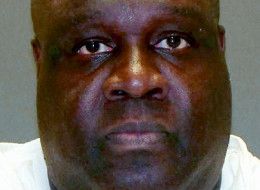 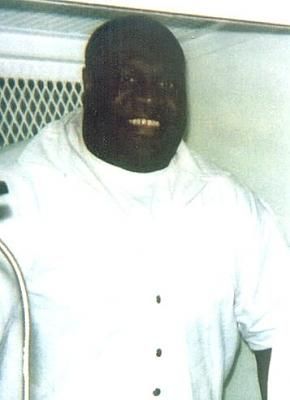 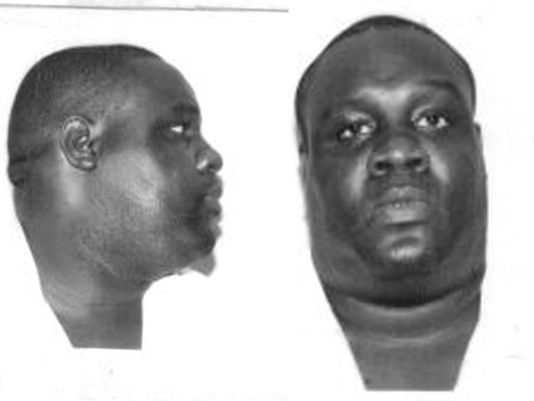 State: Texas Stayed execution date: Wednesday January 28th, 2015 DOB: February 4th, 1963 Age at time of offense: 26. Years on death row: 18. Date of offense: 12-2-89 Co-Defendants: None Victims: Bonita Edwards and her two 16-year-old twin daughters, Bernette and Anette Edwards Facts: There is little doubt about White's guilt. In a 1995 videotaped police interrogation, White admitted going to Bonita's house – his girlfriend – house to smoke crack and stabbing her to death. Her two 16-year-old twin daughters, Bernette and Anette, heard the noise and came out of their bedroom to investigate. White stabbed both of them to death. Police were alerted to the murders days later by Bonita Edwards' 64-year-old married lover, who – looking for his girlfriend – stumbled onto the bloody scene. Annette, attired only in her panties, was found lying just inside the front door. She suffered eight stab wounds in her chest and one on her neck. Bernette, gagged with a pink shirt wrapped around her neck, was found in a back bedroom. She suffered 11 knife wounds in her chest and two on her neck. Semen collected from her vagina and rectum was linked to White with 99.9999 percent certainty, prosecutors reported. The girls' mother was found in the dining room. She suffered 14 stab wounds in the chest, half of them 5 to 6 inches deep. A bloody sock was found beneath the family Christmas tree. The crime remained unsolved until 1995, when one of White's friends, Tecumseh Manuel, being questioned in connection with another crime, told police White had admitted the killings to him. On July 21, 1995, White was arrested for the capital murder of a convenience store clerk that occurred eight days earlier on July 13, 1995. During this investigation of this murder, Tecumseh Manuel told police about the Edwards murders, as well as a third capital murder involving White that occurred in November 1989. The police read White his Miranda rights and questioned him about the Edwards murders. White waived his rights, and although he initially denied involvement in the Edwards murders, he admitted to limited involvement after being confronted with the information provided by Manuel. In his confession, White first told police that he and a second man had offered Bonita Edwards drugs in exchange for sex. Edwards, he said, grabbed a knife from a kitchen drawer when the men reneged on the deal. White's companion then stabbed the three victims, he said. When police learned that White's companion had died four months before the attack, they confronted White again. "I made it all up," White told police. "She reached for a knife, and I took the knife and stabbed her. Some kids come out. I went into the bedroom after them. I stabbed one in the bedroom and one in the living room." The twins were slain one day after their 16th birthday. On their birthday, the girls telephoned their grandmother, begging her to let them live with her. They were terrified, they told her, of the rowdy drug users their mother, Bonita Edwards, admitted into their northeast Houston apartment. Punishment Evidence: White was linked to two other capital murders – the death of a convenience store clerk that occurred on July 24, 1995, several years after he murdered the three women on December 2, 1989. White also had fatally beaten Greta Williams at a neighborhood drug house one month before the Edwards killings. The Defense called White's mother who testified that White - the third of her seven children – performed poorly in school but behaved well. He played football at Wheatley High School, from which he graduated in 1981. After graduation, White attended Lubbock Christian University, a small Church of Christ university, where he also played football. A 1982 knee injury ended White's football and college careers. He returned to Houston, where he worked, first as a house painter, then, beginning in 1984, asa sand blaster. He suffered a head injury in the latter job when he fell "three or four stories" off a building, court documents reveal. White's attorneys argued this injury, coupled with another in which he was hit in the head with a baseball bat, exacerbated his cognitive difficulties. White's cousin testified, "I've seen his good side on the street, and I've seen his bad side on the street. Once he came home from college, his career kind of ended. He just wanted to get high, to cope." Williams said he tried to counsel White, who hid his drug problem from his family. "The family didn't really know," Williams said. "I talked to him a lot. He needed someone to talk to." Defense Psychologists told jurors that White would not be a future danger in prison, where he presumably would be unable to obtain drugs. White, who, standing 6 feet tall and weighing more than 350 pounds, is known on death row as "Big" White. ***** Garcia White Wins Reprieve 1 Day Before Scheduled Execution Click to view source HUNTSVILLE, Texas (AP) — Texas' top criminal court called off Wednesday's scheduled execution of a death-row inmate linked to five killings in Houston, though attorneys said the court didn't immediately explain its decision. The Texas Court of Criminal Appeals issued a reprieve Tuesday afternoon to inmate Garcia White, who was sentenced to death after being convicted of fatally stabbing twin 16-year-old girls at a Houston apartment where their mother also was killed. White also was tied to the deaths of a grocery store owner and a prostitute. Prosecutors and defense attorneys said the court didn't immediately explain its decision. Another inmate is scheduled for execution Thursday for a separate crime in the nation's busiest death-penalty state. In their appeal, White's attorneys argued that he may have been mentally impaired because of longtime cocaine use when he waived his right to an attorney during interrogations. They also said DNA evidence suggests a second person may have been involved in the triple slaying. The bodies of Bonita Edwards, 35, and her 16-year-old daughters Annette and Bernette were found at their Houston apartment a few days after they were last seen in December 1989. But his confession came only after he was arrested six years later, for the July 1995 death of 55-year-old Hai Van Pham, who was fatally beaten during a robbery at his Houston store. White told police he went to Edwards' home to smoke crack cocaine and killed her during an argument, then attacked one of her daughters when she came out of her room. Evidence shows the attacker also broke down the locked door of the girls' bedroom. "I stabbed one in the bedroom and one in the living room," White told detectives, who said both girls' throats were slit. White was convicted of killing the teenagers, and charged but not tried for the deaths of Bonita Edwards and Pham. Authorities also linked but never charged White, who played one year of football at Lubbock Christian University, to the slaying of a prostitute. Another inmate, Robert Ladd, 57, is set for execution Thursday. Ladd was convicted of fatally beating 38-year-old Vickie Ann Garner of Tyler in 1996. 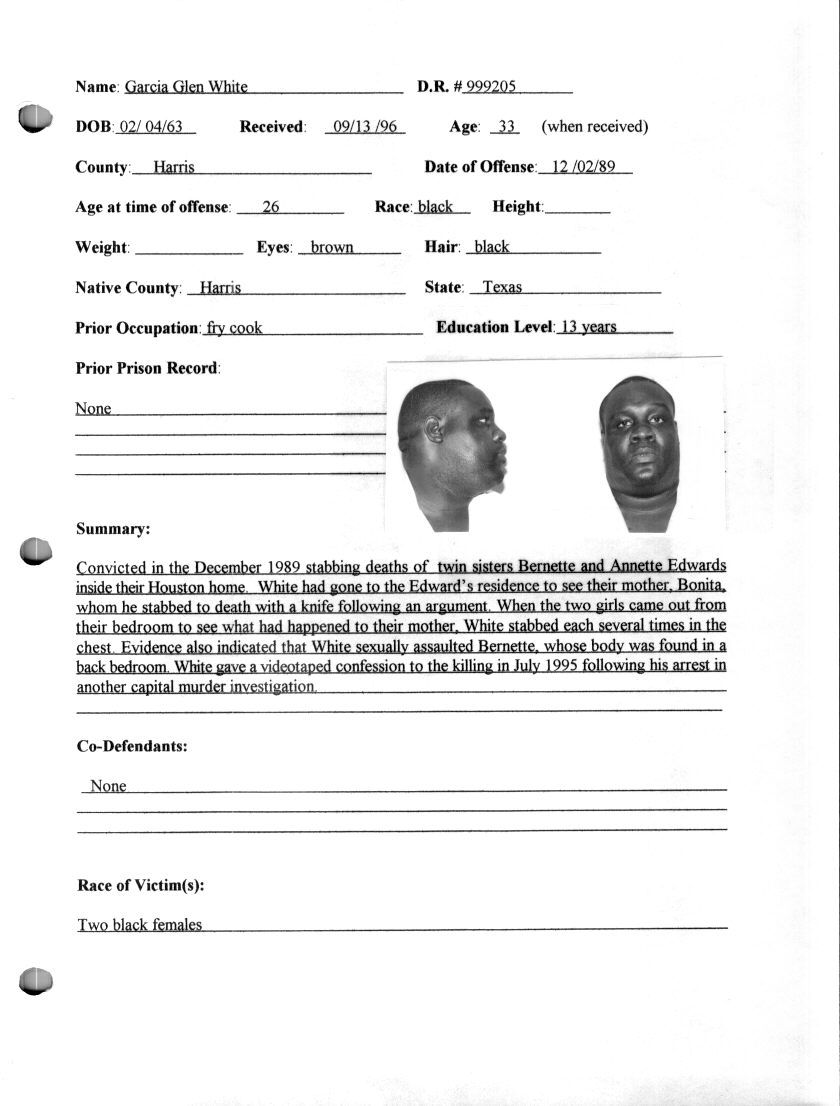 · |
|
#26
●
01-28-2015, 10:42 PM
| ||||||||
| facta non verba Poster Rank:65 Join Date: Feb 2012 Posts: 23,922
Contributions: 56
Mentioned: 37 Post(s) Quoted: 8496 Post(s)
| ||||||||
|
Re: 2015 Executions in the USA
EXECUTION STAYED Name: Richard Eugene GLOSSIP State: Oklahoma Date of stayed execution: Thursday 29th January, 2015 Date of offence: Summary of Offense: Glossip was found guilty in 1998 of plotting the 1997 beating death of motel owner Barry Alan Van Treese in Oklahoma County. The killer, Justin Sneed, then 20, confessed to the slaying. He testified that Glossip persuaded him to kill Van Treese and take the money he had on him. Van Treese was picking up checks from various motels. Sneed pleaded guilty in exchange for a no-parole life sentence. Glossip has been on death row since September 2, 1998. OKLAHOMA CITY (AP) — Executions are on hold in Oklahoma after the U.S. Supreme Court said Wednesday that the state cannot perform executions using a specific drug while the justices consider a challenge over whether the sedative ensures prisoners won't suffer. Both the state and lawyers for three inmates had asked the court to postpone the executions of Richard Glossip, who had been scheduled to die Thursday night, and two others who were scheduled for lethal injection in the coming weeks. Glossip and three other inmates challenged Oklahoma's lethal injection procedures last year, saying the sedative midazolam might not sufficiently mask pain as their hearts and lungs shut down. The justices agreed to take up their case, but not until after one of the inmates was executed two weeks ago. On Wednesday, the justices said Oklahoma could not execute inmates using midazolam while the case is pending. The case will be argued before the court in April and decided by late June. Midazolam has been used in problematic executions in Arizona, Ohio and Oklahoma. Florida has used the drug in 11 executions without apparent incident, as did Oklahoma earlier this month. A Florida execution planned for next month remains on schedule. "Midazolam is an inappropriate drug to use in executions. The scientific evidence tells us that even the proper administration of midazolam can result in an inhumane execution," said lawyer Dale Baich, who represents some Oklahoma death row inmates. Wednesday's Supreme Court order leaves open the possibility that Oklahoma could use other drugs for executions. The state formerly used pentobarbital or sodium thiopental, but manufacturers have stopped selling those drugs to states for use in lethal injections. The state has not been able to find an alternative drug, Oklahoma Department of Corrections spokesman Jerry Massie said Wednesday. Charles Warner died Jan. 15, complaining of pain but showing no obvious signs of discomfort. His execution was the first in the state since April, when Clayton Lockett writhed, moaned and struggled against his restraints after being given 100 milligrams of midazolam at the start of his execution. Investigators blamed a poorly placed intravenous line for Lockett's troubles, not the drug. Still, Oklahoma gave Warner five times as much midazolam at the start of his execution this month. The state Department of Corrections already had moved Glossip and John Marion Grant to isolation cells near the death chamber in preparation for two of three executions that had been set between Thursday and March 5. The prison system said Wednesday they would be moved back to death row. Grant's execution had been set for Feb. 19 and Benjamin Cole was set to die March 5. Oklahoma Gov. Mary Fallin could have issued a stay of up to 60 days but before the justices ruled but said she preferred that the court act. After the court's ruling, Fallin said in a statement she disagreed with the necessity of granting Glossip another round of legal appeals. "However, given that the U.S. Supreme Court has decided to hear this case, it is entirely appropriate to delay his execution until after the legal process has run its course," she said. ***** Petition to save Richard Glossip's Life Click her to view petition Richard Glossip was convicted of commissioning the tragic murder of his boss, Barry Van Treese. The conviction is based on a lie told by the actual murderer, Justin Sneed. Justin’s testimony was the only evidence linking Richard to the crime. Recently, Justin’s daughter came forward to say her father wanted to recant his testimony against Richard. Richard will be executed if Oklahoma Governor Mary Fallin doesn’t intervene. We started this petition to ask Gov. Fallin to stop Richard’s execution, scheduled for January 29th. When the police arrested Justin Sneed for the murder, there was no doubt he had committed the crime. Justin had confessed but changed his story to avoid the death penalty through a plea deal. In exchange for being spared the death penalty, Justin said Richard paid him for the murder. Richard was offered his own deal if he plead guilty. He refused, believing the truth was all he needed. Had Richard taken the deal, he would have been out of prison by now. There was a glimmer of hope when Justin’s daughter wrote a letter to the clemency board. She detailed private conversations where her father said he wanted to recant his testimony against Richard. Hope quickly faded away. Justin, fearing he would lose his plea deal to avoid the death penalty, decided against recanting in an official statement. Richard has given up on Justin doing the right thing. His only hope is enough people speak up on his behalf and demand Gov. Fallin stay the execution. It’s the first step in getting Richard exonerated. Time is running out. Please sign and share our petition today. Your signature could save his life. You can read more details about Richard’s case here: www.richardeglossip.com |
|
#27
●
01-30-2015, 08:53 AM
| ||||||||
| facta non verba Poster Rank:65 Join Date: Feb 2012 Posts: 23,922
Contributions: 56
Mentioned: 37 Post(s) Quoted: 8496 Post(s)
| ||||||||
|
Re: 2015 Executions in the USA
Name: Warren Lee HILL Hill was sentenced to life in prison for the murder of his girlfriend in 1985, however he later killed a fellow inmate and received the death penalty. Hill's case is noteworthy in that he was intellectually disabled. See attached articles for further details on the controversy surrounding his execution. 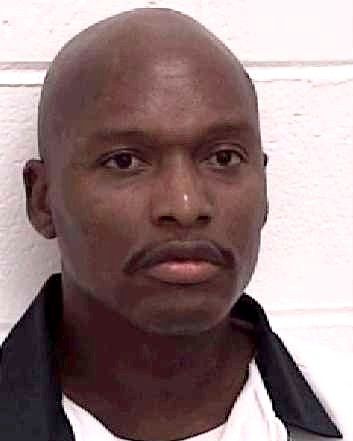 Date of Execution: January 27, 2015 - 7.55pm State: Georgia Date of Birth: 1960 Race: Black Classification: Murderer Method of Murder: Shooting / Beating with nail-studded board Date of Offence: May 30, 1985 / August 17, 1990 Victim/s: Myra Wright (girlfriend) / Joseph Handspike (34, fellow inmate) Years from Sentence to Execution: 25 Method: Lethal Injection (1 drug: pentobarbital) Last Words: Declined to make a statement Last Meal: Declined to order a special last meal, so was served the same meal as all other inmates: Shepherd’s Pie, mashed potatoes, red bean, cabbage relish salad, cornbread, sugar cookies, and fruit punch. Co-defendants: NA ***** Georgia executes inmate Warren Hill after supreme court refuses stay Click to view source ~ Court turns down plea from man seven doctors said as mentally impaired ~ Execution appears in violation of ban on cruel and unusual punishment After four years of relentless legal effort, the state of Georgia has finally achieved its aim: it has executed an intellectually disabled prisoner in an apparent flagrant violation of the US constitution. Warren Hill, who was aged 54 but who had the cognitive ability of a young boy, was pronounced dead at 7.55pm on Tuesday, having been administered a lethal injection. It was the culmination of an aggressive push by state authorities to kill him that has seen him served four death warrants in the past four years. Hill had a lifelong recognised condition of intellectual disability, with his first recording of an abnormally low IQ made at the age of seven. All seven medical experts who saw him – including three appointed by the state itself – concluded that he was mentally impaired by a “preponderance of the evidence”. Georgia, however, was not satisfied by that unanimous body of opinion, and required Hill to prove he was disabled “beyond a reasonable doubt” – a standard no other state in the union requires and which experts say is almost impossible to match. Hill was put on death row for the murder of a fellow prison inmate, Joseph Handspike. He was originally sentenced to life for murdering his girlfriend Myra Wright in 1985. Hill’s execution appears to be a clear breach of the US constitution. In 2002, the US supreme court ruled that it was unlawful to judicially kill an intellectually disabled person, under the Eighth Amendment prohibition of cruel and unusual punishment. Then last year, in Hall v Florida, the high court made clear that death penalty states could not arbitrarily impose their own definitions of what constituted intellectual disability. Yet earlier on Tuesday, the same supreme court refused to stay Hill’s execution. It did not explain its decision, with only the justices Sonia Sotomayor and Stephen Breyer dissenting. Hill’s lawyer, Brian Kammer, who fought doggedly over many years to save his life, called the execution “a grostesque miscarriage of justice” and an “abomination”. He said:“Georgia has been allowed to execute an unquestionably intellectually disabled man, in direct contravention of the supreme court’s clear precedent prohibiting such cruelty.” He added: “The memory of Mr Hill’s illegal execution will live on as a moral stain on the people of this state and on the courts that allowed this to happen.” 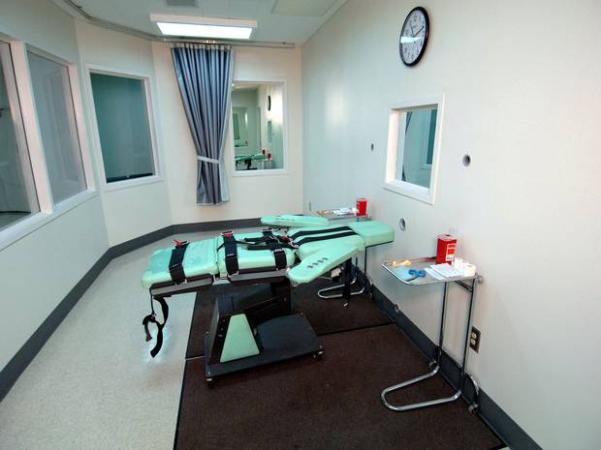 ***** Georgia executes man despite disability claim Click to view source (CNN)Twice-convicted murderer Warren Lee Hill was executed Tuesday, according to the Georgia Department of Corrections. Despite pleas by human rights groups and legal representatives who have argued that Hill's intellectual disability should have made him ineligible for the death penalty, Hill died by injection at the prison in Jackson, Georgia. His time of death was 7:55 p.m. ET, said spokeswoman Gwendolyn Hogan. Hill declined to make a final statement, but requested a final prayer, Hogan said. Hill's attorney slammed the U.S. Supreme Court, which declined to step in and grant a stay of execution. "Today, the court has unconscionably allowed a grotesque miscarriage of justice to occur in Georgia," said Brian Kammer, Hill's lawyer. "The intellectual disability community, which has strongly supported Mr. Hill's case for many years, joined his legal team in the belief that the Supreme Court would step in and prevent Georgia's flagrant disregard of the Constitution on behalf of the rights of people with disabilities," said Kammer. He described the execution as "an abomination." The Georgia State Board of Pardons and Paroles similarly voted to deny clemency. The board said in a release that its members "thoroughly reviewed the parole case file on the inmate, which includes the circumstances of the death penalty case, the inmate's criminal history, and a comprehensive history of the inmate's life" to reach their decision. In a joint statement released Tuesday, the NAACP, the Georgia Council on Developmental Disabilities, and Georgians for Alternatives to the Death Penalty called the board's decision to deny clemency, "an embarrassment to our state." They condemned the legal system for "failing to protect those who are most vulnerable." The groups invited "those concerned about Georgia's criminal justice practices," to join them at vigils in several cities around the state before Hill's scheduled execution. Federal law -- stemming from a 2002 Virginia case that went to the U.S. Supreme Court -- says executing intellectually disabled individuals violates the Eighth Amendment's ban on cruel and unusual punishment. But the ruling also allows states to define intellectual disability. In Georgia, that means attorneys for death row inmates have to prove mental impairment "beyond a reasonable doubt." "This is the strictest standard in any jurisdiction in the nation," Kammer said. Hill's execution comes two weeks after the state executed Andrew Brannan, a Vietnam War veteran suffering from post-traumatic stress disorder who killed Laurens County Deputy Kyle Dinkheller in 1998. Kammer also was Brannan's counsel. Kammer, who has represented Hill for 20 years, said in any other state, Hill would have served a life sentence. Hill was sentenced to death in 1990 for killing fellow prison inmate Joseph Handspike, beating him to death with a nail-studded board. At the time, Hill had been serving a life sentence for the 1985 shooting death of his girlfriend Myra Wright. "We acknowledge that Mr. Hill should be held accountable for his actions and behavior," Torin Togut, president of the Arc of Georgia, said in a letter written on Hill's behalf. "However, it is our contention that Mr. Hill, who has an intellectual disability, should not be subject to capital punishment." The Arc is a nonprofit organization that advocates for and serves people with intellectual and developmental disabilities. Hill had the support of the American Association on Intellectual and Developmental Disabilities, the Georgia NAACP, and former President Jimmy Carter and his wife, Rosalynn Carter. The victim's family and former jurors had also expressed support for mercy in Hill's case, saying they weren't given the option of life without parole when sentencing him to death. Kammer had said seven doctors agreed that his client was intellectually disabled -- including three doctors for the state who initially evaluated Hill and said he didn't meet Georgia's standard. Kammer said those doctors have since signed an affidavit admitting they felt rushed during Hill's examination and now believe he does meet the standard for "intellectually disabled." In previous clemency hearings, attorneys for the state have argued that Hill served in the Navy, held a job and managed his money before killing his girlfriend -- signs that he didn't necessarily meet the legal standard to be considered intellectually disabled, even though he has a low IQ. But Kammer said examples of Hill achieving "self-sufficiency" don't make a strong case for his execution. Hill has an IQ of approximately 70, and "the emotional and cognitive ability of a young boy," according to his attorney. Several of the letters supporting Hill's clemency cited last year's Supreme Court decision that struck down a Florida law that used "unscientific standards for determining intellectual disability" for death row inmates. Attorneys tried to use the Hall v. Florida decision as grounds to spare the life of Georgia inmate Robert Wayne Holsey, who was sentenced to death for the murder of a local sheriff's deputy. Holsey, who also had an IQ of 70, was executed in December. Hill declined to request a special last meal, the Department of Corrections said. He was offered the institutional meal tray, consisting of shepherd's pie, mashed potatoes, red beans, cabbage relish salad, cornbread, sugar cookies and fruit punch. |
|
#28
●
01-30-2015, 10:04 AM
| ||||||||
| facta non verba Poster Rank:65 Join Date: Feb 2012 Posts: 23,922
Contributions: 56
Mentioned: 37 Post(s) Quoted: 8496 Post(s)
| ||||||||
|
Re: 2015 Executions in the USA
Name: Robert Charles LADD Ladd's case is noteworthy in that he was intellectually disabled. See attached articles for further details on the controversy surrounding his execution.  Date of Execution: January 29, 2015 - 7.02pm Years from sentence to execution: 28 State: Texas Date of Birth: 19 March, 1957 Race: Black Classification: Murderer Summary of crimes: A Texas criminal court sentenced Ladd to death for the 1996 murder of a mentally impaired woman, Vickie Ann Garner, 38, who was strangled, bludgeoned with a hammer, bound and her body burned in her East Texas apartment. At the time of the murder, Ladd was on parole after serving 12 years of a 40-year prison sentence for the 1980 fatal stabbing of a Dallas woman, Vivian Thompson, and her infant children, Latoya and Maurice. He set their house on fire after the killing, and stole a TV, jewelry and some other small household items which he traded for crack. Vicki Garner:  Number of victims: 4 Last Words: "Joanna I really love and care about her, I appreciate her. There is a drawing that I forgot to tell you about, send it to Stacey. Art, I appreciate you. Joanna, tell my family I love them all. Trix I love you too. "Teresa I am really sorry, please don't have hate in your heart. I really feel like this. I hope you can find peace in your heart and happiness. A revenge death won't get you anything. Joanna, I love you. Let's ride." "Joanna" refers to Ladd's sister, who was not present. "Art" refers to a friend of Ladd's who was present for the execution. "Teresa" refers to Gardner's (one of the victims) sister, who was present for the execution. It was not immediately apparent who the other names spoken by Ladd were referencing. As the drug took effect, he said: "Stings my arm, man!" He began taking deep breaths, then started snoring. His snores became breaths, each one becoming less pronounced, before he stopped all movement. Last Meal: Since Texas did away with special last meal requests, condemned prisoners are served the same food as others in their unit. Ladd was served meat loaf, mashed potatoes, tomato gravy, carrots, black eyed peas, and sliced bread, with a choice of water, tea, or punch to drink. Co-defendants: Johnny Robertson ***** Convicted killer Robert Ladd executed at 7:02 p.m. Click to view source HUNTSVILLE (KYTX) -- Robert Ladd was put to death Thursday for the 1996 murder of Vicki Ann Garner in Tyler. The warden at the TDCJ Huntsville Unit began Ladd's lethal dose at 6:35pm and was pronounced dead 27 minutes later at 7:02. Ladd's last words were as follows: "Joanna I really love and care about her, I appreciate her. There is a drawing that I forgot to tell you about, send it to Stacey. Art, I appreciate you. Joanna, tell my family I love them all. Trix I love you too. "Teresa I am really sorry, please don't have hate in your heart. I really feel like this. I hope you can find peace in your heart and happiness. A revenge death won't get you anything. "Joanna, I love you. Let's ride." "Joanna" refers to Ladd's sister, who was not present. "Art" refers to a friend of Ladd's who was present for the execution. "Teresa" refers to Garner's sister, who was present for the execution. It was not immediately apparent who the other names spoken by Ladd were referencing. The two people present in support of Ladd were quiet throughout the execution. They displayed little emotion and alternated between watching the proceedings and bowing their heads. The five family members present in memory of Garner were largely solemn well. Outside the prison, protesters were picketing the execution. "This execution should not happen for many reasons," a woman yelled through a megaphone. "We oppose all executions and we explicitly oppose executions of mentally ill, mentally retarded people," Pat Hartwell of Abolitionists of Houston said. Ladd's execution was delayed for years over questions of his mental capabilities. After Ladd was pronounced dead, Wooten spoke about the experience, saying she was glad to have this chapter of Garner's story complete after 18 years. "Tonight, after an 18-plus year journey, we have finally recognized justice for Vicki," she said. "Tonight we will not celebrate the loss of Mr. Ladd's life. The loss of any human being is never a cause for celebration. We know Mr. Ladd had family who loved him." Wooten and her sister Kathy Pirtle weren't sure how to describe the frustration of waiting so long to see Ladd executed. "I don't know if 'bitter' is the right word. 'Disappointed,' maybe," Pirtle said. "'Exhausted,' definitely." They call Ladd's death a weight off their shoulders, and a reason to embrace the people you love. "As we leave this place to return to our homes, we will do so only with the good memories of Vicki and the very special person that she was." 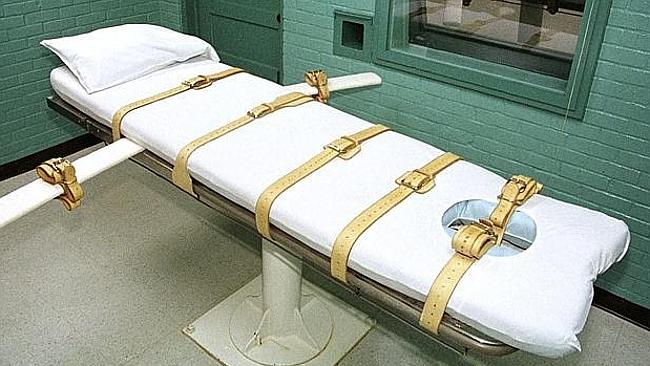  ***** 'Stings my arm, man!' Last words of Texas killer as he was executed with controversial drug Click to view source Texas death row inmate Robert Ladd man was executed this evening for the killing a 38-year-old woman nearly two decades ago while he was on parole for a triple slaying years earlier. Robert Ladd, 57, received a lethal injection after the US Supreme Court rejected arguments he was mentally impaired and ineligible for the death penalty. The court also rejected an appeal in which Ladd's attorney challenged whether the pentobarbital Texas uses in executions is potent enough to not cause unconstitutional pain and suffering. Ladd was put to death for the 1996 slaying of Vicki Ann Garner, of Tyler, who was strangled and beaten with a hammer. Her arms and legs were bound, bedding was placed between her legs, and she was set on fire in her apartment. He was pronounced dead at 7.02pm, 27 minutes after the drug was administered. Teresa Garner Wooten, Vicki's sister who was on hand Thursday to watch Ladd put to death, told CBS19 on the eve of the execution that it has been a long time coming. 'I did not think, 18-plus years ago, that I would still be fighting for justice for her,' Mrs Wooten said, adding that she had forgiven her sister's killer. Ladd came within hours of lethal injection in 2003 before a federal court agreed to hear evidence about juvenile records that suggested he was mentally impaired. Ladd and fellow death row inmate Garcia Glenn White were plaintiffs in a lawsuit that seeks a federal court order to block Texas prison officials from carrying out executions until the 'quality and viability' of pentobarbital can be examined and verified. That appeal was denied and the Supreme Court last year turned down a review of Ladd's case. His attorneys renewed similar arguments as his new execution date approached. 'Ladd's deficits are well documented, debilitating and significant,' Brian Stull, a senior staff lawyer with the American Civil Liberties Union Capital Punishment Project, told the high court. In a press release sent out immediately after Ladd's execution, Stull said that his death 'is yet another example of how capital punishment routinely defies the rule of law and human decency.' Kelli Weaver, a Texas attorney general, reminded the justices in a filing that 'each court that has reviewed Ladd's claim has determined that Ladd is not intellectually disabled.' Ladd's lawyers cited a psychiatrist's determination in 1970 that Ladd, then a 13-year-old in custody of the Texas Youth Commission, had an IQ of 67. Courts have embraced scientific studies that consider an IQ of 70 a threshold for impairment. The inmate's attorneys also contended he long has had difficulties with social skills and functioning on his own. Ladd also was a plaintiff in a lawsuit questioning the 'quality and viability' of Texas' supply of its execution drug, pentobarbital. The Texas Attorney General's Office called the challenge 'nothing more than rank speculation.' When he was arrested for Garner's slaying, Ladd had been on parole for about four years after serving about a third of a 40-year prison term for the slayings of a Dallas woman and her two children. He pleaded guilty to those crimes. 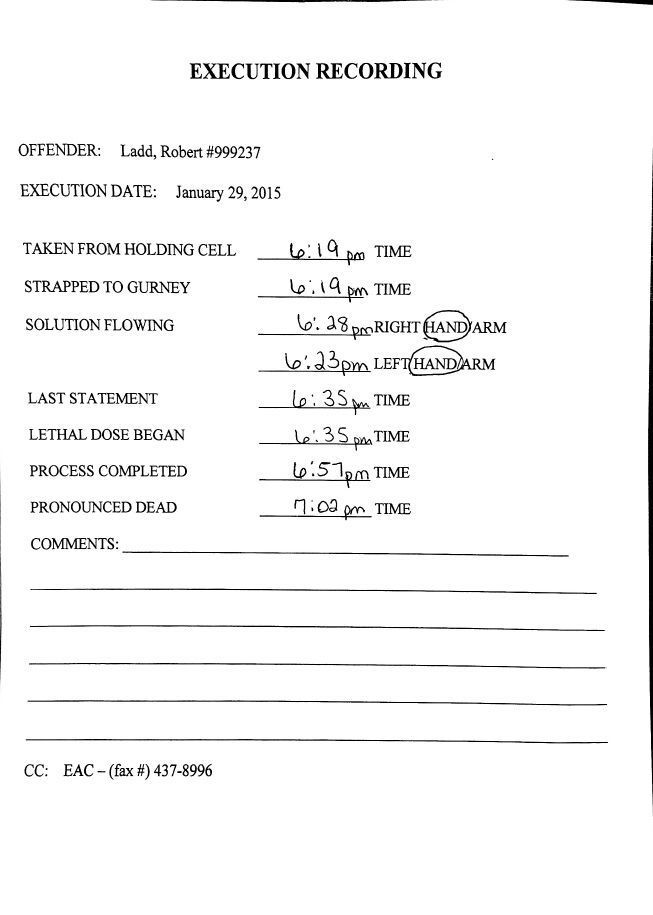 · 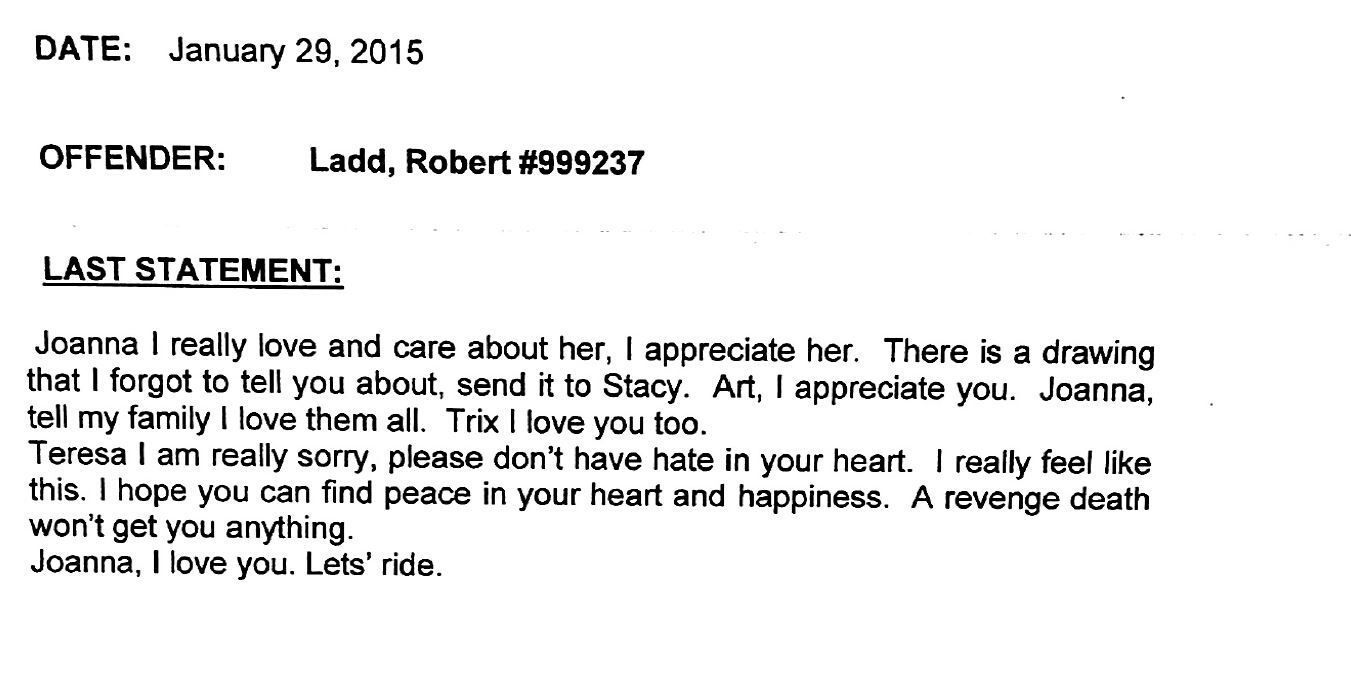 · |
|
#29
●
01-30-2015, 10:21 AM
| ||||||||
| facta non verba Poster Rank:65 Join Date: Feb 2012 Posts: 23,922
Contributions: 56
Mentioned: 37 Post(s) Quoted: 8496 Post(s)
| ||||||||
|
Re: 2015 Executions in the USA
SUMMARY FOR JANUARY 2015 Executions Carried Out: 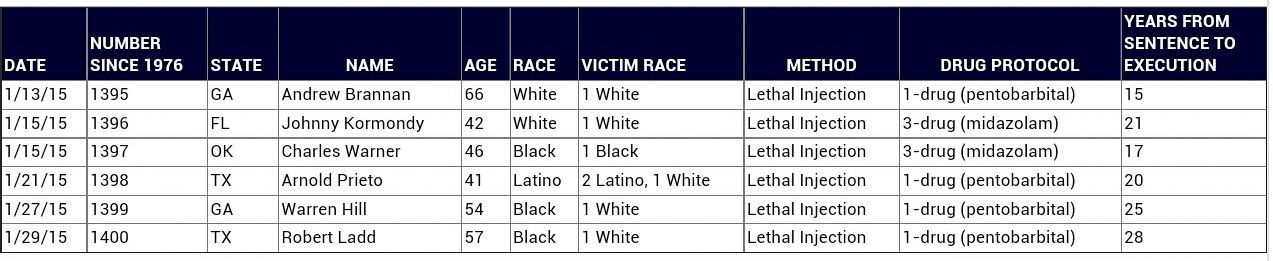 Executions Stayed: 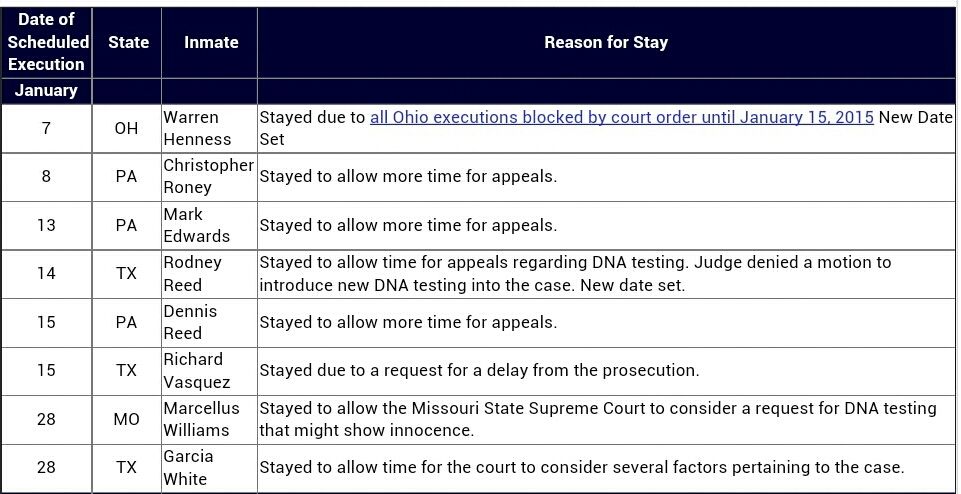 Updated Schedule of Upcoming Executions 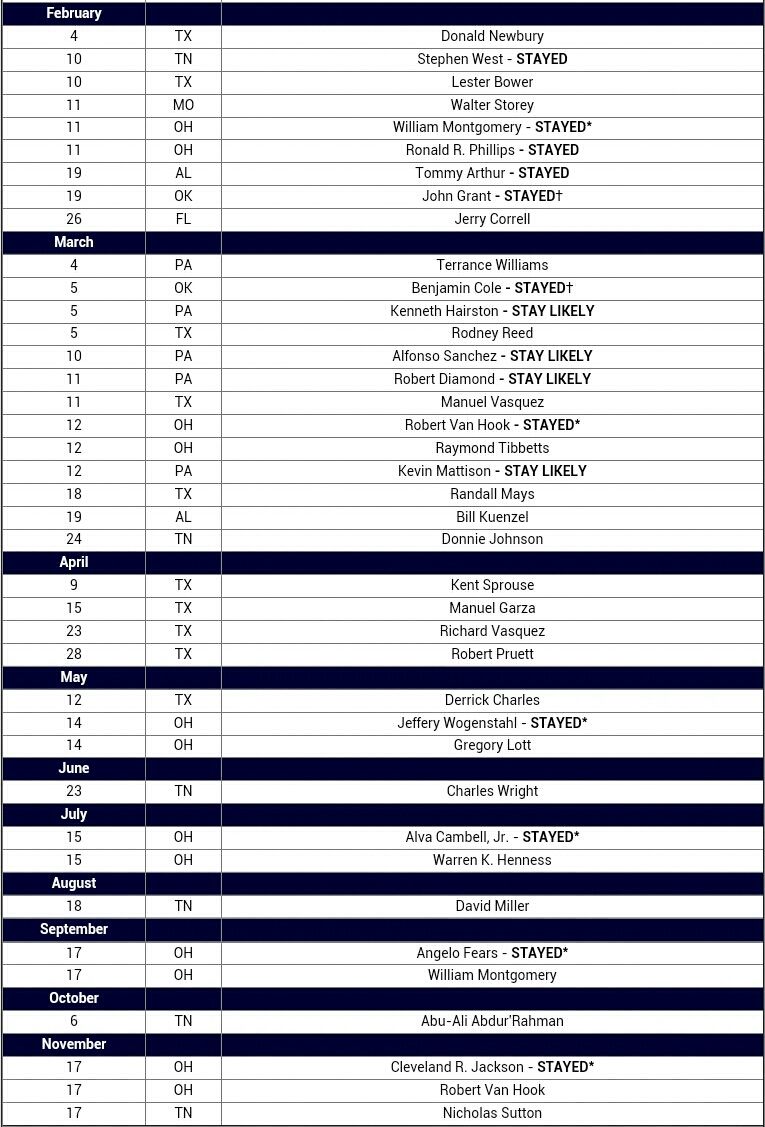 |
|
#30
●
01-30-2015, 05:24 PM
| ||||||||
 My Rank: MASTER GUNNERY SERGEANT Poster Rank:332 Join Date: Feb 2010 Posts: 3,860 Mentioned: 44 Post(s) Quoted: 920 Post(s)
| ||||||||
|
Re: 2015 Executions in the USA
don't mess with texas..   · |