|
#1
●
04-08-2011, 01:04 PM
|
 ★ Legacy Member ★ Poster Rank:340 Male Join Date: Mar 2010 Posts: 3,793 3,793Posts 1,151Thanked 28Quoted 0Mentioned 0Contrib. |
|
10 Most Painful Stings and Bites.
10# SWEAT BEE Sweat bee is the common name for bees that are attracted to pollen and the salt in human perspiration. In its strict application, the name refers to members of the Halictidae, a large family of bees that are common in most of the world except Australia and Southeast Asia, where they are only a minor faunistic element. 9# FIRE ANT A typical fire ant colony produces large mounds in open areas, and feeds mostly on young plants, seeds, and sometimes crickets. Fire ants often attack small animals and can kill them. Unlike many other ants, which bite and then spray acid on the wound, fire ants only bite to get a grip and then sting (from the abdomen) and inject a toxic alkaloid venom (piperidine). 8# BULLHORN ACACIA The ants act as a defense mechanism for the tree, protecting it against harmful insects, animals or humans that may come into contact with it. The ants live in the hollowed-out thorns for which the tree is named after. In return, the tree supplies the ants with protein-lipid nodules called Beltian bodies from its leaflet tips and carbohydrate-rich nectar from glands on its leaf stalk. 7# BALD FACED HORNET The Bald-faced hornet, Dolichovespula maculata is not a true hornet at all. It is actually more closely related to another type of wasp called the yellowjacket than it is to true hornets like the Asian giant hornet or European hornet, but the term "hornet" is often used colloquially to refer to any vespine with an exposed aerial nest. 6# YELLOW JACKETS Yellowjackets are black-and-yellow wasps of the genus Vespula or Dolichovespula (some can be black-and-white, the most notable of these being the bald-faced hornet, Dolichovespula maculata). They can be identified by their distinctive combination of black-and-yellow color, small size (slightly larger than a bee), and entirely black antennae. 5# HONEY BEE & EUROPEAN HORNET Honey bees (or honeybees) are a subset of bees which represent a far smaller fraction of bee diversity than most people suspect; of the approximately 20,000 known species of bees, there are only seven presently-recognized species with a total of 44 subspecies. 4# RED HARVESTER ANT Their chief food source usually consists of seeds, which they hoard in great numbers, hence their name. As with most ant species, their mating castes consist of winged alates (reproductives) that reside in the nest until weather permits them to fly away and mate, after which the male usually dies, and the now-fertilized queen returns to the ground to search for a suitable nesting site. 3# PAPER WASP Paper wasps are 3/4 inch to 1 inch (2-2.5 cm)-long wasps that gather fibers from dried plant stems, which they mix with saliva, and use to construct water-resistant nests that appear to be made of gray or brown papery material. Paper wasps are also sometimes called umbrella wasps, due to the distinctive design of their nests. 2# TARANTULA HAWK The tarantula hawk is the common name for species in the genera Pepsis and Hemipepsis of the family Pompilidae, in the insect Order Hymenoptera. These genera of wasps are called tarantula hawks due to their hunting of tarantulas as food for their larvae. 1# THE BULLET ANT Paraponera is a genus of ponerine ant. The most infamous member species is the so-called bullet ant (P. clavata), named on account of its powerful and potent sting, the sensation of which has often been likened with that of being shot with a bullet by those who have had the misfortune to be at its receiving end. It is called by the locals, "Hormiga Veinticuatro," from 24 hours of pain that follow a stinging. 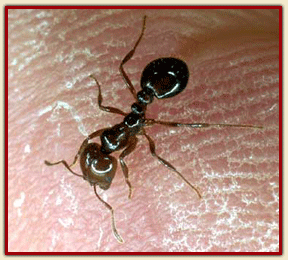 · 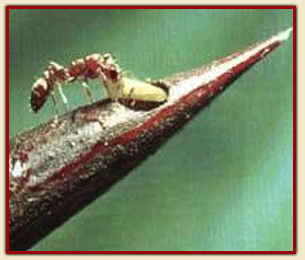 · 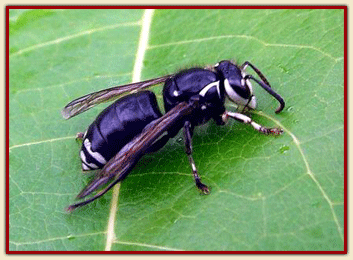 · 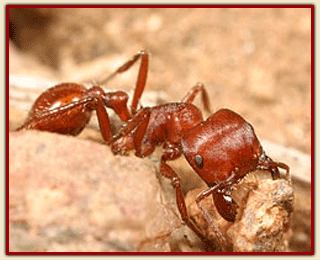 · 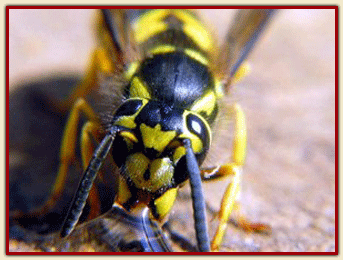 · 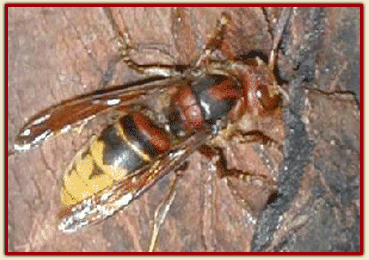 · 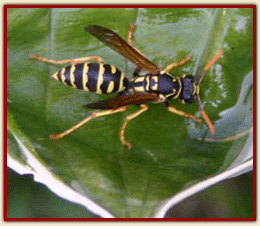 · 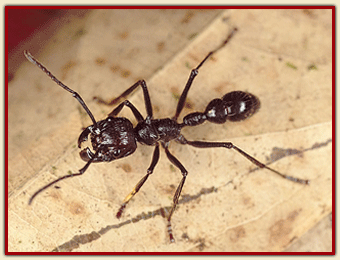 ·  · |
|
#2
●
04-08-2011, 01:05 PM
|
| ★ Legacy Member ★ Poster Rank:340 Male Join Date: Mar 2010 Posts: 3,793 3,793Posts 1,151Thanked 28Quoted 0Mentioned 0Contrib. |
|
Re: 10 Most Painful Stings and Bites.
fuck it.. is anyone gona explain to me how the fuck to format my threads ? why my pics in wrong order. and why they at the bottom... that really twists my tits that does. ruins a good thread every feckin time,  |