JavaScript and Cookies are required to view this site. Please enable both in your browser settings.
1,600-year-old Roman Chalice Shows That Romans Were Pioneers in Nanotechnology
Documenting Reality True Crime Related Chat & Research Interesting People, Places, Things, Animals 1,600-year-old Roman Chalice Shows That Romans Were Pioneers in Nanotechnology

1,600-year-old Roman Chalice Shows That Romans Were Pioneers in Nanotechnology 

Current Rating:

Unlimited Views No Ads No Algorithms Lifetime Account

Documenting Reality

Community Forum · Est. 2006

Join Now
Thread Tools
  #1  
08-29-2013, 03:21 PM
kellyhound's Avatar
kellyhound
Offline:
✝Mudderator from Hell✝
Poster Rank:10
e-mail
Join Date: Oct 2006
Posts: 95,057
Contributions: 817
 
Mentioned: 472 Post(s)
Quoted: 10090 Post(s)
Activity Longevity
18/20 20/20
Today Posts
11/11 ssss95057
1,600-year-old Roman Chalice Shows That Romans Were Pioneers in Nanotechnology


The colorful secret of a 1,600-year-old Roman chalice at the British Museum is the key to a super*sensitive new technology that might help diagnose human disease or pinpoint biohazards at security checkpoints.

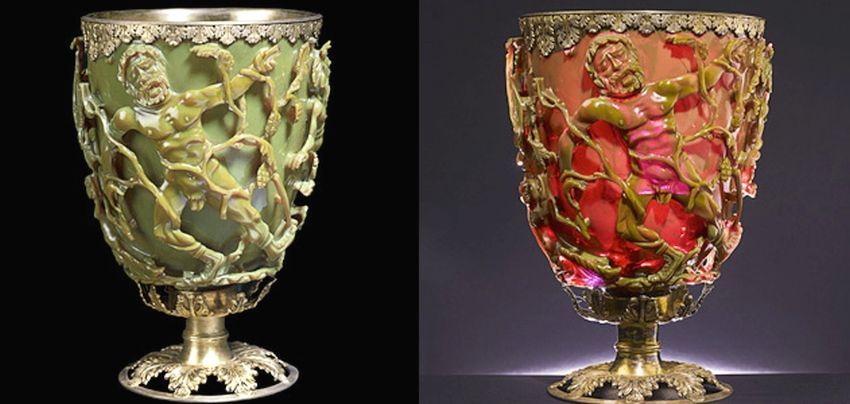
The glass chalice, known as the Lycurgus Cup because it bears a scene involving King Lycurgus of Thrace, appears jade green when lit from the front but blood-red when lit from behind—a property that puzzled scientists for decades after the museum acquired the cup in the 1950s.

The mystery wasn’t solved until 1990, when researchers in England scrutinized broken fragments under a microscope and discovered that the Roman artisans were nanotechnology pioneers: They’d impregnated the glass with particles of silver and gold, ground down until they were as small as 50 nanometers in diameter, less than one-thousandth the size of a grain of table salt.

The exact mixture of the precious metals suggests the Romans knew what they were doing—“an amazing feat,” says one of the researchers, archaeologist Ian Freestone of University College London.

The ancient nanotech works something like this: When hit with light, electrons belonging to the metal flecks vibrate in ways that alter the color depending on the observer’s position.

Gang Logan Liu, an engineer at the University of Illinois at Urbana-Champaign, who has long focused on using nanotechnology to diagnose disease, and his colleagues realized that this effect offered untapped potential.

“The Romans knew how to make and use nanoparticles for beautiful art,” Liu says. “We wanted to see if this could have scientific applications.”

When various fluids filled the cup, Liu suspected, they would change how the vibrating electrons in the glass interacted, and thus the color. (Today’s home pregnancy tests exploit a separate nano-based phenomenon to turn a white line pink.)

Since the researchers couldn’t put liquid into the precious artifact itself, they instead imprinted billions of tiny wells onto a plastic plate about the size of a postage stamp and sprayed the wells with gold or silver nanoparticles, essentially creating an array with billions of ultra-miniature Lycurgus Cups.

When water, oil, sugar solutions and salt solutions were poured into the wells, they displayed a range of easy-to-distinguish colors—light green for water and red for oil, for example.

The proto*type was 100 times more sensitive to altered levels of salt in solution than current commercial sensors using similar techniques.

It may one day make its way into handheld devices for detecting pathogens in samples of saliva or urine, or for thwarting terrorists trying to carry dangerous liquids onto airplanes.

The original fourth-century A.D. Lycurgus Cup, probably taken out only for special occasions, depicts King Lycurgus ensnared in a tangle of grapevines, presumably for evil acts committed against Dionysus, the Greek god of wine.

If inventors manage to develop a new detection tool from this ancient technology, it’ll be Lycurgus’ turn to do the ensnaring.
chalice.jpg
207.6 KB ·214 views
9 Users Say Thank You For This Post:
bdjackass318, Faline, JONESJIM, Kanda444, Raevynn, Sharon, Soar, Viking64, Vorgrus
▼ PROMO FROM DOCUMENTING REALITY
Cheaper than the doctor bills, guaranteed
Join Now
Hidden for upgraded members.
  #2  
08-29-2013, 03:37 PM
JohnFrash's Avatar
JohnFrash
Offline:
My Rank: MASTER SERGEANT
Poster Rank:486
Male
Join Date: Feb 2010
Posts: 2,151
 
Mentioned: 35 Post(s)
Quoted: 1198 Post(s)
Activity Longevity
0/20 17/20
Today Posts
0/11 sssss2151
Re: 1,600-year-old Roman Chalice Shows That Romans Were Pioneers in Nanotechnology

This is the coolest thing I have ever seen. Fairly humbling to think we haven't "re-discovered" that in all this time.
3 Users Say Thank You For This Post:
kellyhound, lkduke3, Sharon
  #3  
08-29-2013, 04:39 PM
Kanda444's Avatar
Kanda444
Offline:
You holdin....?
Poster Rank:21
Join Date: May 2010
Posts: 58,107
Contributions: 23
 
Mentioned: 263 Post(s)
Quoted: 25273 Post(s)
Activity Longevity
0/20 17/20
Today Posts
0/11 ssss58107
Re: 1,600-year-old Roman Chalice Shows That Romans Were Pioneers in Nanotechnology

amazing!

i've always thought it was kinda silly the way modern society just assumes ancient societies were primitive with their technology...
4 Users Say Thank You For This Post:
bdjackass318, JohnFrash, kellyhound, Sharon
  #4  
08-29-2013, 06:14 PM
bdjackass318's Avatar
bdjackass318
Offline:
My Rank: MAJOR
Poster Rank:199
Join Date: Jan 2010
Posts: 7,658
Contributions: 5
 
Mentioned: 22 Post(s)
Quoted: 2389 Post(s)
Activity Longevity
0/20 17/20
Today Posts
0/11 sssss7658
Re: 1,600-year-old Roman Chalice Shows That Romans Were Pioneers in Nanotechnology

pretty amazing!
  #5  
08-30-2013, 01:44 PM
Faline's Avatar
Faline
Offline:
My Rank: MAJOR
Poster Rank:11
Join Date: Jun 2009
Posts: 93,130
Contributions: 226
 
Mentioned: 91 Post(s)
Quoted: 2009 Post(s)
Activity Longevity
0/20 18/20
Today Posts
0/11 ssss93130
Re: 1,600-year-old Roman Chalice Shows That Romans Were Pioneers in Nanotechnology

  #6  
08-30-2013, 03:30 PM
Sharon's Avatar
Sharon
Offline:
♚ Legacy Gold Member ♚
Poster Rank:34
Female
Join Date: Nov 2008
Posts: 43,403
Contributions: 204
 
Mentioned: 95 Post(s)
Quoted: 2281 Post(s)
Activity Longevity
0/20 18/20
Today Posts
0/11 ssss43403
Re: 1,600-year-old Roman Chalice Shows That Romans Were Pioneers in Nanotechnology

i've always thought it was kinda silly the way modern society just assumes ancient societies were primitive with their technology...
It's so patronizing isn't it?
2 Users Say Thank You For This Post:
JohnFrash, Kanda444
  #7  
08-31-2013, 03:18 AM
kizzcee007
Offline:
My Rank: LANCE CORPORAL
Poster Rank:2930
Join Date: Oct 2009
Posts: 135
 
Mentioned: 0 Post(s)
Quoted: 17 Post(s)
Activity Longevity
0/20 17/20
Today Posts
0/11 ssssss135
Re: 1,600-year-old Roman Chalice Shows That Romans Were Pioneers in Nanotechnology

Could this have been used to indicate the presence of poison in the chalice? If so a similar idea is being introduced into pubs and clubs in the UK to warn of a drink spiked with Rohypnol, etc.
3 Users Say Thank You For This Post:
kellyhound, lkduke3, LuckiiDevil21
  #8  
09-01-2013, 07:30 PM
Soar's Avatar
Soar
Offline:
Poster Rank:82
Join Date: Oct 2006
Posts: 18,649
Contributions: 49
 
Mentioned: 96 Post(s)
Quoted: 2921 Post(s)
Activity Longevity
0/20 20/20
Today Posts
0/11 ssss18649
Re: 1,600-year-old Roman Chalice Shows That Romans Were Pioneers in Nanotechnology

This is awesome.
Documenting Reality True Crime Related Chat & Research Interesting People, Places, Things, Animals 1,600-year-old Roman Chalice Shows That Romans Were Pioneers in Nanotechnology


Powered by vBulletin Copyright 2000-2010 Jelsoft Enterprises Limited.

Search Engine Friendly URLs by vBSEO