|
#1
●
01-04-2013, 06:40 PM
| ||||||||
 My Rank: MAJOR Poster Rank:12 Join Date: Jun 2009 Posts: 93,128
Contributions: 226
Mentioned: 91 Post(s) Quoted: 2009 Post(s)
| ||||||||
|
Vintage Medical Devices
British 18th century bleeding bowl Bloodletting was once used to treat just about every illness. This bowl has a scale marked in fluid ounces to measure how much blood had been let out of the patient. And as barbers were once surgeons, the running blood was marked by their red-striped poles. 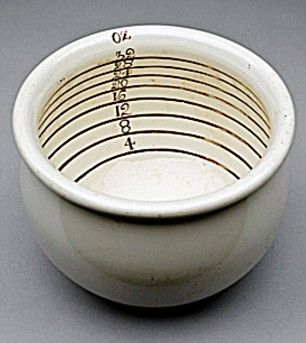 German amputation knife: This 18th century instrument allowed a skilled surgeon to remove a leg, above the knee, in less than a couple of minutes - though without anaesthetic it must have seemed like an eternity to the patient. As techniques became more refined, shorter, straighter knives were used to allow the surgeon to peel back a flap of skin to close the wound over the stump. Small pincers were used to trim and smooth the edge of the sawn-off bone, to prevent the serrations tearing into the healing flesh. 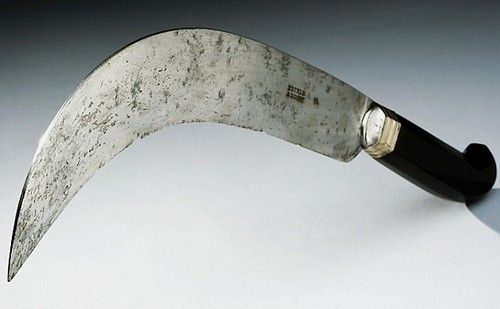 Anti-masturbation device: In the West, until quite recently, masturbation, particularly among males, was thought to rob the body of vital fluids and energy. This model was worn as a codpiece and was designed to be worn under clothes. 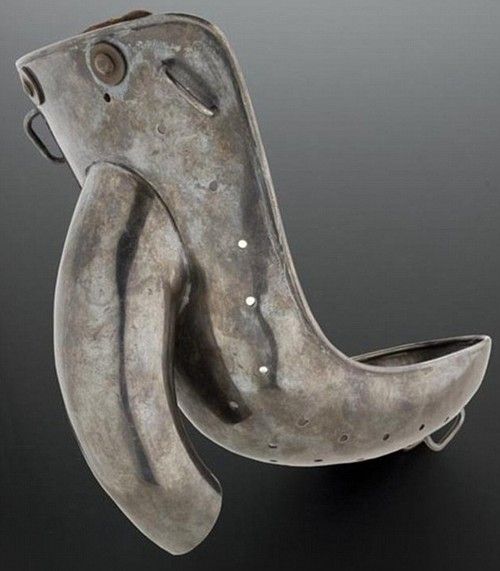 Jugum penis: This evil-looking contraption was designed to waken a male sleeper should an erection occur. It was part of the drive against the ‘moral weakness’ that was masturbation, which was thought to be a source of mental and physical ill health. 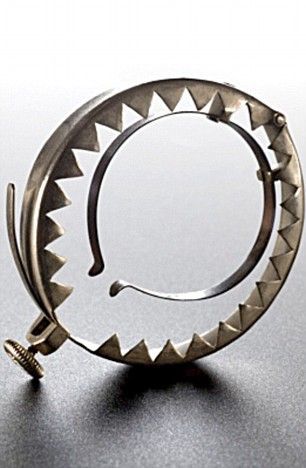 17th century bow-framed amputation saw: The best surgeons became rich and liked to spend a lot of money on beautifully made, highly decorated instruments, such as this ebony-handled, gold-inlaid device. Unfortunately, all this intricacy provided an ideal environment in which germs could flourish. Few surgeons bothered even to wash their instruments between operations 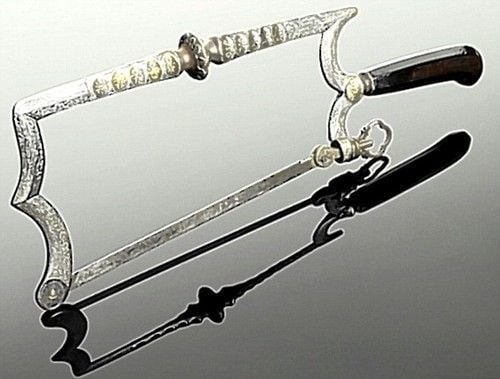 French 18th century bullet extractor: Special instruments for removing bullets came into use in the early 1500s as firearms became more sophisticated. Extractors like this one have a hollow rod which contains a screw that can be lengthened or shortened by turning the handles to remove the bullet. 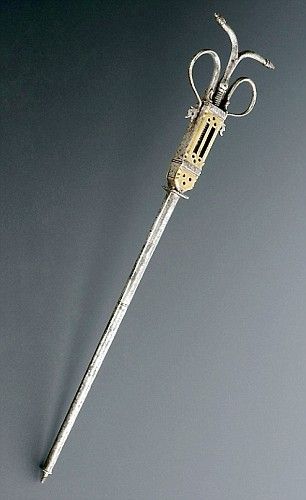 Domestic enema device 1830's: In certain credulous circles, it was thought that squirting various liquids up your bottom would rejuvenate the body and even revive a flagging sex life. Today the same practice, now known as ‘colonic irrigation’ is once again fashionable among certain classes. 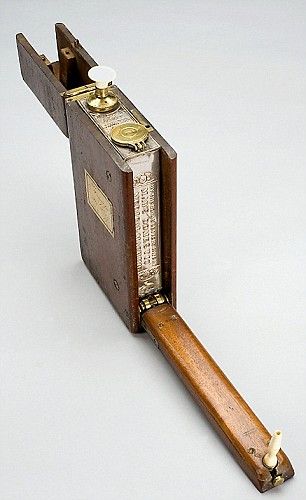 Cephalotribe; obstetric tool, Geneva, Switzerland, 1750-1850 Three vicious-looking pronged hands comprise this steel cephalotribe. It is a skull-crushing instrument. Cephalotribes were used by obstetric physicians. These doctors assist at the birth of a baby. The instrument pierced and crushed the foetus head to extract it from the mother’s body. They were used as a last resort only after the foetus was dead. The foetus may have died during the pregnancy or during a difficult labour. This example was made by Swiss instrument maker Demaurex. 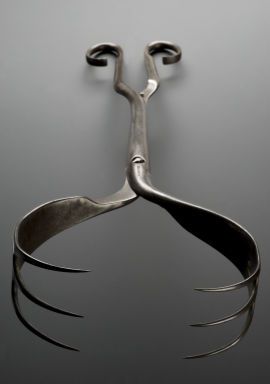 Assalini-type obstetrical forceps, London, England, 1851-1900: This type of forceps was invented by Italian surgeon Paolo Assalini (1759-1840) in 1811. They are made from nickel-plated steel. Obstetrical forceps gripped a baby’s head during difficult childbirths. Assalini’s design was immediately popular and was manufactured until the 1930s. 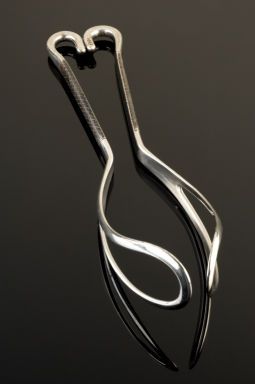 |
|
#4
●
01-05-2013, 08:26 AM
| ||||||||
 My Rank: LANCE CORPORAL Poster Rank:2287 Join Date: Jul 2012 Posts: 202 Mentioned: 0 Post(s) Quoted: 36 Post(s)
| ||||||||
|
Re: Vintage Medical Devices
Wish I had the jugum thing for my husband some mornings. "6am? You fucking kidding me?"   |
|
#6
●
01-05-2013, 09:38 PM
| ||||||||
 ★ Legacy Member ★ Poster Rank:193 All woman Join Date: Jun 2012 Posts: 7,774 Mentioned: 22 Post(s) Quoted: 1420 Post(s)
| ||||||||
|
Re: Vintage Medical Devices
That anti-masturbation thingy with the special place for the dick would make a nice Masquerade mask.....
|