|
#1
●
11-06-2023, 01:22 AM
|
 My Rank: PRIVATE FIRST CLASS Poster Rank:5354 Join Date: Jul 2017 Posts: 48 48Posts 112Thanked 13Quoted 0Mentioned 0Contrib. |
|
Vintage Crime Scene Photos I Found
I found these crime scene photos on a website. They were photographed by Arthur Fellig (1899-1968). Here are the photos with descriptions. I copied/pasted from the page. Fingers crossed the images show up! We can see that the body is resting on a tray in a boat that is tied to a pier (notice the tensioned rope top right). It has obviously been in the river quite a while because all the flesh has withered from the vine. A piece of metal wire is coiled near the hands, proposing that this person met foul play. The photographer stands on the bank and you can just imagine the conversation. You can imagine Weegee saying to the working men who were in the boat (there must have been two for the lid of the container, top left, is parallel to the body), “Do us a favour, lift the lid for a second.” He only had a second, his camera slanted 45 degrees down looking at the body, and he missed his focus point (or is it deliberate?) … the depth of field low, the focus is on the workers shoes and the skeletal body is out of focus. Does it matter? Not one bit.  Secondly, the lady with the shoe (below). In a seedy tenement house (a run-down and often overcrowded apartment house, especially in a poor section of a large city) we observe how Weegee approaches the body, photographing it from above, from opposing directions, using flash to illuminate the scene. In this case he contextualises the body… in a room, against a cheap vinyl patterned floor covering. A single suitcase sits with open locks on a small trestle table. An old cast iron bed (you know the ones, with metal springs) is framed to the right in front of a heavy iron radiator. In this first photograph the definitive focus is on the body, and its attitude at the point of destruction. The out flung arm, the bend of the knee, the ravaging of the breast. And how it is surrounded by a smashed plate and a discarded shoe. 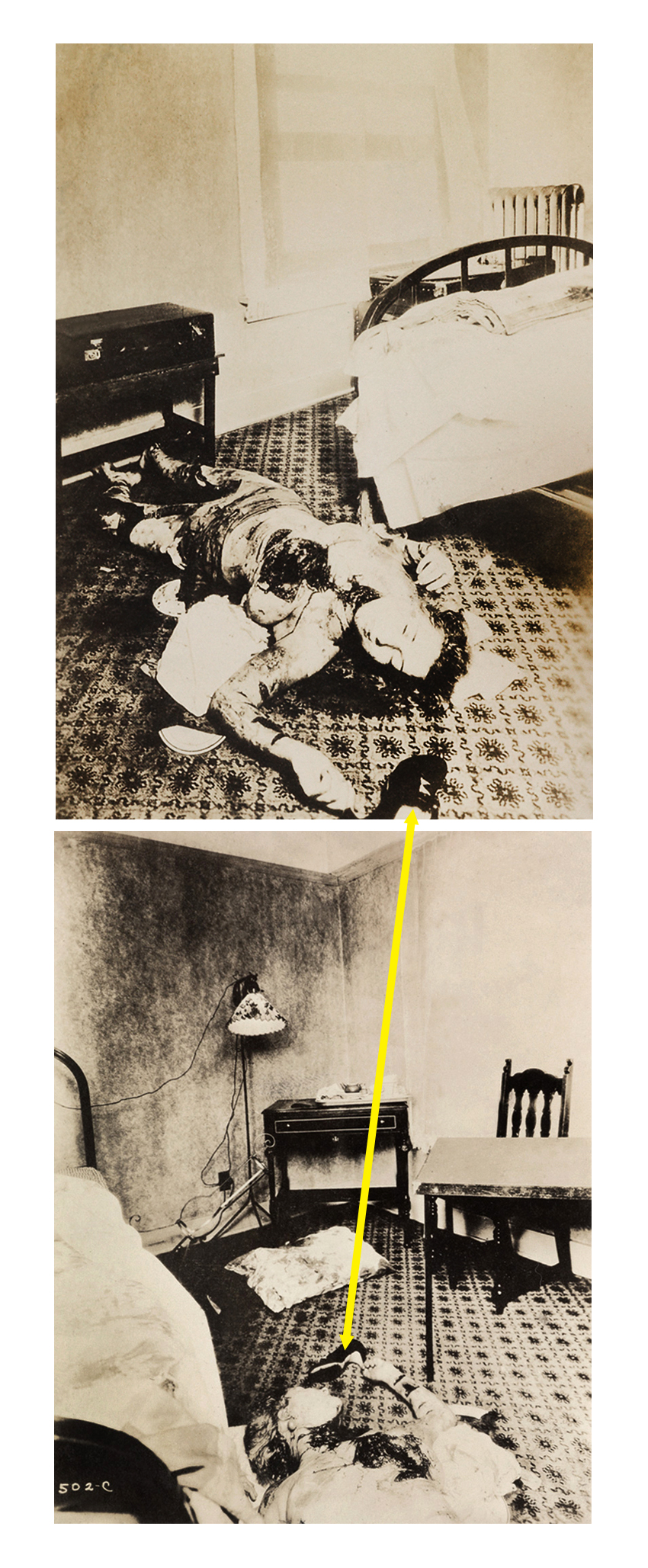  Thirdly, and most interestingly in terms of Weegee’s photographic process, is the murder in the storeroom (below). It took me a while to work out what was going on here, and I have created a composite photograph of the three images to explain the photographic sequence. I believe that Weegee took the central images first, using flash, reasonable depth of field, looking down on the victim. The body of a young man lies crammed into a small space, face down in an unnatural pose, table to the left, boxes at back and shelf to right. The flash has blown out the floorboards and objects to the right, but intensifies the bloodstains on the floor. Weegee has then stepped around the table to photograph the lower portion of the man’s body, one leg resting behind a step ladder, the other leg out of sight to the right of the Du Pont box. The curl of the man’s hand is particularly poignant. As in the second photograph of the women in the apartment, it is the placement of the body in the context of life and death that is so important in this photograph. The space of existence. Finally, and this is where it gets really interesting, Weegee walks to where the foot of the step ladder must have been in the second photograph. He must have removed the ladder and photographed the foreshortened space, where we can just see the man’s head resting on the floor above the darkness of his jacket. The blue line in the composite photograph shows the opposite ends of this box (in the first and third images), with the table out of the picture to the right in the third photograph. This is fascinating stuff, to understand how Weegee intuitively approached a crime scene, how his eye saw so clearly and quickly what he needed to capture. The essence of a scene revealed to the photographer and the viewer in the blink of an eye. A series of decisive moments captured not on the fly, but in the mind.  https://artblart.files.wordpress.com...-1930-web1.jpg https://artblart.files.wordpress.com...-1930-web3.jpg Couldn't find the story on this one:  |
|
#2
●
11-06-2023, 03:18 PM
|
 ✖ The Antique Christ ✖ Poster Rank:106 Gonzo Punk Join Date: Jan 2009 Posts: 15,478
Contributions: 62
15,478Posts 39,159Thanked 2,046Quoted 23Mentioned 62Contrib. |
|
Re: Vintage Crime Scene Photos I Found
You should have posted this in the Vintage Black and White Medical & Death Pictures section. That's what it's there for.
|
|
#3
●
11-06-2023, 09:41 PM
|
| My Rank: PRIVATE FIRST CLASS Poster Rank:5354 Join Date: Jul 2017 Posts: 48 48Posts 112Thanked 13Quoted 0Mentioned 0Contrib. |
|
Re: Vintage Crime Scene Photos I Found
Maybe a mod can move it since I don't know how to.
|
|
#4
●
11-07-2023, 02:00 AM
|
 My Rank: MASTER GUNNERY SERGEANT Poster Rank:352 Manly Man Join Date: Sep 2017 Posts: 3,601 3,601Posts 12,428Thanked 700Quoted 0Mentioned 0Contrib. |
|
Re: Vintage Crime Scene Photos I Found
Great find.
|
|
#5
●
11-07-2023, 02:27 AM
|
 ✝Mudderator from Hell✝ Poster Rank:10 e-mail Join Date: Oct 2006 Posts: 96,845
Contributions: 904
96,845Posts 544,738Thanked 10,391Quoted 481Mentioned 904Contrib. |
|
Re: Vintage Crime Scene Photos I Found
cool stuff  |