|
#1
●
04-08-2012, 02:07 PM
| ||||||||
 My Rank: MAJOR Poster Rank:12 Join Date: Jun 2009 Posts: 93,128
Contributions: 226
Mentioned: 91 Post(s) Quoted: 2009 Post(s)
| ||||||||
|
Schnee Bath
Schnee bath, from Edward Reginald Morton and Elkin Cumberbatch’s Essentials of Medical Electricity (Third Edition), 1916 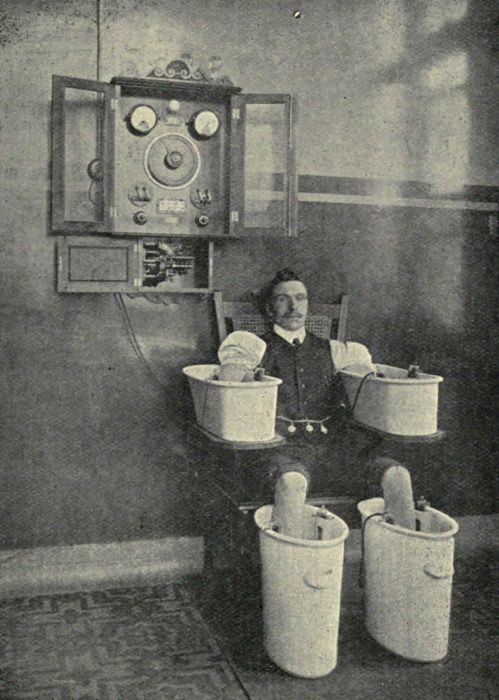 · |
|
#10
●
04-12-2012, 12:13 AM
| ||||||||
 My Rank: PRIVATE Poster Rank:9052 Join Date: Feb 2009 Posts: 17 Mentioned: 0 Post(s) Quoted: 0 Post(s)
| ||||||||
|
Re: Schnee Bath
Purpose of this device: The Schnee Four Cell Bath was used for treating general rheumatic conditions and painful joints. A patient would be seated with an individual bath for each limb. Each bath had its own current, which could be varied independently. In this treatment patients could bear a much stronger current than with electrodes on small areas, because of the large skin area exposed to the current in each bath. There was no danger of electric shock as in a full bath as the porcelain tubs were not connected to water pipes and were well insulated from earthing. The quantity of water required was not great and did not depend on a nearby water supply. It also allowed the person to be treated without undressing, speeding up treatment times and proving much more comfortable and convenient than a full body bath. Text from the Sacred Medical Order of Hope. Photo from Edward Reginald Morton and Elkin Cumberbatch’s Essentials of Medical Electricity (Third Edition) (1916), via A London Salmagundi Jennie Kidd Trout, M.D. was one of the first to truly believe in these treatments for certain prolonging health problems. She has an important part in the history of the galvanic bath. Jennie Trout from Canada became the very first woman legally to become a medical doctor and she was also the only woman in Canada licensed to practice medicine up until the 1880's. In July 1875 Trout opened her Toronto practice featuring "special facilities for giving treatment to ladies by galvanic baths or electricity." The practice of electrotherapeutics often involved application by means of the hand requiring the presence of a female physician. Dr. Trout’s practice grew rapidly; the Therapeutic and Electrical Institute encompassed six houses adjoining the family residence. It had well heated rooms and numerous baths and could house some sixty patients. Only six months after the opening the Institute, Dr. Trout, in gratitude to God’s blessing upon her practice, began operating the free dispensary for the poor. As one historian has noted, the dispensary "aptly expressed her dedication to direct social action based upon an overriding commitment to Christian social values." Sadly, Trout’s connection to the Restoration Movement in Canada is largely unknown by its modern day adherents. Her courage and determination in pursuing a career in medicine, in an era when such was not viewed favourably, her subsequent compassion and service to the poor, and her active role in helping other Canadian women pursue careers in medicine were all very personal expressions of Jenny’s faith in God. Her mind and her heart were concentrated on doing "much good work for the Master." |