|
#1
●
07-23-2014, 07:42 PM
| ||||||||
 ✖ The Antique Christ ✖ Poster Rank:105 Gonzo Punk Join Date: Jan 2009 Posts: 15,488
Contributions: 58
Mentioned: 23 Post(s) Quoted: 2046 Post(s)
| ||||||||
|
First Photograph of New York City
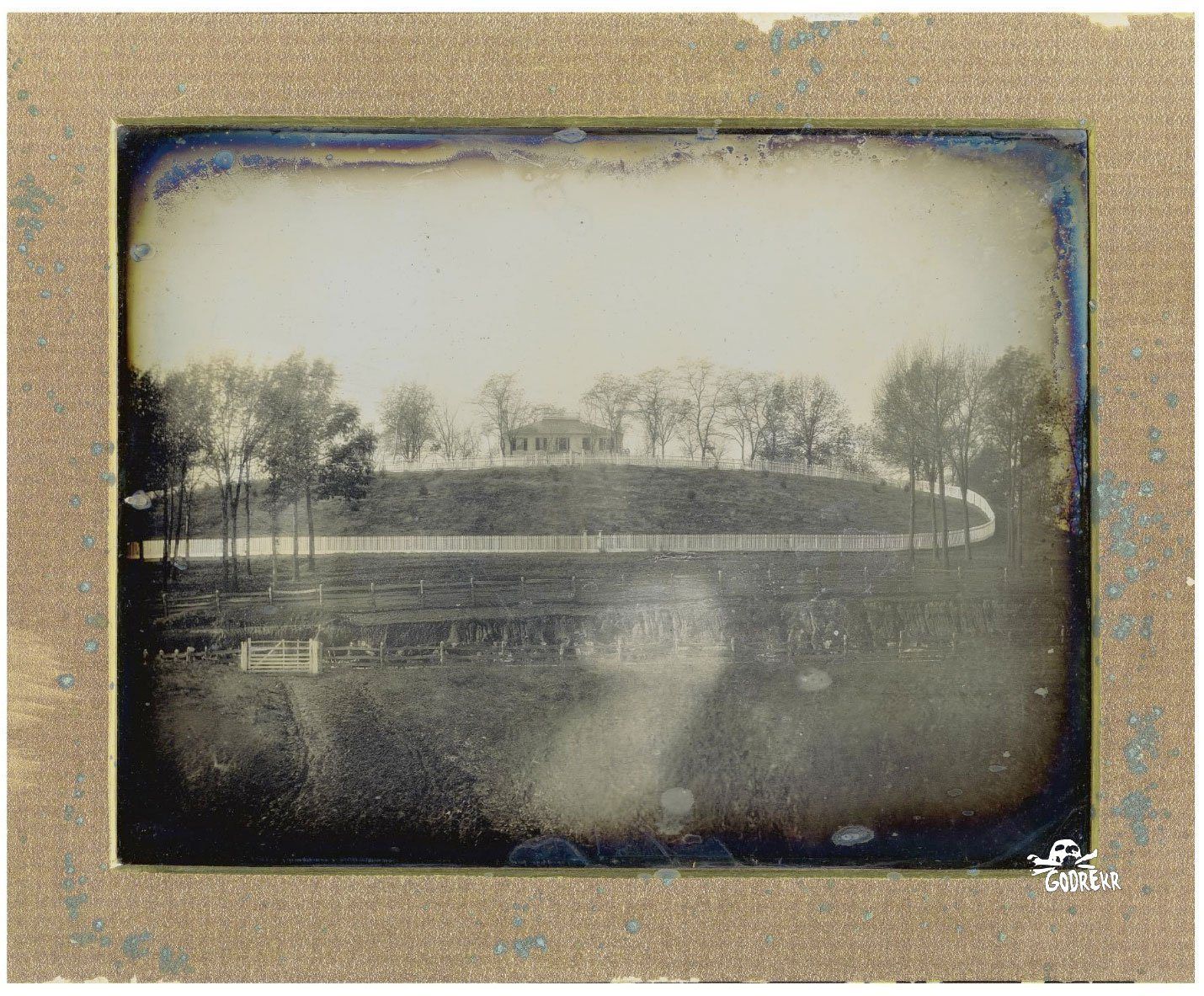 1840s Daguerreotype Is Sold for $62,500 By JENNIFER 8. LEE March 30, 2009 A photo believed to be one of the oldest ever taken in New York City was sold on Monday at Sotheby’s for $62,500 to a buyer who submitted the winning bid by phone, the auction house said. The pre-auction sales estimate was $50,000 to $70,000. The winners were Billy and Jennifer Frist of Nashville. “It’s a very unique, historically significant daguerreotype,” said Mr. Frist, who has been collecting photos since 1993 and is a nephew of Bill Frist, the Tennessee Republican and former Senate majority leader. The picture, believed to date from October 1848 or earlier, shows a white house on a hill with a white picket fence, next to what is believed to be the old Bloomingdale Road, the continuation of Broadway, in what is now the Upper West Side. The photo was discovered at a small New England auction, and the date and location of the image were taken from a note that was folded and placed behind the daguerreotype plate in its original leather case. The note — misspelling the word “magnifying,” among other irregularities — is written in a neat, cursive hand, in dark ink on pale blue paper: “It took a tremendous amount of research to establish where it was,” said Denise Bethel, director of the photography department at Sotheby’s New York. “The clue is the phrase ‘a continuation of Broadway.’ The owner thought the phrase ‘continuation of Broadway’ might indicate it was New York City. That was his best guess. We fanned out and did a lot of research to back him up.” Bloomingdale Road, often referred to as “continuation of Broadway” in the city directories of the day, was one of two main roads that ran up and down the island in the 1700s. The other was Old Boston Road, which is where Park Avenue is now. Bloomingdale Road was named for the Bloemendael area, now the Upper West Side, and cut through hilly terrain in Midtown and Upper Manhattan, from Union Place to Manhattanville. (The road name survived as the name of a restaurant, recently closed, at West 88th and Broadway.) The photo, whose creator is unknown, is unusual because it shows a bucolic scene at a time when daguerreotypes were still an experimental technology. Daguerreotypes, each of which is an in-camera positive image on a polished silvered metal plate, were very popular in the United States in the 1840s and 1850s. They were generally indoor portraits due to the fickleness of weather and outdoor conditions. Early known daguerreotypes of New York City are rare, and those that exist usually focus on the urban setting of buildings in Lower Manhattan, such as Chatham Street (now Park Place) and City Hall Park. “There were so many studios in Manhattan, it has always been a mystery why we don’t have more outdoor daguerreotypes of New York City,” Ms. Bethel said. She said she suspected that such outdoor photos were made but that over time their identifying information was lost. “If we did not have this note, we would simply not know it was New York City,” she said. Source 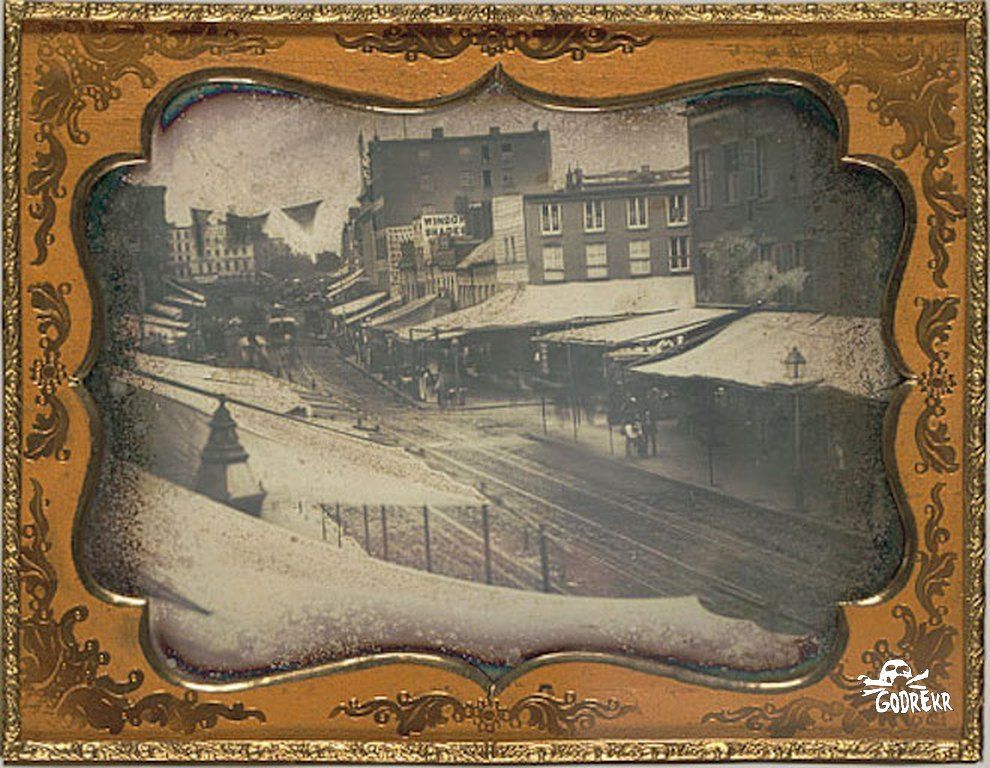 From The NY Times Streetscapes: Lower Manhattan; Rare Daguerrotype Raises Questions By CHRISTOPHER GRAY Published: August 2, 1992 IT is a frustrating puzzle for historians: The photographic process was introduced in New York City from France in 1839, but the earliest views of the city date from 1853. Written accounts describe exhibitions of early daguerreotype views of New York, but none survive, whereas such views exist for Boston, Philadelphia and other cities. Now a Connecticut collector, Joseph Buberger, has cracked the puzzle with a daguerreotype of Chatham Street. But it is a crack that still wants widening, because research indicates the small, silvery image dates from no earlier than 1848. Louis Daguerre perfected the first photographic process in 1839, using a silvered metal plate. Details reached New York City in September 1839 when D.W. Seager exhibited a daguerreotype view of St. Paul's Chapel in a drugstore at 263 Broadway. At about the same time, Samuel F.B. Morse made a daguerreotype of City Hall Park and some sweeping scenes from rooftops. These and other early views have been lost, and the earliest firmly dated photos are usually considered those from wax paper negatives made by Victor Prevost in 1853. This gap has long troubled photo historians. Now Mr. Buberger has announced the discovery of a daguerreotype view of Chatham Street -- later called Park Row -- a few blocks northeast of City Hall. He announced it as the work of a well-known family of daguerreotypists, William, John and Richard Lewis, because their address at the time, 142 Chatham Street, corresponds to the vantage point of the photo. The Lewises were listed as "machinists" at that address beginning in 1843, adding "daguerreotype apparatus" to their directory listing in 1847. They moved out in 1859, dating the photograph as at least between 1847 and 1859, and perhaps as early as 1843. Under such circumstances, it might or might not be earlier than the Prevost negatives. But there was a street-numbering change on Chatham Street. The number of the building from which the daguerreotype was made was, in the mid-19th century, not 142 but about 86 to 96 Chatham. There are only two traceable daguerreotypists at that address, Thomas Yearwood, there only in 1850, and John J. Woodbridge, who is listed as an artist at 90 Chatham Street beginning in 1848 and then as a "daguerrean" from 1851 to 1853. No sign or building changes offer closer dating than that. This discovery, which Mr. Buberger bought from an antiques dealer on behalf of Daniel Wolf, a New York dealer, modestly pushes back the starting date for surviving photography of the city. Woodbridge both lived and worked at 90 Chatham, and his neighbors did the same -- a gold beater at 88, a wig maker at 92 and Perkins and Brother, carpet dealers, in the two-toned building in the center of the daguerreotype at the corner of Pearl and Chatham Streets. TAX records suggest the dark, six-story building in the distance was built in 1837, and over a decade later it is still a skyscraper to its neighbors. Just beyond it, a colonnade forms the front of the Chatham Theater, built in 1839. According to Mary C. Henderson's book "The City and the Theater," this was the site of the New York premiere of "Uncle Tom's Cabin" in 1852 -- perhaps even when this picture was taken. In the distance, the triangular Chatham Square opens up, with East Broadway receding in the center. The area around the Square had been urbanized early in the 19th century and by mid-century was a middle-grade section of open-air auctions, hotels, markets and stores. The entire area has been rebuilt with the Chatham Green housing, Police Plaza and other buildings. By the date of the picture, daguerreotypes had exploded in popularity; research by Jaine Liveson, an intern in the Print Room of the New-York Historical Society, shows there were 50 "daguerreotype likeness" studios in New York City in 1850, most within a few blocks of the Woodbridge/ Yearwood studio. Mr. Buberger believes that since there was little market for street views, the photographer was just "having fun, playing with his equipment." Perhaps it was artist Woodbridge contemplating a career switch to photography; daguerreotype portraits were far more economical. The daguerreotype itself is in the "half plate" format, 4 1/2 by 5 1/2 inches, with an embossed brass border. The image is sharp, but also white and silvery -- tip it one way and the image goes from positive to negative, another way and it just disappears. Mr. Buberger says it is "not really" for sale; he and Mr. Wolf are trying to arrange the gift of the image, which they value at $150,000, to an institution like the New York Historical Society. Photo: A daguerreotype view of Chatham Street made between 1848 and 1853. Pearl Street is at center. (Daniel Wolff, Inc.) Source |