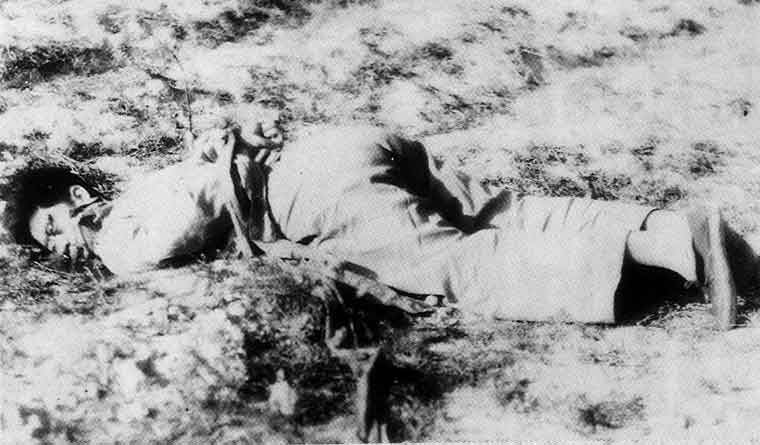
Citizen being killed by the Chinese Nationalist Army in the White Terror after the 228 Incident. 
The 228 Incident, also known as the 228 Massacre, was an anti-government uprising in Taiwan that began on February 27, 1947, and was violently suppressed by the Kuomintang (KMT) government. Estimates of the number of deaths vary from 10,000 to 30,000 or more. The Incident marked the beginning of the Kuomintang's White Terror period in Taiwan, in which thousands more inhabitants vanished, died, or were imprisoned. The number "228" refers to the day the massacre began: February 28, or 02-28.
In 1945, 50 years of Japanese rule ended, and in October the United Nations Relief and Rehabilitation Administration (UNRRA) handed administrative control of Taiwan as a province to the Kuomintang-administered Republic of China (ROC). But one year (12 months) of KMT administration led to the widespread impression that the party was plagued by nepotism, corruption, and economic failure. Tensions increased between inhabitants and the ROC administration. The flashpoint came on February 27 in Taipei, when a dispute between a cigarette vendor and an officer of the Office of Monopoly triggered civil disorder and open rebellion that lasted for days. The uprising was violently put down by the military of the Republic of China.
The subject was officially taboo for decades. On the anniversary of the event in 1995, President Lee Teng-hui addressed the subject publicly, a first for a Taiwanese head of state. The event is now openly discussed and commemorated as Peace Memorial Day (simplified Chinese: 和平纪念日; traditional Chinese: 和平紀念日; pinyin: hépíng jìniànrì), and details of the event have become the subject of investigation. Every February 28, the president of the ROC gathers with other officials to ring a commemorative bell in memory of the victims. The president bows to family members of 2-28 victims and gives each one a certificate officially declaring the family innocent of any crime. Monuments and memorial parks to the victims of 2-28 have been erected in a number of Taiwanese cities, including Kaohsiung and Taipei.