Hydrocephalus; Megacephalus
True congenital hydrocephalus is usually of the internal type with enlarged ventricles. The external form is very rare. Megacephalus must be differentiated from hydrocephalus, the two often being confused in the premature, as previously mentioned in the discussion of Pathology and Rachitis. Internal hydrocephalus results from a transudation or exudation. Obstruction to the outflow may be the cause as in the case of intracranial hemorrhage or cerebellar cysts. However, most of the cases are probably due to an intra-uterine serous meningitis or meningoencephalitis of unknown origin. Syphilis is frequently the cause of congenital hydrocephalus.
The inflammatory process bringing about hydrocephalus may be at end by the time of completion of pregnancy, but usually persists thereafter. Most of the infants show enlargement of the head soon after birth or the enlargement becomes apparent at a later period. When the process begins early, intra-uterine, it may bring about a marked retardation in brain development. The head need not necessarily be enlarged; indeed the head may be small as in a microcephalic. The brain in these cases is really a large cyst. Often the skull is enlarged at birth, and it may hinder labor to such an extent that perforation or puncture of the head becomes necessary.
When the head has the classic hydrocephalic configuration the diagnosis is, of course, easy. In many instances there are also the following symptoms at birth: Hypertonus and spasms of the muscles, increased reflexes, convulsions, psychic disturbances and apathy.
Where the characteristic head is not seen and only slight enlargement of the fontanelle areas is noted, the diagnosis is difficult. Intracranial hemorrhage and meningitis must be ruled out. Lumbar or ventricular puncture is of great assistance.
The prognosis is usually difficult to make early. The only early therapeutic measure is lumbar or ventricular puncture with drawing off of cerebrospinal fluid. Late surgical interference may be indicated.
The term megacephalus is applied to conditions in which the head develops out of proportion to the other body measurements and length. It is characterized by an abnormally large head, with a relatively larger brain. This condition is a characteristic finding in a high percentage of infants prematurely born and is seen in inverse proportion to the fetal age and birth weight. Rosenstern, in a series of sixty-one prematures observed over a period of at least three months, noted megacephalus in forty-four. He concluded that the lower the birth weight of the premature the more likely is megacephalus to develop.
Megacephalus. Baby P. H. at four months:
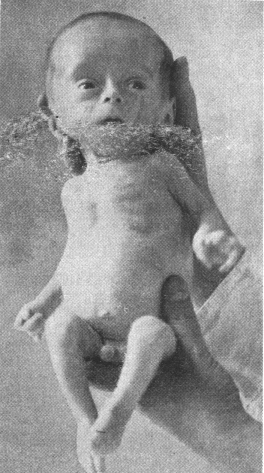
Baby P. H. at six months:

Hydrocephalus. First signs when infant was four weeks old:
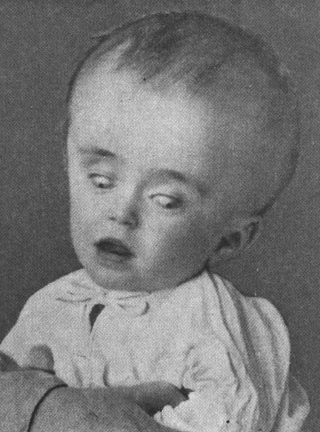
Oxycephalus (Tower skull). Usually associated with other congenital defects and stigmata of degeneration. The skull is dome shape with bulging temporal regions. The deformity was present at birth. It is generally associated with exophthalmos, propotosis and frequently with other ocular abnormalities. Some children are mentally normal. Others subnormal: