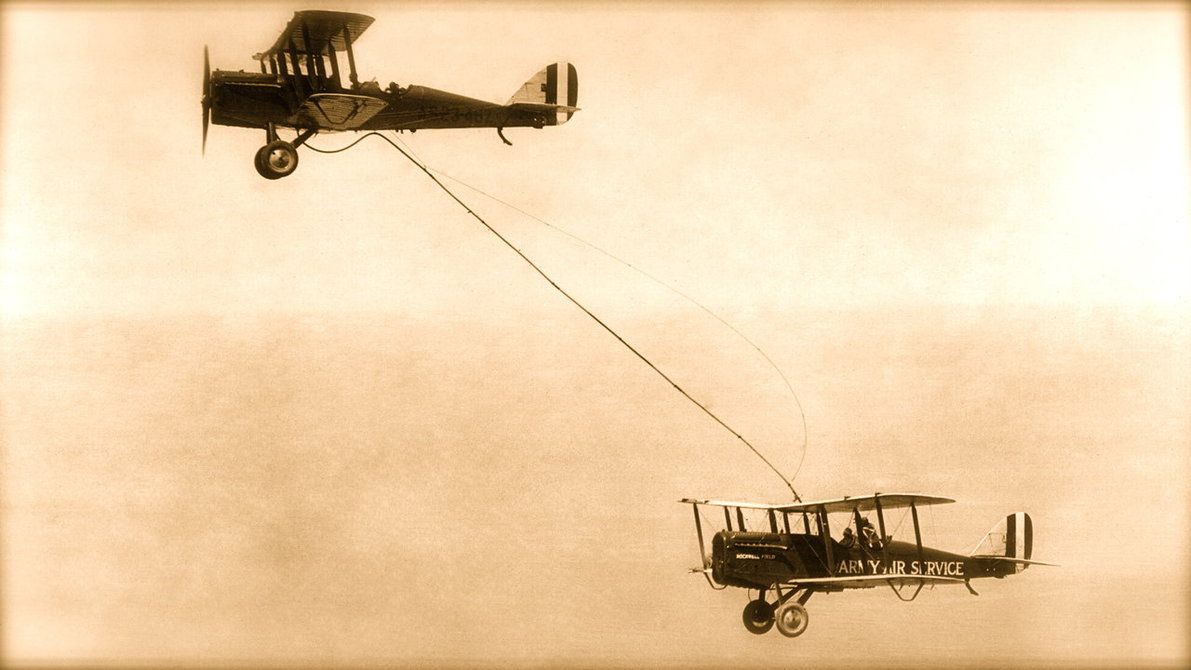
On June 27, 1923, four US Army Air Corps officers with two single-engine bi-planes and a 50-foot hose had a crazy idea, to refuel an airplane mid-flight.
500 feet in the air above a San Diego, California air base, the 4 men successfully conducted the world’s first mid-flight aerial refueling of an airplane.
Convinced that the short range of aircraft at the time could be extended, 1st Lt. Virgil Hine piloted the first plane while 1st Lt. Frank Selfert dangled a hose, which 1st Lt. John Paul Richter managed to grab from a second plane piloted by Capt. Lowell H. Smith.
The 4 airmen successfully transferred 75 gallons of fuel between the two planes, proving that the unusual fete was indeed possible.
Two months later, Smith and Richter attempted the experiment once again, this time setting the record for longest flight, keeping their bi-plane in the air for 37 hours using nine mid-air refuelings.
Two months after that, the practical use of the method was demonstrated when the same crew flew from the Canadian border on the United States’ west coast down to the Mexican border, refueling twice along the way, using the “dangle and grab” method first attempted months earlier.
In 1929, several US military pilots made an even more daring demonstration for their military command, hoping to sell the idea as the future of long-range air warfare.
On New Year’s Day, the airmen managed to stay in the air for 150 hours – nearly seven days.
Their impressive flight, however, was overshadowed later that year by another pair of airmen, who set the still-standing record for the longest flight, staying in the air for 653 hours and 34 minutes – 27 days – while being on the receiving end of 484 plane-to-plane contacts, which delivered fuel, oil, food and spare parts for their aircraft.
The impressive fetes and records set by these early daredevil pilots, however, were not necessarily put into practical use.
The earliest thoughts of the technology being put to operational use was by the British RAF, who in the early 1930s began experimenting with the technique in order to reduce takeoff weight, enabling their planes to use shorter (grass) runways while carrying heavier payloads.
This was necessary at the time to make up for the primitive understanding of aerodynamics being used in airplane design at the time.
For years, however, each time refueling was seriously considered, advances in aviation design made it unnecessary and obsolete.