|
#1
●
04-25-2013, 09:29 AM
|
 My Rank: MAJOR Poster Rank:12 Join Date: Jun 2009 Posts: 93,062
Contributions: 239
93,062Posts 137,684Thanked 2,009Quoted 91Mentioned 239Contrib. |
|
Time-lapse Images Capture Solar Activity Over Three Years
Nasa has released time-lapse images of the Sun, which have been taken over three years, using two images a day. The images are amazingly still despite them being filmed by a spacecraft travelling at 11,000km/h. The second video is the full Nasa vid  |
|
#2
●
04-25-2013, 09:35 AM
|
| My Rank: MAJOR Poster Rank:12 Join Date: Jun 2009 Posts: 93,062
Contributions: 239
93,062Posts 137,684Thanked 2,009Quoted 91Mentioned 239Contrib. |
|
Re: Time-lapse Images Capture Solar Activity Over Three Years
SDO’s Atmospheric Imaging Assembly captures a shot of the sun every 12 seconds in 10 different wavelengths. The images shown here are based on a wavelength of 171 angstroms, which is in the extreme ultraviolet range and shows solar material at around 600,000 kelvins (about 1.08 million F). In this wavelength it is easy to see the sun’s 25-day rotation as well as how solar activity has increased over three years. During the course of the video, the sun subtly increases and decreases in apparent size. This is because the distance between the SDO spacecraft and the sun varies over time. The image is, however, remarkably consistent and stable despite the fact that SDO orbits Earth at 6,876 mph and Earth orbits the sun at 67,062 mph. This image is a composite of 25 separate images spanning the period of April 16, 2012, to April 15, 2013. It uses the SDO AIA wavelength of 171 angstroms and reveals the zones on the sun where active regions are most common during this part of the solar cycle. Click for Extreme High Res: 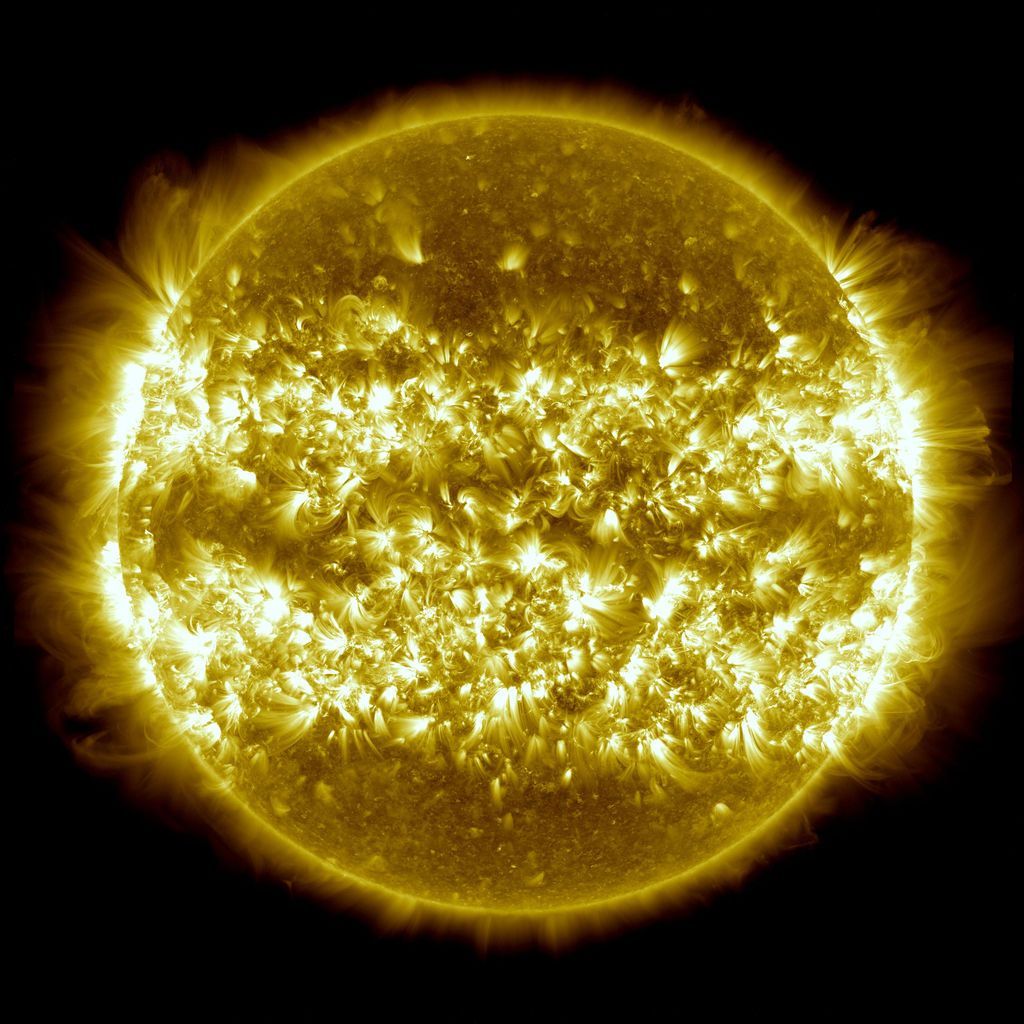 Such stability is crucial for scientists, who use SDO to learn more about our closest star. These images have regularly caught solar flares and coronal mass ejections in the act, types of space weather that can send radiation and solar material toward Earth and interfere with satellites in space. SDO’s glimpses into the violent dance on the sun help scientists understand what causes these giant explosions -- with the hopes of some day improving our ability to predict this space weather. Source |
|
#3
●
04-25-2013, 09:47 AM
|
 ┌∩┐(◣_◢)┌∩ Poster Rank:31 Pointing true north Join Date: Jul 2009 Posts: 48,501 48,501Posts 21,702Thanked 2,806Quoted 13Mentioned 0Contrib. |
|
Re: Time-lapse Images Capture Solar Activity Over Three Years
Last video the music almost put me to sleep but! WOW! Kinda looks like a cool gem!!
|
|
#4
●
04-25-2013, 09:48 AM
|
| My Rank: MAJOR Poster Rank:12 Join Date: Jun 2009 Posts: 93,062
Contributions: 239
93,062Posts 137,684Thanked 2,009Quoted 91Mentioned 239Contrib. |
|
Re: Time-lapse Images Capture Solar Activity Over Three Years
I was thinking the same, it's quite soothing lol Might be a good idea to find the music and pop it on my Mp3 player :)
|