The Three Inca Children - 500 Yo Mummies Reveal Secrets
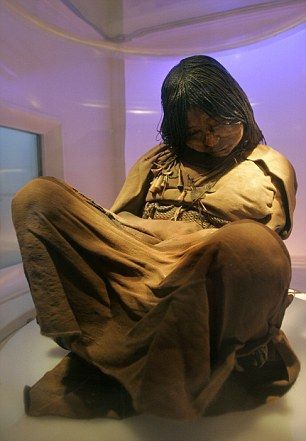
Three Inca children whose 500 year-old mummies were found at the top a 22,000 foot volcano in Argentina were drugged with beer and cocaine before being left to freeze to death as human sacrifices.
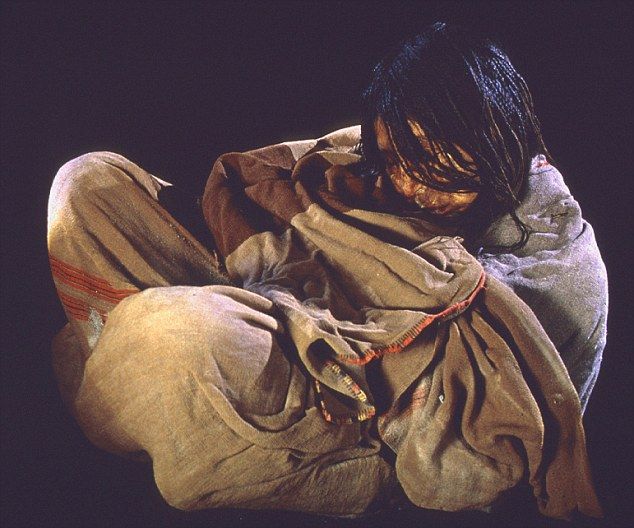
The children included a 13 year-old known as the 'Llullaillaco Maiden' and a boy and girl of about four or five, whose remains were struck by lightning and charred.
According to Inca beliefs, the children served as guardians over their villages from the heights of the mountains.
The trio were brought to the summit of Mount Llullaillco in the Andes which lies near the Chilean border where they were put to death in a ritual called capacocha.
They were well fed and chosen for their beauty and possibly nobility.
Dr Andrew Wilson and his colleagues from Bradford University, were able to trace the children's consumption of coca leaves and chicha - an alcoholic maize beer.
Their study, published in Proceedings of the National Academy of Sciences, compared chemicals found in their hair with its growth rate from scalp to tip over the last 21 months of life.
They found the 13-year-old 'Maiden' consumed more coca and chicha than the two others. The pattern of consumption suggests drugs and alcohol were used to aid her compliance in a ceremony that culminated in her death.
The study paints a picture of the final moments of their lives.
Archaelogist Dr Wilson said: ‘The three bodies discovered separately entombed within a shrine in 1999 make up arguably the best naturally preserved assemblage of mummies found anywhere in the world.
‘What we can be clear of here is the three individuals - children in our terms, although the 13 year-old may have been perceived as belonging to a different age grade than the two younger ones - did not die accidentally and their deaths were commissioned as a central and probably defining element of a capacocha ritual.
‘The frozen remains of the 13 year-old Llullaillaco Maiden, the four to five year-old Llullaillaco Boy and the four to five year-old Lightning Girl provide unusual and valuable analytical opportunities.’
The Maiden's long, tightly braided hair provided a two-year timeline before death during which dramatic dietary changes marked her change in status.
The apparent absence of evidence for direct violence suggests the deaths may have been accomplished in some other ways- possibly painless.
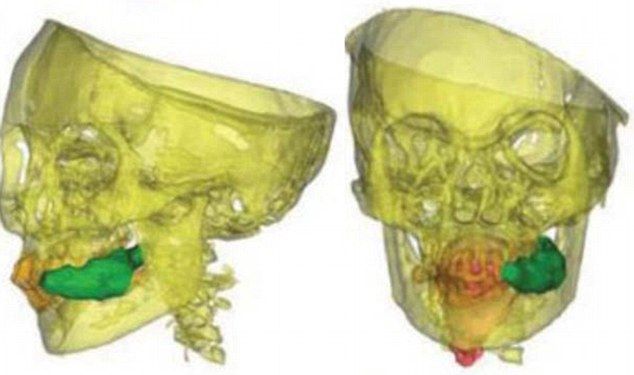
The older girl had pieces of coca leaves on her mouth. They would have fallen asleep from intoxication before they were placed in burial niches where they froze to death in the thin air.
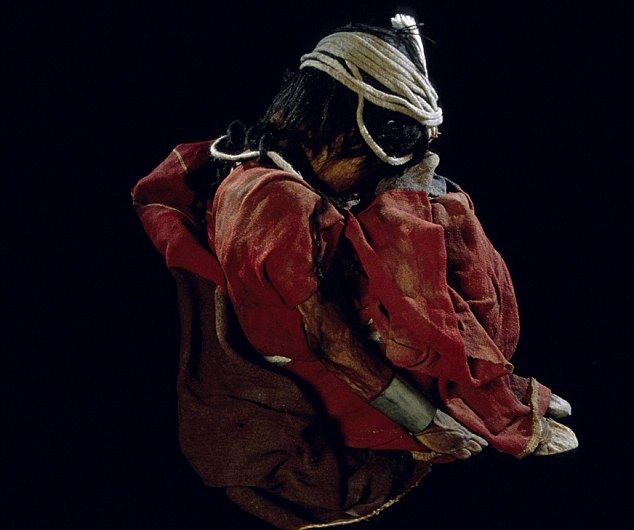
The children wore shoes or slippers as well as colourful clothing elaborately decorated with metal, bone and cords. They were loosely wrapped in shawls and sat cross-legged or crouched as they would have fallen asleep.
The older girl's face - which showed red ochre markings - was creased from the place it rested on her shawl. Among the artifacts placed with them were figurines with headdresses decorated with colourful bird feathers.
Along with the remains of the two younger children the teenager was plucked from the slopes of a cloud swept volcano in 1999 by a team who battled for three days through driving blizzards and 70mph winds to reach the summit.
There, the archaeologists spotted a rectangular walled area, dug down through five feet of rocks and soil and finally uncovered an Inca burial platform.
The three Children of Llullaillaco, who were deep frozen rather than embalmed, were also found with an extraordinary collection of elaborate gold, silver and shell statues, textiles and pots containing food.
Dr Wilson said: ‘At this altitude - being sealed within a ritual structure - meant that death from exposure would have been inevitable in the absence of other proximate causes but the physiological and psychological effects of coca and chicha must have played a role in this extreme environmental context.
‘Understood within the cultural frameworks of Inca religious ideology both were associated with elite ritual practice.
‘Coca and alcohol were substances that induced altered states interpreted as sacred and which could suggest to victims and those associated with them the proximity of the divine beings whose continued benevolence was underwritten by these rites.
‘From a cross-cultural perspective the psychologically deadening, disorienting and mood-modifying effects of these psychoactive compounds on young victims for whom any kind of informed consent to their own deaths cannot be unproblematically presumed should not be downplayed.’