|
#1
●
07-28-2011, 12:56 PM
| ||||||||
 My Rank: MAJOR Poster Rank:190 Join Date: Dec 2009 Posts: 8,081 Mentioned: 0 Post(s) Quoted: 42 Post(s)
| ||||||||
|
New Planetary Nebula Found
New Planetary Nebula Found By Amateur Astronomer Updated: Thursday, 28 Jul 2011, 11:35 AM CDT Published : Thursday, 28 Jul 2011, 11:35 AM CDT Kurt Moore (EndPlay Staff Reports) - A team led by an amateur astronomer has discovered a planetary nebula while helping NASA comb the universe for such sights. Wired reported that Austrian Mattias Kronberger, a member of the amateur astronomy group Deep Sky Hunters, found the nebula while searching a section of sky near the northern constellation Cygnus the Swan. The discovery has been named Kronberger 61 after the 61-year-old star searcher. He found the nebula, which LiveScience describes as shells of gas thrown out by some stars near the end of their lives, while using the National Science Foundation-supported Gemini Observatory. Nebulae form when the nuclear fusion in an old star can not sustain the pressure of gravity. LiveScience stated the star becomes unstable and throws off a shell of gas from its outer layers. That shell is what's called a planetary nebula. It still glows because of the star's radiation. The Milky Way galaxy contains more than 3,000 planetary nebulae. A press release from the Gemini Observatory states that the nebula is within a patch of sky being monitored by NASA's Kepler planet finding mission. The goal of the mission is to determine how often Earth-sized planets are found around Sun-like stars. It enters into a debate over what part stellar companions play in the formation and structure of planetary nebulae. “Explaining the puffs left behind when medium sized stars like our Sun expel their last breaths is a source of heated debate among astronomers, especially the part that companions might play,” Orsola De Marco of Macquarie University in Sydney, Australia stated in the press release. Professional astronomers have teamed up with amateurs to help dedicate the time needed to scan the region and make such finds. “Without this close collaboration with amateurs, this discovery would probably not have been made before the end of the Kepler mission,” George Jacoby of the Giant Magellan Telescope Organization and the Carnegie Observatories, stated in the release. “Professionals, using precious telescope time, aren't as flexible as amateurs who did this using existing data and in their spare time.” Read more: http://www.myfoxhouston.com/dpps/dpg...#ixzz1TQ62PReJ 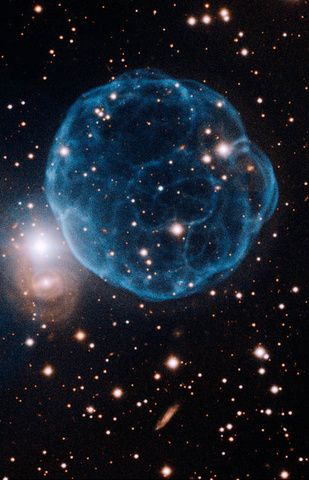 · |