|
#1
●
09-22-2011, 04:41 PM
| ||||||||
 So Fucking Banned Poster Rank:319 dude Join Date: Sep 2011 Posts: 4,085 Mentioned: 0 Post(s) Quoted: 0 Post(s)
| ||||||||
|
Neutrinos Exceed the Speed of Light !
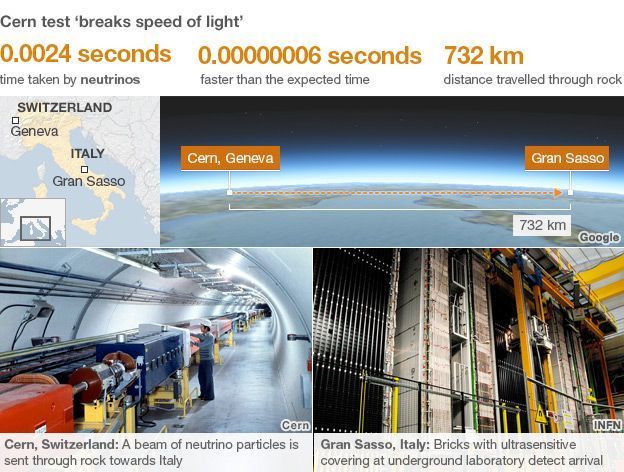
Speed-of-light experiments give baffling result at Cern By Jason Palmer Science and technology reporter, BBC News Gran Sasso sign The neutrinos are fired deep under the Italian Alps at Gran Sasso Continue reading the main story Related Stories Particle 'flips to all flavours' Light-speed trick in stock trades Neutrino beam reveals 'new aspect' of cosmos Puzzling results from Cern, home of the LHC, have confounded physicists - because it appears subatomic particles have exceeded the speed of light. Neutrinos sent through the ground from Cern toward the Gran Sasso laboratory 732km away seemed to show up a tiny fraction of a second early. The result - which threatens to upend a century of physics - will be put online for scrutiny by other scientists. In the meantime, the group says it is being very cautious about its claims. "We tried to find all possible explanations for this," said report author Antonio Ereditato of the Opera collaboration. "We wanted to find a mistake - trivial mistakes, more complicated mistakes, or nasty effects - and we didn't," he told BBC News. "When you don't find anything, then you say 'Well, now I'm forced to go out and ask the community to scrutinise this.'" Caught speeding? The speed of light is the Universe's ultimate speed limit, and much of modern physics - as laid out in part by Albert Einstein in his special theory of relativity - depends on the idea that nothing can exceed it. Thousands of experiments have been undertaken to measure it ever more precisely, and no result has ever spotted a particle breaking the limit. But Dr Ereditato and his colleagues have been carrying out an experiment for the last three years that seems to suggest neutrinos have done just that. Neutrinos come in a number of types, and have recently been seen to switch spontaneously from one type to another. The team prepares a beam of just one type, muon neutrinos, sending them from Cern to an underground laboratory at Gran Sasso in Italy to see how many show up as a different type, tau neutrinos. In the course of doing the experiments, the researchers noticed that the particles showed up a few billionths of a second sooner than light would over the same distance. The team measured the travel times of neutrino bunches some 15,000 times, and have reached a level of statistical significance that in scientific circles would count as a formal discovery. But the group understands that what are known as "systematic errors" could easily make an erroneous result look like a breaking of the ultimate speed limit, and that has motivated them to publish their measurements. "My dream would be that another, independent experiment finds the same thing - then I would be relieved," Dr Ereditato said. But for now, he explained, "we are not claiming things, we want just to be helped by the community in understanding our crazy result - because it is crazy". "And of course the consequences can be very serious." |
|
#6
●
11-21-2011, 09:06 AM
| ||||||||
 *Born Retard* Poster Rank:101 Dude Join Date: Dec 2009 Posts: 16,039 Mentioned: 2 Post(s) Quoted: 57 Post(s)
| ||||||||
|
Re: Neutrinos Exceed the Speed of Light !
Has to be mistake somewhere. No way anything can travel faster than the speed of light. To even achieve the speed of light, a particle would have to assume infinite mass--in other words, infinite energy to even accelerate to that speed. Where are all these infinite somethings coming from? Definitely human error.
|
|
#8
●
11-21-2011, 03:08 PM
| ||||||||
 Super ********* Poster Rank:90 Join Date: Nov 2008 Posts: 17,425 Mentioned: 5 Post(s) Quoted: 99 Post(s)
| ||||||||
|
Re: Neutrinos Exceed the Speed of Light !
what they need is for a different group of scientists to confirm the results through their own separate test
|