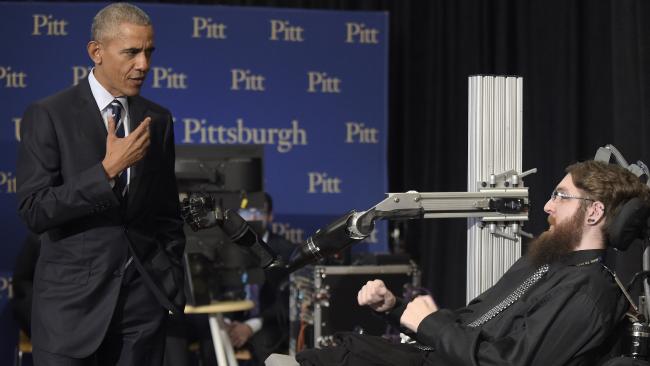
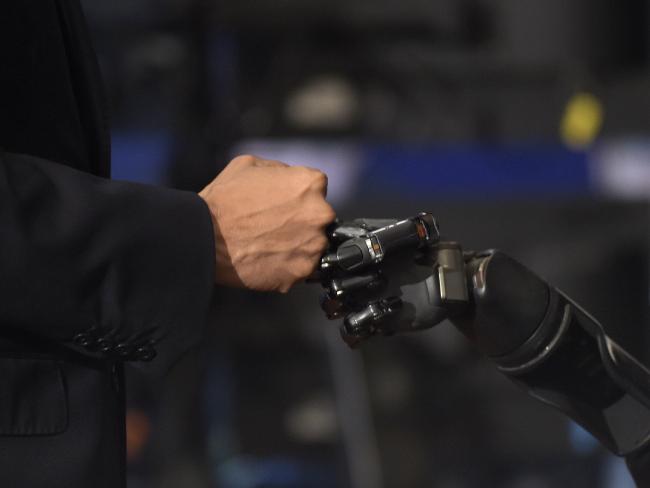
The experiment is an early step in the quest to create prosthetics that can feel.
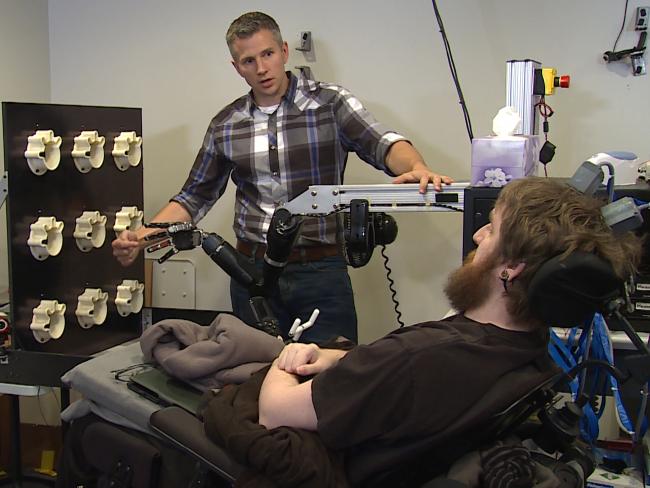
How it works: tiny chips implanted in Nathan Copeland’s brain are bypassing his broken spinal cord, relaying electrical signals that govern movement and sensation to and from that robotic arm.
Mr Copeland broke his neck in a car accident on a rainy night more than 10 years ago, rendering him unable to move or feel his lower arms or legs.
When University of Pittsburgh researchers blindfolded Copeland, he could correctly identify which robotic finger they touched 84 per cent of the time.
“The majority of them, it felt like a pressure or a tingling” in his own corresponding finger, said Copeland, 30, of Dunbar, Pennsylvania.
When a researcher touched two fingers at the same time, “I just laughed and I said, ‘Are you trying to be tricky or something?’”.
Harnessing brain waves to power prosthetics is a hot field, with a goal of giving the disabled more independence and improving artificial limbs for amputees as well.
Headlines in recent years have reported experiments that let paralysed people move a robotic arm to touch a loved one or take a drink simply by imagining the motion.
Their thoughts activate brain implants that relay electrical signals needed to command movement. The signals are transmitted through a computer to the robotic limb.
What’s new is recreating sensation using this brain-controlled technology. After all, proper motion depends on more than muscle movement.
Reach for something and that sense of touch helps you naturally grasp with just enough force to hang on while not either dropping something or crushing it.
Advances in the field of robotics are offering hope to millions with cybernetic limbs now being developed that look, move, and feel like the real thing.
http://www.news.com.au/technology/in...c3b1972b02d37b