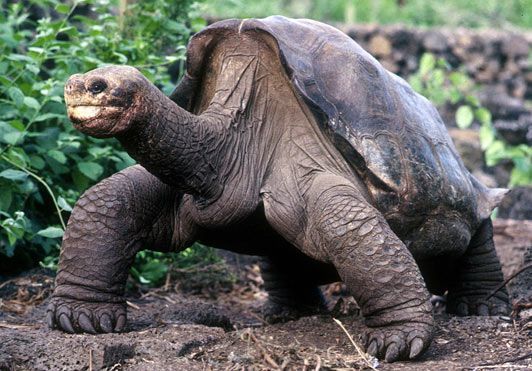
The giant tortoise Lonesome George has been found dead, officials at the Galapagos National Park have said.
George, believed to be the last of his subspecies, was known as one of the rarest animals in the world. The tortoise was thought to be around 100 years old.
His failed efforts to produce offspring made him a symbol of disappearing species.
While his exact age was not known, Lonesome George was estimated to be about 100, which made him a young adult as the subspecies can live up to an age of 200.
Lonesome George was first seen by a Hungarian scientist on the Galapagos island of Pinta in 1972.
Environmentalists had believed his subspecies (Chelonoidis ***** abingdoni) had become extinct.
Lonesome George became part of the Galapagos National Park breeding programme.
After 15 years of living with a female tortoise from the nearby Wolf volcano, Lonesome George did mate, but the eggs were infertile.
He also shared his corral with female tortoises from Espanola island, which are genetically closer to him than those from Wolf volcano, but Lonesome George failed to mate with them.
He became a symbol of the Galapagos Islands, which attract some 180,000 visitors a year.
Galapagos National Park officials said that with George's death, the Pinta tortoise subspecies has become extinct.
They said his body would probably be embalmed to conserve him for future generations.
Tortoises were plentiful on the Galapagos islands until the late 19th century, but were later hunted for their meat by sailors and fishermen to the point of extinction.
Their habitat furthermore suffered when goats were introduced from the mainland.
The differences in appearance between tortoises from different Galapagos islands were among the features which helped the British naturalist Charles Darwin formulate his theory of evolution.
Some 20,000 giant tortoises of other subspecies still live on the Galapagos.