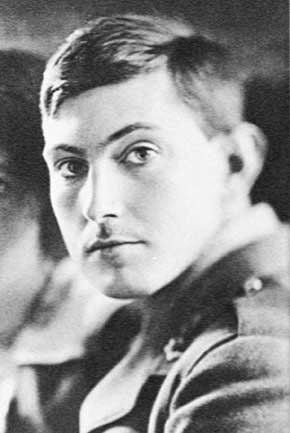
The 1924 British Mount Everest Expedition was—after the 1922 British Mount Everest Expedition—the second expedition with the goal of achieving the first ascent of Mount Everest. After two summit attempts in which Edward Norton set a world altitude record, the mountaineers George Mallory and Andrew "Sandy" Irvine disappeared on the third attempt. Their disappearance has given rise to mountaineering history's most notorious unanswered question: whether or not the pair successfully climbed to the summit. Mallory's body was found in 1999 but the resulting clues did not provide conclusive evidence as to whether the summit was reached.
At the beginning of the 20th century, the British participated in contests to be the first to reach the North and South Poles, without success. A desire to restore national prestige led to scrutiny and discussion of the possibility of "conquering the third pole" – making the first ascent of the highest mountain on Earth.
The southern side of the mountain, which is accessible from Nepal and today is the standard climbing route, was unavailable as Nepal was a "forbidden country" for westerners. Going to the north side was politically complex: it required the persistent intervention of the British-Indian government with the Dalai Lama regime in Tibet to allow British expedition activities. At the time, Tibet was one focus of the "Great Game", a struggle between Russia and Britain for military, political and commercial dominance in Central Asia.
A major handicap of all expeditions to the north side of Mount Everest is the tight time window between the end of winter and the start of the monsoon rains. To travel from Darjeeling in northern India over Sikkim to Tibet, it was necessary to climb high, long snow-laden passes east of the Kangchenjunga area. After this first step, a long journey followed through the valley of the Arun River to the Rongbuk valley near the north face of Mt. Everest. Horses, donkeys, yaks, and dozens of local porters provided transport. The expeditions arrived at Mt. Everest in late April and only had until June before the monsoon began, allowing only six to eight weeks for altitude acclimatization, setting up camps, and the actual climbing attempts.
Two other British expeditions preceded the 1924 effort. The first in 1921 was an exploratory expedition led by Harold Raeburn which described a potential route along the whole northeast ridge. Later George Mallory proposed a longer modified climb to the north col, then along the north ridge to reach the northeast ridge, and then on to the summit. This approach seemed to be the “easiest” terrain to reach the top. After they had discovered access to the base of the north col via the East Rongbuk Glacier, the complete route was explored and appeared to be the superior option. Several attempts on Mallory's proposed route occurred during the 1922 expedition.
After this expedition, insufficient time for preparation and a lack of financial means prevented an expedition in 1923. The Common Everest Committee had lost some 700 pounds in the bankruptcy of the Simla Bank. So the third expedition was postponed until 1924.
Like the two earlier expeditions, the 1924 expedition was also planned, financed and organized by the membership of the Royal Geographic Society, the Alpine Club, and a major contribution by Captain John Noel, who thereby purchased all photographic rights. The Mount Everest Committee which they formed used military strategies with some military personnel.
One important change was the role of the porters. The 1922 expedition recognized several of them were capable of gaining great heights and quickly learning mountaineering skills. The changed climbing strategy which increased their involvement later culminated in an equal partnership of Tenzing Norgay for the first known ascent in 1953 together with Edmund Hillary. The gradual reversal in the system of “Sahib - Porter” from the earliest expeditions eventually led to a “professional - client” situation where the Sherpa “porters” are the real strong mountaineering professionals and the westerners mainly weaker clients.
Like the 1922 expedition, the 1924 expedition also brought bottled oxygen to the mountain. The oxygen equipment had been improved during the two intervening years, but was still not very reliable. Also there was no real clear agreement whether to use this assistance at all. It was the start of a discussion which still lasts today: the “sporting” arguments intend to climb Everest “by fair means” without the technical measure which reduces the effects of high altitude by a couple thousand metres.
While Somervell and Norton ascended, Mallory and Bruce had climbed down to Camp III (ABC)and returned to the North Col with oxygen. Mallory selected Sandy Irvine as his climbing partner for this climb. Since Norton was the expedition leader after the illness of Bruce, and Mallory was the chief climber, he decided not to challenge Mallory’s plan, in spite of Irvine's inexperience in high-altitude climbing. Irvine was not chosen primarily for his climbing abilities. Rather it was due to his practical skill with the oxygen equipment. Mallory and Irvine had also become fast friends since they shared a lot of time aboard ship to India, and Mallory considered the personable 22-year old as "strong as an ox."
On June 5 they were in Camp IV. At 8:40 a.m. of the following day they reached Camp V with five porters, and on June 7 ascended to Camp VI. Odell and one porter went to Camp V to support the summit team. Shortly after Odell's arrival in Camp V, four porters of the Mallory team came down, sent by Mallory. They handed over a message from Mallory to Odell with an estimated time of their arrival on the ridge.
Dear Noel,
We'll probably start early to-morrow (8th) in order to have clear weather. It won't be too early to start looking out for us either crossing the rockband under the pyramid or going up skyline at 8.0 p.m.
Yours ever
G Mallory
(Mallory really meant 8 a.m., not 8 p.m.)
On the morning of June 8, Odell started an ascent to make geological studies. The mountain was swept by mists so he could not see the NE Ridge clearly along which Mallory and Irvine intended to climb. At 7900m (26,000-ft) he climbed over a small outcropping. At 12:50, the mists suddenly cleared. Odell noted in his diary that he saw Mallory and Irvine just below the NE Ridge when they reached the foot of the Second Step—and surmounted it (in about 5 minutes). In a first report on July 5 to The Times he clarified this view. He saw the summit, the ridge and the final pyramid of Mt. Everest. His eyes caught a tiny black dot which moved on a snowy area below the Second Step. A second black dot was moving toward the first one. The first dot reached the crest of the ridge ("broke skyline"). He could not be certain if the second dot also did so.
Odell's initial opinion was that the two climbers had reached the base of the Second Step. He was concerned because Mallory and Irvine seemed to be five hours behind their schedule. After this sighting, Odell continued on to Camp VI where he found the tent in chaotic disorder. At 2pm an intense snow squall began. Odell went out in the squall hoping to signal the two climbers who he believed would by now be descending. He whistled and shouted, hoping to lead them back to the tent, but gave up because of the intense cold. Odell holed up in C-VI until the squall ended at 4pm. He then scanned the mountain for Mallory and Irvine but saw no one.
Because the single C-VI tent could only sleep two, Mallory had advised Odell to leave Camp VI and return to Camp IV on the North Col. Odell left C-VI at 4:30 p.m. arrived at C-IV at 6:45 p.m. As they had not seen any sign from Mallory and Irvine then or the next day, Odell again climbed up the mountain together with two porters. Around 3:30 p.m., they arrived at Camp V and stayed for the night. The following day Odell again went alone to Camp VI which he found unchanged. He then climbed up to around 8200m but could not see any trace of the two missing climbers. In Camp VI he laid two sleeping bags out in a T form on the snow which was the signal for "No trace can be found, Given up hope, Awaiting orders" to the advanced base camp. Odell climbed down to Camp IV. In the morning of June 11 they started to leave the mountain by climbing down the icy slopes of north col to end the expedition. Five days later they said goodbye to the Lama at Rongbuk Monastery.
The opinion of the Everest climbing community began to challenge the location Odell must have seen the two climbers. Many thought the Second Step if not unclimbable, at least not being climbable in the five minutes Odell says he saw one of the two surmount it. After the expedition, Odell was privately certain that Mallory and Irvine had reached the summit of Mount Everest. Key to this belief was the spot where he had seen the two climbers, and his evaluation of their fitness and strength. However, under social pressure from the climbing community Odell varied his opinion on several occasions as to the very spot where he had seen the two black dots. Most climbers believe he must have seen them climbing the far easier First Step. In the expedition report he wrote that the climbers were on the second-to-last step below the summit pyramid, indicating the famous and more difficult Second Step. Odell's account of the weather situation also varied. At first, he described that he could see the whole ridge and the summit. Later, he said that only a part of the ridge was free of mist. After viewing photographs of the 1933 expedition, Odell again said that he might have seen the two climbers at the Second Step. In 1988, he admitted that since 1924 he had never been clear about the exact location along the northeast ridge where he had seen the black dots.
A recent theory suggests the two climbers were cresting the First Step after they had given up their climb and were already on the descent. They scrambled up the small hillock in order to take photographs of the remaining route, much as the French did in 1981, when they too were blocked from further progress.
Odell discovered the first evidence which might reveal something about the climb of Mallory and Irvine among the equipment in camps V and VI. In addition to Mallory's compass, which normally was a critical component for climbing activities, he discovered some oxygen bottles and spare parts. This situation suggesting the possibility that there had been a problem with the oxygen equipment which might have caused a delayed start in the morning. A hand-generator electric lamp also remained in the tent – it was still in working order when it was found by the Ruttledge expedition nine years later.
During their assault in the 1933 British Mount Everest expedition, Wynn Harris found the ice axe of Irvine some 250 yards (230 metres) east of the First Step and 60-ft (20 metres) below the ridge. This location raises additional questions. The area is a 30-degree slab of rock with loose pebbles, according to Wynn Harris. Expedition leader Hugh Rutledge says: "We have naturally paid close attention to the problem. Firstly, it seems probable that the axe marked the scene of a fatal accident. For reasons already given, neither climber would be likely to abandon it deliberately on the slabs..." "...its presence there would seem to indicate that it was accidentally dropped when a slip occurred or that its owner put it down in order to have both hands free to hold the rope." Everest, 1933, p 145.
On the second summit climb of the Chinese in 1975, the Chinese mountaineer Wang Hong Bao saw an "English dead" (body) at 8,100 m (26,575 ft). This news was officially denied by the Chinese Mountaineering Association (CMA), but this report to a Japanese climber, who passed it on to Tom Holzel led to the first Mallory and Irvine Research Expedition in 1986, which was unsuccessful due to bad weather.
In 1999, a new search expedition was mounted, founded by German Everest researcher Jochen Hemmleb, and led by Eric Simonson. Simonson had seen some very old oxygen bottles near the First Step during his first summit climb in 1991. One of these bottles was again found in 1999 and was one belonging to Mallory and Irvine, thus proving the two climbed at least as high as shortly below the First Step. Their location also suggests a climbing speed of approximately 275 vert-ft/hr, good time for the altitude and an indication the oxygen systems were working perfectly. The expedition also tried to reproduce Odell's position when he had seen Mallory and Irvine. The mountaineer Andy Politz later reported that they could clearly identify each of the three steps without any problems.
The most remarkable finding was the corpse of George Leigh Mallory at a height of 8,159 metres (26,768 ft). The lack of extreme injuries indicated he had not tumbled very far. His waist showed severe rope-jerk mottling, showing the two had been roped when they fell. Mallory's injuries were such that a walking descent was impossible: his right foot was nearly broken off and there was a golf ball-sized puncture wound in his forehead. Even though his unbroken leg was on top of the broken one, as if to protect it, Mass. General Hospital neurosurgeon Dr. Elliot Schwamm believes it not possible that he would have been conscious after the forehead injury. There was no oxygen equipment near the body, but the oxygen bottles would have been empty by that time and discarded at a higher altitude to relinquish the heavy load. Mallory was not wearing snow goggles, although a pair was stored in his vest, which may indicate that he was on the way back by night. However, a contemporary photograph shows he had two sets of goggles when he started his summit climb. The image of his wife Ruth which he intended to put on the summit was not in his vest. He carried the picture throughout the whole expedition—a sign that he might have reached the top. Since his Kodak pocket camera was not found, there is no proof of a successful climb to the summit.
From 1924 to this day, there are supporting claims and rumors that Mallory and Irvine had been successful and so were actually the first to summit Mount Everest. One counter argument claims that their fleece, vests and trousers were too poor quality. In 2006, Graham Hoyland climbed to 21,000 ft. in an exact reproduction of Mallory's original clothing. He said that it functioned very well and was quite comfortable.
However, human thermo-regulation expert Professor George Havenith of Loughborough University (UK), has tested a rigorously accurate recreation of Mallory's clothing in a weather chamber. His conclusion: "If the wind speed had picked up, a common feature of weather on Everest, the insulation of the clothing would only just be sufficient to minus -10C [+14F]. Mallory would not have survived any deterioration in conditions."
Odell's sighting is of especially high interest. The description of Odell's sighting and the current knowledge indicate Mallory's 5-minute surmounting of the Second Step is unlikely. This wall cannot be climbed as fast as described by Odell. Only the first and the third step can be climbed quickly. Odell said that they were at the foot of the summit pyramid, which contradicts a location at the First Step, but it is unlikely the pair could have started early enough to reach the Third Step by 12:50 p.m. Since the First Step is far away from the Third Step, confusing them is also not likely. One suggestion proposes Odell confused a sighting of birds for climbers—a result which occurred with Eric Shipton in 1933.
This speculation also involves theories concerning whether Mallory and Irvine could have managed to climb the Second Step. Oscar Cadiach was the first to climb it in 1985 free and rated it V+. Conrad Anker led an experiment to free climb this section without using the “Chinese ladder” for assistance, since that equipment was not installed in 1924. In 1999, he did not manage a complete free climb as he put one foot briefly on the ladder when it blocked the only available foothold. At that time he rated the difficulty of the Second Step as 5.10—well outside of Mallory's capability. In June 2007, Anker returned as a member of the Altitude Everest Expedition 2007, and with Leo Houlding successfully free-climbed the Second Step, after removing the "Chinese ladder" (which was later replaced). Houlding rated the climb at 5.9, just within Mallory's estimated capabilities. Theo Fritsche climbed the step free solo on-sight in 2001 and rated it V+.
An argument against the possible summit claim is the long distance from high camp VI to the summit. It is normally not possible to reach the summit before dark after starting in daylight. It was not until 1990 that Ed Viesturs was able to reach the top from an equivalent distance as Mallory and Irvine planned. In addition, Viesturs knew the route, while for Mallory and Irvine it was completely unknown territory. Finally, Irvine was not an experienced climber and it is considered unlikely that Mallory had put his friend into such danger or would have aimed for the summit without calculating the risks.
How and where exactly the two climbers lost their lives is still unknown.
Modern climbers who take a very similar route start their summit bid from high camp at 8,300 m (27,230 ft) around midnight to avoid the risk of a second night on the descent or a highly risky bivouac without the protection of a tent. They also use headlamps during the dark, a technology which was not used by the early British climbers.