|
#1
●
01-26-2011, 03:03 PM
| ||||||||
 Satan's Playground Poster Rank:168 Southern Bell Join Date: Sep 2009 Posts: 9,382 Mentioned: 31 Post(s) Quoted: 157 Post(s)
| ||||||||
|
Wolff-Parkinson-White Syndrome
My boyfriend and I just found out that he has his rare heart problem. In the left illustration, the arrows represent electrical signals beginning at the sinus node or "spark plug" in the heart, activating both atria and then passing through the atrioventricular (AV) node, or "relay station," on the way to the ventricles. The panel below the heart is a typical electrocardiogram (ECG or EKG) recording of a normal heart rhythm Wolff-Parkinson-White syndrome — In the right illustration of the heart, the arrows represent the path of electrical activity. The accessory pathway is an abnormal "bridge" of tissue that allows the heart's electrical impulse to travel in a circular pattern from the ventricles to the atria. The panels below the heart are typical electrocardiogram recordings from a heart with WPW with an accessory pathway (left) and a heart with tachycardia (right). 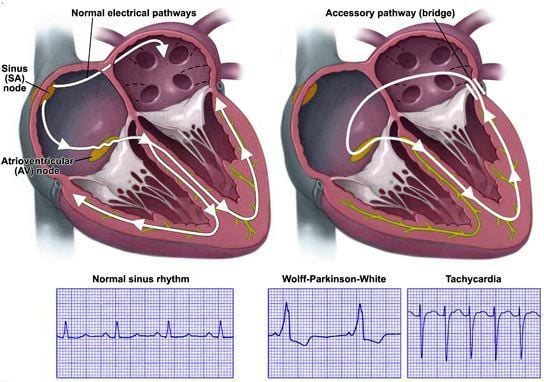 · |
|
#4
●
01-26-2011, 04:20 PM
| ||||||||
 ★Wizard Of Gore★ Poster Rank:2 Join Date: Aug 2009 Posts: 127,808
Contributions: 1
Mentioned: 457 Post(s) Quoted: 30201 Post(s)
| ||||||||
|
Re: Wolff-Parkinson-White Syndrome
Sorry to hear that, Butterfly. Thankfully, this disease has an extremely low mortality rate and can be treated with medications or at worst, a pacemaker. I know a pacemaker sounds frightening, but my mother had one installed back in October. She was out of the hospital the same day as her surgery and she is 78 years old. I hope all goes well for him!!!  |
|
#6
●
01-26-2011, 05:01 PM
| ||||||||
| Satan's Playground Poster Rank:168 Southern Bell Join Date: Sep 2009 Posts: 9,382 Mentioned: 31 Post(s) Quoted: 157 Post(s)
| ||||||||
|
Re: Wolff-Parkinson-White Syndrome
If you don't understand what it is: Wolff-Parkinson-White Syndrome What is the heart's normal condition? In a normal heart, electrical signals use only one path when they move through the heart. This is the atrio-ventricular or A-V node. As the electrical signal moves from the heart's upper chambers (the atria) to the lower chambers (the ventricles), it causes the heart to beat. For the heart to beat properly, the timing of the electrical signal is important. What is the Wolff-Parkinson-White syndrome? If there's an extra conduction pathway, the electrical signal may arrive at the ventricles too soon. This condition is called Wolff-Parkinson-White syndrome (WPW). It's in a category of electrical abnormalities called "pre-excitation syndromes." It's recognized by certain changes on the electrocardiogram, which is a graphical record of the heart's electrical activity. The ECG will show that an extra pathway or shortcut exists from the atria to the ventricles. Many people with this syndrome who have symptoms or episodes of tachycardia (rapid heart rhythm) may have dizziness, chest palpitations, fainting or, rarely, cardiac arrest. Other people with WPW never have tachycardia or other symptoms. About 80 percent of people with symptoms first have them between the ages of 11 and 50. How is this syndrome treated? People without symptoms usually don't need treatment. People with episodes of tachycardia can often be treated with medication. But sometimes such treatment doesn't work. Then they'll need to have more tests of their heart's electrical system. The most common procedure used to interrupt the abnormal pathway is radiofrequency or catheter ablation. In this, a flexible tube called a catheter is guided to the place where the problem exists. Then that tissue is destroyed with radiofrequency energy, stopping the electrical pathway. Successful ablation ends the need for medication. Whether a person will be treated with medication or with an ablation procedure depends on several factors. These include the severity and frequency of symptoms, risk for future arrhythmias and patient preference. |
|
#7
●
01-26-2011, 06:44 PM
| ||||||||
 Narcissist Psycho ****** Poster Rank:8 Supreme Queer Overlord Join Date: Sep 2009 Posts: 101,166
Contributions: 2
Mentioned: 199 Post(s) Quoted: 50371 Post(s)
| ||||||||
|
Re: Wolff-Parkinson-White Syndrome
At least it's treatable and from the context of your post it seems like you two are optimistic and he is doing well.
|
|
#10
●
01-27-2011, 06:56 AM
| ||||||||
 So Fucking Banned Poster Rank:313 Male Join Date: Mar 2010 Posts: 4,167 Mentioned: 0 Post(s) Quoted: 0 Post(s)
| ||||||||
|
Re: Wolff-Parkinson-White Syndrome
Sorry to hear that Butterfly but from all indications it is something that can be treated and he will live a long life. Wish you two all the best
|