|
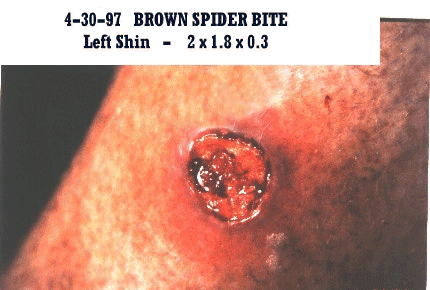
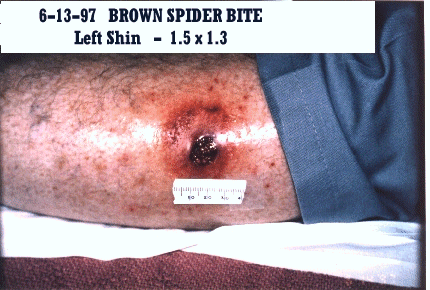
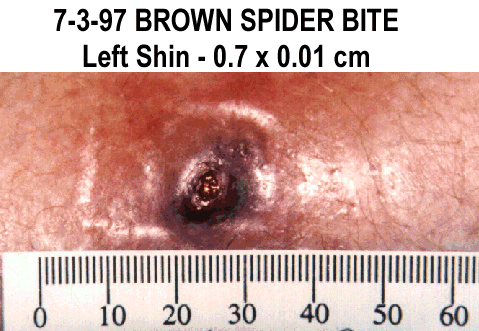
This is What A Brown Recluse Spider Bite Looks Like
The brown recluse spider or violin spider, Loxosceles reclusa, is a well-known member of the family Sicariidae (formerly placed in a family "Loxoscelidae").
Brown recluse spiders are usually between 6–20 mm , but may grow larger. They may be brown, gray, or a deep yellow color and usually have markings on the dorsal side of their cephalothorax, with a black line coming from it that looks like a violin with the neck of the violin pointing to the rear of the spider, resulting in the nicknames fiddleback spider, brown fiddler or violin spider.
Recluse spiders build irregular webs that frequently include a shelter consisting of disorderly threads. These spiders frequently build their webs in woodpiles and sheds, closets, beds, garages, plenum, cellars and other places that are dry and generally undisturbed. They seem to favor cardboard when dwelling in human residences, possibly because it mimics the rotting tree bark which they inhabit naturally.
They also have been encountered in shoes, inside dressers, in bed sheets of infrequently used beds, in stacks or piles of clothes, behind baseboards and pictures, and near sources of warmth when ambient temperatures are lower than usual. Human-recluse contact often is when such isolated spaces are disturbed and the spider feels threatened. Unlike most web weavers, they leave these webs at night to hunt. Males will move around more when hunting, while the female spiders tend to remain nearer to their webs.
The brown recluse spider is native to the United States from the southern Midwest south to the Gulf of Mexico. The native range lies roughly south of a line from southeastern Nebraska through southern Iowa, Illinois, and Indiana to southwestern Ohio.
In the southern states, it is native from central Texas to western Georgia north of Virginia. A related species, the brown violin spider (Loxosceles rufescens), is found in Hawaii. Despite many rumors to the contrary, the brown recluse spider has not established itself in California. There are other species of Loxosceles native to the southwestern part of the United States, including California, that may resemble the brown recluse, but these species have never been documented as physiologically significant. Bite treatment
First aid involves the application of an ice pack to control inflammation, the application of aloe vera to soothe and help control the pain, and prompt medical care. If it can be easily captured, the spider should be brought with the patient in a clear, tightly closed container so it may be identified.
There is no established treatment for necrosis. Routine treatment should include elevation and immobilization of the affected limb, application of ice, local wound care, and tetanus prophylaxis. Many other therapies have been used with varying degrees of success including hyperbaric oxygen, dapsone, antihistamines (e.g., cyproheptadine), antibiotics, dextran, glucocorticoids, vasodilators, heparin, nitroglycerin, electric shock, curettage, surgical excision, and antivenom.[16][17] None of these treatments have been subjected to randomized controlled trials to conclusively show benefit. In almost all cases, bites are self-limited and typically heal without any medical intervention.
It is important to seek medical treatment if a brown recluse bite is suspected, as in the rare cases of necrosis the effects can quickly spread, particularly when the venom reaches a blood vessel. Cases of brown recluse venom traveling along a limb through a vein or artery are rare, but the resulting mortification of the tissue can affect an area as large as several inches, to the extreme of requiring excising of the wound.
Dapsone is commonly used in the USA and Brazil for the treatment of necrosis. In presumed cases of recluse bites, dapsone is often used effectively, but controlled clinical trials do not demonstrate similar effectiveness; however, dapsone may be effective at treating many "spider bites" because many such cases are actually misdiagnosed microbial infections. There have been conflicting reports about its efficacy and some have suggested it should no longer be used routinely, if at all
Wound infection is rare. Antibiotics are not recommended unless there is a credible diagnosis of infection.
Studies have shown surgical intervention is ineffective and may worsen outcome. Excision may delay wound healing, cause abscesses, and lead to objectionable scarring.
Anecdotal evidence suggests benefit can be gained with the application of nitroglycerin patches.[22] The brown recluse venom is a vasoconstrictor, and nitroglycerin causes vasodilation, allowing the venom to be diluted into the bloodstream, and fresh blood to flow to the wound. Theoretically this prevents necrosis, as vasoconstriction may contribute to necrosis. However, one scientific animal study found no benefit in preventing necrosis, with results showing it increased inflammation and it caused symptoms of systemic envenoming. The authors concluded the results of the study did not support the use of topical nitroglycerin in brown recluse envenoming.
Antivenom, available in South America for the venom of other species of recluse spiders, appears to be the most promising therapy. However, antivenoms are most effective if given early and because of the painless bite patients do not often present until 24 or more hours after the event, possibly limiting the effect of this intervention.
It is estimated that 80% of reported brown recluse bites may be misdiagnosed. The misdiagnosis of a wound as a brown recluse bite could delay proper treatment of serious diseases. There is now an ELISA-based test for brown recluse venom that can determine if a wound is a brown recluse bite, although it is not commercially available and not in routine use.
There are numerous documented infectious and noninfectious conditions (including pyoderma gangrenosum, bacterial infections by Staphylococcus and Streptococcus, herpes, diabetic ulcer, fungal infections, chemical burns, toxicodendron dermatitis, squamous cell carcinoma, localized vasculitis, syphilis, toxic epidermal necrolysis, sporotrichosis, and Lyme disease) that produce wounds that have been initially misdiagnosed as recluse bites by medical professionals; many of these conditions are far more common and more likely to be the source of mysterious necrotic wounds, even in areas where recluses actually occur.
Reported cases of bites occur primarily in Arkansas, Texas, Kansas, Missouri, Colorado, Nebraska and Oklahoma. There have been many reports of brown recluse bites in California (and elsewhere outside the range of the brown recluse. (though a few related species may be found there, none of which has been shown to bite humans). To date, the reports of bites from areas outside of the spider's native range have been either unverified, or—if verified—specimens moved by travelers or commerce. Gertsch and Ennik (1983) report that occasional spiders have been intercepted in various locations where they have no known established populations; Arizona, California, Colorado, Florida, Maine, Minnesota, New Jersey, Mexico, New York, North Carolina, Wyoming and Tamaulipas (Mexico), which indicates that these spiders may indeed be transported fairly easily, though the lack of established populations well outside the natural range also indicates that such movement does not lead to colonization of new areas. Many arachnologists believe that many bites attributed to the brown recluse in the West Coast are not spider bites at all, or possibly instead the bites of other spider species; for example, the bite of the hobo spider has been reported to produce similar symptoms, and is found in the northwestern United States and southern British Columbia. However, the toxicity of the hobo spider has been called into question as bites have not been proven to cause necrosis, and the spider is not considered a problem in Europe. In addition, published work has shown that tick-induced Lyme disease rashes are often misidentified as brown recluse spider bites. ... |