JavaScript and Cookies are required to view this site. Please enable both in your browser settings.
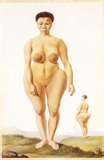
This is from wikipedia: Sarah Baartman A caricature of Baartman drawn in the early 19th century, photo below Born Before 1790[1] Near Gamtoos River, Eastern Cape, Dutch Empire Died 29 December 1815(1815-12-29) Paris, France Resting place Vergaderingskop, Hankey, Eastern Cape, South Africa 33°50′14″S 24°53′05″E / 33.8372°S 24.8848°E / -33.8372; 24.8848Coordinates: 33°50′14″S 24°53′05″E / 33.8372°S 24.8848°E / -33.8372; 24.8848 Other names Hottentot Venus Ethnicity Khoikhoi Occupation "freak show" performer Sarah "Saartjie" Baartman (before 1790 – 29 December 1815)[1] (also spelled Bartman, Bartmann, Baartmen) was the most famous of at least two Khoikhoi women who were exhibited as freak show attractions in 19th-century Europe under the name Hottentot Venus—"Hottentot" as the then-current name for the Khoi people, now considered an offensive term,[2] and "Venus" in reference to the Roman goddess of love. Contents 1 Southern Africa 2 Great Britain 3 France 4 Death and legacy 5 Cultural references 6 See also 7 Bibliography 8 Footnotes 9 References 10 External links Southern Africa Sarah Baartman was born to a Khoisan family in the vicinity of the Gamtoos River in what is now the Eastern Cape of South Africa.[2] She was orphaned in a commando raid. Saartjie, pronounced "Sahr-kee", is the diminutive form of her name; in Afrikaans the use of the diminutive form commonly indicates familiarity, endearment or contempt. Her birth name is unknown. Baartman was a slave[2][3][4] of Dutch farmers near Cape Town when Hendrick Cezar, the brother of her slave owner, suggested that she travel to England for exhibition, promising her that she would become wealthy. Lord Caledon, governor of the Cape, gave permission for the trip, but later regretted it after he fully learned its purpose. She left for London in 1810. Great Britain Baartman was exhibited first in London, entertaining people by showing what were thought of as highly unusual bodily features. She had large buttocks (steatopygia) and also the elongated labia of some Khoisan women. To quote historian of science Stephen Jay Gould, "The labia minora, or inner lips, of the ordinary female genitalia are greatly enlarged in Khoi-San women, and may hang down three or four inches below the vulva when women stand, thus giving the impression of a separate and enveloping curtain of skin".[5] Baartman never allowed this trait to be exhibited while she was alive,[6] and an account of her appearance in London in 1810 makes it clear that she was wearing a garment, although a tight-fitting one.[7] Her exhibition in London, scant years after the passing of the Slave Trade Act 1807, created a scandal. An abolitionist benevolent society called the African Association – the equivalent of a charity or pressure group – conducted a newspaper campaign for her release. Hendrick Cezar in an answer protested that Baartman was entitled to earn her living by this means: "...has she not as good a right to exhibit herself as an Irish Giant or a Dwarf?".[8] The African Association took the matter to court and on 24 November 1810 at the Court of King's Bench the Attorney-General began the attempt 'to give her liberty to say whether she was exhibited by her own consent'. In support he produced two affidavits in court. The first, from a Mr Bullock of Liverpool Museum, was intended to show Baartman had been brought to Britain by persons who referred to her as if she were property. The second, by the Secretary of the African Association, described the degrading conditions under which she was exhibited and also gave evidence of coercion.[7] Baartman was questioned before a court in Dutch, in which she was fluent, and stated that she was not under restraint and understood perfectly that she was guaranteed half of the profits. The conditions under which she made these statements are suspect, because it directly contradicts accounts of her exhibitions made by Zachary Macaulay of the African Institution and other eyewitnesses.[6] A written contract was also produced by Dunlop, though this is considered by modern commentators as a legal subterfuge.[8] Ironically the publicity given by the court case increased Baartman's popularity as an exhibit.[8] She later toured other parts of Britain and visited Ireland.[8] On 1 December 1811 Baartman was christened at Manchester Cathedral.[9][10] France Baartman was sold[citation needed] to a Frenchman, who took her to his country.[11] An animal trainer, S. Réaux, exhibited her under more pressured conditions for fifteen months. French naturalists, among them Georges Cuvier, head keeper of the menagerie at the Muséum national d'Histoire naturelle, visited her. She was the subject of several scientific paintings at the Jardin du Roi, where she was examined in March 1815: as Saint-Hilaire [12] and Frédéric Cuvier, a younger brother of Georges, reported, "she was obliging enough to undress and to allow herself to be painted in the nude." In accordance with her own cultural norms of modesty[13] however, throughout these sessions she wore a small apron-like garment which concealed her genitalia. She steadily refused to remove this even when offered money by one of the attending scientists.[8] Once her novelty had worn thin with Parisians, she began to drink heavily and support herself with prostitution.[2] Death and Legacy She died on 29 December 1815 of an undetermined[14] inflammatory ailment, possibly smallpox,[15] while other sources suggest she contracted syphilis,[2] or pneumonia. An autopsy was conducted, and published by French anatomist Henri Marie Ducrotay de Blainville in 1816 and republished by French naturalist Georges Cuvier in the Memoires du Museum d'Histoire Naturelle in 1817. Cuvier notes in his monograph that its subject was an intelligent woman with an excellent memory, particularly for faces. In addition to her native tongue she spoke fluent Dutch, passable English and a smattering of French. He describes her shoulders and back as "graceful", arms "slender", hands and feet as "charming" and "pretty". He adds she was adept at playing the jew's harp, could dance according to the traditions of her country and had a lively personality. Despite this he interpreted her remains, in accordance with his theories on racial evolution, as evidencing ape-like traits. He thought her small ears were similar to those of an orangutan and also compared her vivacity, when alive, to the quickness of a monkey.[8] Her skeleton, preserved genitals and brain were placed on display in Paris' Musée de l'Homme[16] until 1974, when they were removed from public view and stored out of sight; a cast was still shown[17] for the following two years. Last resting place of Saartjie Baartman, on a hill overlooking Hankey in the Gamtoos River Valley, Eastern Cape, South Africa, photo below. There were sporadic calls for the return of her remains, beginning in the 1940s, but the case became prominent only after Stephen Jay Gould wrote The Hottentot Venus in the 1980s. After the victory of the African National Congress in the South African general election, 1994, President Nelson Mandela formally requested that France return the remains. After much legal wrangling and debates in the French National Assembly, France acceded to the request on 6 March 2002. Her remains were repatriated to her homeland, the Gamtoos Valley, on 6 May 2002[11] and they were buried on 9 August 2002 on Vergaderingskop, a hill in the town of Hankey over 200 years after her birth.[18] Baartman became an icon in South Africa as representative of many aspects of the nation's history. The Saartjie Baartman Centre for Women and Children,[19] a refuge for survivors of domestic violence, opened in Cape Town in 1999. South Africa's first offshore environmental protection vessel, the Sarah Baartman, is also named after her.[20] Cultural References Signboard at the grave, photo below, including the poem by Diana Ferrus On 10 January 1811 at the New Theatre, London, a pantomime called 'The Hottentot Venus' featured at the end of the evening's entertainment.[21] In his 1847 novel Vanity Fair, William Makepeace Thackeray referred to the Hottentot Venus, explaining George's aversion to marrying a woman of color. Dame Edith Sitwell referred to her allusively in "Hornpipe", a poem in the satirical collection "Façade".[22] Poet Elizabeth Alexander explores her story in a 1987 poem and 1990 book, both entitled The Venus Hottentot. Playwright Suzan-Lori Parks used the story of Saartjie Baartman as the basis for her 1996 play Venus. Artist Lyle Ashton Harris collaborated with the model Renee Valerie Cox to produce a photographic image, Hottentot Venus 2000 A movie entitled Black Venus, directed by Abdellatif Kechiche and starring Yahima Torres as Sarah, was released in 2010. Composer Hendrik Hofmeyr composed a 20 minute opera entitled Saartjie which was to be premiered by Cape Town Opera in November 2010. Poet Douglas Kearney published a poem titled "Drop It Like It's Hottentot Venus" in April 2012.[23] See also South Africa Portal Biography Portal Human Zoo Ota Benga Racism in Europe Bibliography Sara Baartman and the Hottentot Venus: a ghost story and a biography. Princeton University Press. 2009. ISBN 0-691-13580-0. Holmes, Rachel (2006). The Hottentot Venus. Bloomsbury, Random House. ISBN 0-7475-7776-5. Footnotes1.^ a b Sara Baartman and the Hottentot Venus: a ghost story and a biography. Princeton University Press. 2009. pp. 184. ISBN 978-0-691-13580-9. 2.^ a b c d e Lucille Davie (12 August 2002). "Sarah Baartman, at rest at last". SouthAfrica.info. http://www.southafrica.info/ess_info/sa_glance/history/saartjie.htm. 3.^ Venus abused | Salon Books 4.^ Sara Story 5.^ Gould, 1985 6.^ a b (Strother 1999) 7.^ a b The Times, 26 November 1810, p. 3: "...she is dressed in a colour as nearly resembling her skin as possible. The dress is contrived to exhibit the entire frame of her body, and the spectators are even invited to examine the peculiarities of her form." 8.^ a b c d e f Sadiah Qureshi, Displaying Sara Baartman, the ‘Hottentot Venus’ History of Science, Volume 42, Part 2, Number 136, June 2004, p.233-257 9.^ The Times, Thursday 12 December 1811, p.3:'The African fair one who has so greatly attracted the notice of the town...is stated to have been baptized on Sunday week last, in the Collegiate church at Manchester, by the name of Sarah Bartmann.' 10.^ England Births and Christenings 1538-1975, Sarah Bartmann http://www.familysearch.org 11.^ a b "'Hottentot Venus' goes home". BBC. 29 April 2002. http://news.bbc.co.uk/2/low/europe/1957240.stm. Retrieved 13 October 2008. 12.^ possibly Étienne Geoffroy Saint-Hilaire 13.^ “It is but justice to the modesty of the Hottentots to say that I have constantly found as many difficulties in the part of the women to submit to the exposure parts which a closer inspection required, as in all probability would have occurred in persuading an equal number of females of any other description to undergo examination.” William Somerville, a British surgeon stationed at the Cape between 1799 and 1802, describing his difficulty in gathering information about Khoisan anatomy. 14.^ The Journal of Science and the Arts III (V): p. 154. 1818. http://www.archive.org/stream/journalsciencea02britgoog#page/n187/mode/1up/search/venus. Retrieved 19 July 2010. 15.^ In The Blood by Steve Jones has it that "Saartje's hands are covered by the marks of the smallpox that killed her" (p. 204). 16.^ Hal Morgan and Kerry Tucker. Rumor! Fairfield, Pennsylvania: Penguin Books, 1984, p. 29. 17.^ Untrodden fields of anthropology : observations on the esoteric manners and customs of semi-civilized peoples. American Anthropoligical society. http://www.archive.org/stream/cu31924029859174#page/n459/mode/1up/search/venus. Retrieved 19 July 2010. 18.^ Kerseboom, Simone. ""Burying Sara Baartman": Commemoration, Memory and Historica Ethics.1". Stellenbosch University History Department. http://academic.sun.ac.za/history/news/s_kerseboom.pdf. Retrieved 23 October 2008. 19.^ The Saartjie Baartman Centre for Woman and Children 20.^ "SA takes on poachers". 11 November 2005. Archived from the original on 30 September 2007. http://web.archive.org/web/20070930211009/http://www.news24.com/News24/Technology/News/0,,2-13-1443_1645283,00.html. 21.^ The Times, 10 January 1811; p. 2 22.^ Walton: 'Hornpipe' from Facade 23.^ National poetry month at the rumpus ReferencesCrais, Clifton and Pamela Scully (2008). Sara Baartman and the Hottentot Venus: A Ghost Story and a Biography. Princeton, Princeton University Press. ISBN 978-0-691-13580-9 Fausto- Sterling, Anne (1995). "Gender, Race, and Nation: The Comparative Anatomy of 'Hottentot' Women in Europe, 1815–1817". In Terry, Jennifer and Jacqueline Urla (Ed.) "Deviant Bodies: Critical Perspectives on Difference in Science and Popular Culture", 19-48. Bloomington, Indiana University Press. ISBN 0-253-32898-5. Gilman, Sander L. (1985). "Black Bodies, White Bodies: Toward an Iconography of Female Sexuality in Late Nineteenth-Century Art, Medicine, and Literature". In Gates, Henry (Ed.) Race, Writing and Difference 223-261. Chicago, University of Chicago Press. Gould, Stephen Jay (1985). "The Hottentot Venus". In The Flamingo's Smile, 291-305. New York, W.W. Norton and Company. ISBN 0-393-30375-6. Ritter, Sabine: Facetten der Sarah Baartman: Repräsentationen und Rekonstruktionen der ‚Hottentottenvenus‘. Münster etc.: Lit 2010. ISBN 3-643-10950-4. Strother, Z.S. (1999). "Display of the Body Hottentot", in Lindfors, B., (ed.), Africans on Stage: Studies in Ethnological Show Business. Bloomington, Indiana, Indiana University Press: 1-55. Qureshi, Sadiah (2004), 'Displaying Sara Baartman, the 'Hottentot Venus', History of Science 42:233-257. PDF available here. Willis, Deborah (Ed.) "Black Venus 2010: They Called Her 'Hottentot' ISBN 978-1-4399-0205-9. Philadelphia, PA. Temple University Press External links Wikimedia Commons has media related to: Saartjie Baartman South Africa government site about her, including Diana Ferrus's pivotal poem A French print Mara Verna's interactive audio and video piece including a bibliography Guardian article on the return of her remains A documentary film called The Life and Times of Sara Baartman by Zola Masekokipedia to start." /> This is from wikipedia: Sarah Baartman A caricature of Baartman drawn in the early 19th century, photo below Born Before 1790[1] Near Gamtoos River, Eastern Cape, Dutch Empire Died 29 December 1815(1815-12-29) Paris, France Resting place Vergaderingskop, Hankey, Eastern Cape, South Africa 33°50′14″S 24°53′05″E / 33.8372°S 24.8848°E / -33.8372; 24.8848Coordinates: 33°50′14″S 24°53′05″E / 33.8372°S 24.8848°E / -33.8372; 24.8848 Other names Hottentot Venus Ethnicity Khoikhoi Occupation "freak show" performer Sarah "Saartjie" Baartman (before 1790 – 29 December 1815)[1] (also spelled Bartman, Bartmann, Baartmen) was the most famous of at least two Khoikhoi women who were exhibited as freak show attractions in 19th-century Europe under the name Hottentot Venus—"Hottentot" as the then-current name for the Khoi people, now considered an offensive term,[2] and "Venus" in reference to the Roman goddess of love. Contents 1 Southern Africa 2 Great Britain 3 France 4 Death and legacy 5 Cultural references 6 See also 7 Bibliography 8 Footnotes 9 References 10 External links Southern Africa Sarah Baartman was born to a Khoisan family in the vicinity of the Gamtoos River in what is now the Eastern Cape of South Africa.[2] She was orphaned in a commando raid. Saartjie, pronounced "Sahr-kee", is the diminutive form of her name; in Afrikaans the use of the diminutive form commonly indicates familiarity, endearment or contempt. Her birth name is unknown. Baartman was a slave[2][3][4] of Dutch farmers near Cape Town when Hendrick Cezar, the brother of her slave owner, suggested that she travel to England for exhibition, promising her that she would become wealthy. Lord Caledon, governor of the Cape, gave permission for the trip, but later regretted it after he fully learned its purpose. She left for London in 1810. Great Britain Baartman was exhibited first in London, entertaining people by showing what were thought of as highly unusual bodily features. She had large buttocks (steatopygia) and also the elongated labia of some Khoisan women. To quote historian of science Stephen Jay Gould, "The labia minora, or inner lips, of the ordinary female genitalia are greatly enlarged in Khoi-San women, and may hang down three or four inches below the vulva when women stand, thus giving the impression of a separate and enveloping curtain of skin".[5] Baartman never allowed this trait to be exhibited while she was alive,[6] and an account of her appearance in London in 1810 makes it clear that she was wearing a garment, although a tight-fitting one.[7] Her exhibition in London, scant years after the passing of the Slave Trade Act 1807, created a scandal. An abolitionist benevolent society called the African Association – the equivalent of a charity or pressure group – conducted a newspaper campaign for her release. Hendrick Cezar in an answer protested that Baartman was entitled to earn her living by this means: "...has she not as good a right to exhibit herself as an Irish Giant or a Dwarf?".[8] The African Association took the matter to court and on 24 November 1810 at the Court of King's Bench the Attorney-General began the attempt 'to give her liberty to say whether she was exhibited by her own consent'. In support he produced two affidavits in court. The first, from a Mr Bullock of Liverpool Museum, was intended to show Baartman had been brought to Britain by persons who referred to her as if she were property. The second, by the Secretary of the African Association, described the degrading conditions under which she was exhibited and also gave evidence of coercion.[7] Baartman was questioned before a court in Dutch, in which she was fluent, and stated that she was not under restraint and understood perfectly that she was guaranteed half of the profits. The conditions under which she made these statements are suspect, because it directly contradicts accounts of her exhibitions made by Zachary Macaulay of the African Institution and other eyewitnesses.[6] A written contract was also produced by Dunlop, though this is considered by modern commentators as a legal subterfuge.[8] Ironically the publicity given by the court case increased Baartman's popularity as an exhibit.[8] She later toured other parts of Britain and visited Ireland.[8] On 1 December 1811 Baartman was christened at Manchester Cathedral.[9][10] France Baartman was sold[citation needed] to a Frenchman, who took her to his country.[11] An animal trainer, S. Réaux, exhibited her under more pressured conditions for fifteen months. French naturalists, among them Georges Cuvier, head keeper of the menagerie at the Muséum national d'Histoire naturelle, visited her. She was the subject of several scientific paintings at the Jardin du Roi, where she was examined in March 1815: as Saint-Hilaire [12] and Frédéric Cuvier, a younger brother of Georges, reported, "she was obliging enough to undress and to allow herself to be painted in the nude." In accordance with her own cultural norms of modesty[13] however, throughout these sessions she wore a small apron-like garment which concealed her genitalia. She steadily refused to remove this even when offered money by one of the attending scientists.[8] Once her novelty had worn thin with Parisians, she began to drink heavily and support herself with prostitution.[2] Death and Legacy She died on 29 December 1815 of an undetermined[14] inflammatory ailment, possibly smallpox,[15] while other sources suggest she contracted syphilis,[2] or pneumonia. An autopsy was conducted, and published by French anatomist Henri Marie Ducrotay de Blainville in 1816 and republished by French naturalist Georges Cuvier in the Memoires du Museum d'Histoire Naturelle in 1817. Cuvier notes in his monograph that its subject was an intelligent woman with an excellent memory, particularly for faces. In addition to her native tongue she spoke fluent Dutch, passable English and a smattering of French. He describes her shoulders and back as "graceful", arms "slender", hands and feet as "charming" and "pretty". He adds she was adept at playing the jew's harp, could dance according to the traditions of her country and had a lively personality. Despite this he interpreted her remains, in accordance with his theories on racial evolution, as evidencing ape-like traits. He thought her small ears were similar to those of an orangutan and also compared her vivacity, when alive, to the quickness of a monkey.[8] Her skeleton, preserved genitals and brain were placed on display in Paris' Musée de l'Homme[16] until 1974, when they were removed from public view and stored out of sight; a cast was still shown[17] for the following two years. Last resting place of Saartjie Baartman, on a hill overlooking Hankey in the Gamtoos River Valley, Eastern Cape, South Africa, photo below. There were sporadic calls for the return of her remains, beginning in the 1940s, but the case became prominent only after Stephen Jay Gould wrote The Hottentot Venus in the 1980s. After the victory of the African National Congress in the South African general election, 1994, President Nelson Mandela formally requested that France return the remains. After much legal wrangling and debates in the French National Assembly, France acceded to the request on 6 March 2002. Her remains were repatriated to her homeland, the Gamtoos Valley, on 6 May 2002[11] and they were buried on 9 August 2002 on Vergaderingskop, a hill in the town of Hankey over 200 years after her birth.[18] Baartman became an icon in South Africa as representative of many aspects of the nation's history. The Saartjie Baartman Centre for Women and Children,[19] a refuge for survivors of domestic violence, opened in Cape Town in 1999. South Africa's first offshore environmental protection vessel, the Sarah Baartman, is also named after her.[20] Cultural References Signboard at the grave, photo below, including the poem by Diana Ferrus On 10 January 1811 at the New Theatre, London, a pantomime called 'The Hottentot Venus' featured at the end of the evening's entertainment.[21] In his 1847 novel Vanity Fair, William Makepeace Thackeray referred to the Hottentot Venus, explaining George's aversion to marrying a woman of color. Dame Edith Sitwell referred to her allusively in "Hornpipe", a poem in the satirical collection "Façade".[22] Poet Elizabeth Alexander explores her story in a 1987 poem and 1990 book, both entitled The Venus Hottentot. Playwright Suzan-Lori Parks used the story of Saartjie Baartman as the basis for her 1996 play Venus. Artist Lyle Ashton Harris collaborated with the model Renee Valerie Cox to produce a photographic image, Hottentot Venus 2000 A movie entitled Black Venus, directed by Abdellatif Kechiche and starring Yahima Torres as Sarah, was released in 2010. Composer Hendrik Hofmeyr composed a 20 minute opera entitled Saartjie which was to be premiered by Cape Town Opera in November 2010. Poet Douglas Kearney published a poem titled "Drop It Like It's Hottentot Venus" in April 2012.[23] See also South Africa Portal Biography Portal Human Zoo Ota Benga Racism in Europe Bibliography Sara Baartman and the Hottentot Venus: a ghost story and a biography. Princeton University Press. 2009. ISBN 0-691-13580-0. Holmes, Rachel (2006). The Hottentot Venus. Bloomsbury, Random House. ISBN 0-7475-7776-5. Footnotes1.^ a b Sara Baartman and the Hottentot Venus: a ghost story and a biography. Princeton University Press. 2009. pp. 184. ISBN 978-0-691-13580-9. 2.^ a b c d e Lucille Davie (12 August 2002). "Sarah Baartman, at rest at last". SouthAfrica.info. http://www.southafrica.info/ess_info/sa_glance/history/saartjie.htm. 3.^ Venus abused | Salon Books 4.^ Sara Story 5.^ Gould, 1985 6.^ a b (Strother 1999) 7.^ a b The Times, 26 November 1810, p. 3: "...she is dressed in a colour as nearly resembling her skin as possible. The dress is contrived to exhibit the entire frame of her body, and the spectators are even invited to examine the peculiarities of her form." 8.^ a b c d e f Sadiah Qureshi, Displaying Sara Baartman, the ‘Hottentot Venus’ History of Science, Volume 42, Part 2, Number 136, June 2004, p.233-257 9.^ The Times, Thursday 12 December 1811, p.3:'The African fair one who has so greatly attracted the notice of the town...is stated to have been baptized on Sunday week last, in the Collegiate church at Manchester, by the name of Sarah Bartmann.' 10.^ England Births and Christenings 1538-1975, Sarah Bartmann http://www.familysearch.org 11.^ a b "'Hottentot Venus' goes home". BBC. 29 April 2002. http://news.bbc.co.uk/2/low/europe/1957240.stm. Retrieved 13 October 2008. 12.^ possibly Étienne Geoffroy Saint-Hilaire 13.^ “It is but justice to the modesty of the Hottentots to say that I have constantly found as many difficulties in the part of the women to submit to the exposure parts which a closer inspection required, as in all probability would have occurred in persuading an equal number of females of any other description to undergo examination.” William Somerville, a British surgeon stationed at the Cape between 1799 and 1802, describing his difficulty in gathering information about Khoisan anatomy. 14.^ The Journal of Science and the Arts III (V): p. 154. 1818. http://www.archive.org/stream/journalsciencea02britgoog#page/n187/mode/1up/search/venus. Retrieved 19 July 2010. 15.^ In The Blood by Steve Jones has it that "Saartje's hands are covered by the marks of the smallpox that killed her" (p. 204). 16.^ Hal Morgan and Kerry Tucker. Rumor! Fairfield, Pennsylvania: Penguin Books, 1984, p. 29. 17.^ Untrodden fields of anthropology : observations on the esoteric manners and customs of semi-civilized peoples. American Anthropoligical society. http://www.archive.org/stream/cu31924029859174#page/n459/mode/1up/search/venus. Retrieved 19 July 2010. 18.^ Kerseboom, Simone. ""Burying Sara Baartman": Commemoration, Memory and Historica Ethics.1". Stellenbosch University History Department. http://academic.sun.ac.za/history/news/s_kerseboom.pdf. Retrieved 23 October 2008. 19.^ The Saartjie Baartman Centre for Woman and Children 20.^ "SA takes on poachers". 11 November 2005. Archived from the original on 30 September 2007. http://web.archive.org/web/20070930211009/http://www.news24.com/News24/Technology/News/0,,2-13-1443_1645283,00.html. 21.^ The Times, 10 January 1811; p. 2 22.^ Walton: 'Hornpipe' from Facade 23.^ National poetry month at the rumpus ReferencesCrais, Clifton and Pamela Scully (2008). Sara Baartman and the Hottentot Venus: A Ghost Story and a Biography. Princeton, Princeton University Press. ISBN 978-0-691-13580-9 Fausto- Sterling, Anne (1995). "Gender, Race, and Nation: The Comparative Anatomy of 'Hottentot' Women in Europe, 1815–1817". In Terry, Jennifer and Jacqueline Urla (Ed.) "Deviant Bodies: Critical Perspectives on Difference in Science and Popular Culture", 19-48. Bloomington, Indiana University Press. ISBN 0-253-32898-5. Gilman, Sander L. (1985). "Black Bodies, White Bodies: Toward an Iconography of Female Sexuality in Late Nineteenth-Century Art, Medicine, and Literature". In Gates, Henry (Ed.) Race, Writing and Difference 223-261. Chicago, University of Chicago Press. Gould, Stephen Jay (1985). "The Hottentot Venus". In The Flamingo's Smile, 291-305. New York, W.W. Norton and Company. ISBN 0-393-30375-6. Ritter, Sabine: Facetten der Sarah Baartman: Repräsentationen und Rekonstruktionen der ‚Hottentottenvenus‘. Münster etc.: Lit 2010. ISBN 3-643-10950-4. Strother, Z.S. (1999). "Display of the Body Hottentot", in Lindfors, B., (ed.), Africans on Stage: Studies in Ethnological Show Business. Bloomington, Indiana, Indiana University Press: 1-55. Qureshi, Sadiah (2004), 'Displaying Sara Baartman, the 'Hottentot Venus', History of Science 42:233-257. PDF available here. Willis, Deborah (Ed.) "Black Venus 2010: They Called Her 'Hottentot' ISBN 978-1-4399-0205-9. Philadelphia, PA. Temple University Press External links Wikimedia Commons has media related to: Saartjie Baartman South Africa government site about her, including Diana Ferrus's pivotal poem A French print Mara Verna's interactive audio and video piece including a bibliography Guardian article on the return of her remains A documentary film called The Life and Times of Sara Baartman by Zola Masekokipedia to start." /> Saartjie Baartman, Aka, Hottentot Venus, Aka, The First Black Vixen
Documenting Reality Death Pictures & Death Videos Human Deformities & Medical Problems Saartjie Baartman, Aka, Hottentot Venus, Aka, The First Black Vixen

Saartjie Baartman, Aka, Hottentot Venus, Aka, The First Black Vixen 

Current Rating:

Unlimited Views No Ads No Algorithms Lifetime Account

Documenting Reality

Community Forum · Est. 2006

Join Now
Thread Tools
  #1  
08-04-2012, 11:01 PM
DiamondSmiles's Avatar
DiamondSmiles
Offline:
★The Queen★
Poster Rank:68
Female
Join Date: Jun 2011
Posts: 23,498
Contributions: 120
 
Mentioned: 95 Post(s)
Quoted: 3083 Post(s)
Activity Longevity
0/20 16/20
Today Posts
0/11 ssss23498
Saartjie Baartman, Aka, Hottentot Venus, Aka, The First Black Vixen

I came upon this interesting story doing research. As usual, she found me. She was known for her large buttocks and elongated labia, pictures of which I cannot yet locate. I cannot tell if her areolas are naturally huge, or if she has some kind of modification.

This is where I found her:

Sex Organs Were On Public Display For Almost 200 Years

Saartje Baartman, the so-called “Hottentot Venus” of South Africa, was exhibited to a paying public eager to get a look at her exaggerated buttocks. She was too modest to display her equally-legendary elongated labia, but was at the mercy of medical men who arranged for custody of her corpse within twenty-four hours of her death in 1815. Baartman was anatomized and plaster cast. French naturalist Georges Cuvier preserved her brain and external genitals in fluid, and boiled her bones to assemble her skeleton. Petitions to repatriate her remains were ignored for decades until the case was brought to light by Harvard paleontologist Stephen Jay Gould, in his 1987 book The Flamingo’s Smile. Eight years after a formal request by South African president Nelson Mandela in 1994, Baartman’s body parts were ceremoniously buried in the valley where she was born, and she is now regarded as a national hero.

Read more at http://www.toptenz.net/top-10-astoni...fzXKzgtiMW5.99

Her skeleton and some body parts are preserved, including the labia and brain.

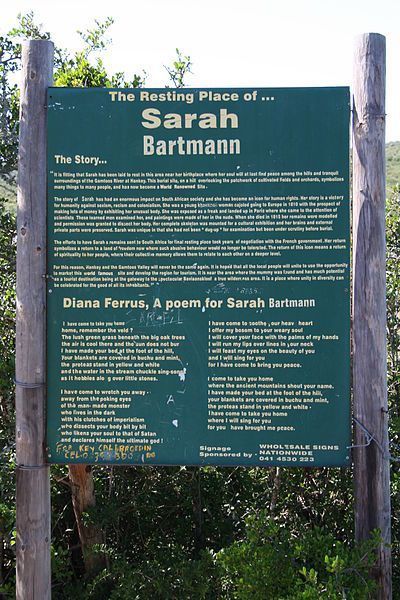
The signpost outside her resting place is small. It reads as follows:

A Poem for Sarah Baartman
By Diana Ferrus

“I’ve come to take you home –
home, remember the veld?
the lush green grass beneath the big oak trees
the air is cool there and the sun does not burn.
I have made your bed at the foot of the hill,
your blankets are covered in buchu and mint,
the proteas stand in yellow and white
and the water in the stream chuckle sing-songs
as it hobbles along over little stones.I have come to wretch you away –
away from the poking eyes
of the man-made monster
who lives in the dark
with his clutches of imperialism
who dissects your body bit by bit
who likens your soul to that of Satan
and declares himself the ultimate god!I have come to soothe your heavy heart
I offer my bosom to your weary soul
I will cover your face with the palms of my hands
I will run my lips over lines in your neck
I will feast my eyes on the beauty of you
and I will sing for you
for I have come to bring you peace.I have come to take you home
where the ancient mountains shout your name.
I have made your bed at the foot of the hill,
your blankets are covered in buchu and mint,
the proteas stand in yellow and white –
I have come to take you home
where I will sing for you
for you have brought me peace.”
~Diana Ferrus~

<iframe width="560" height="315" src="http://www.youtube.com/embed/49HDYFlkW3A" frameborder="0" allowfullscreen></iframe>

This is from wikipedia:

Sarah Baartman

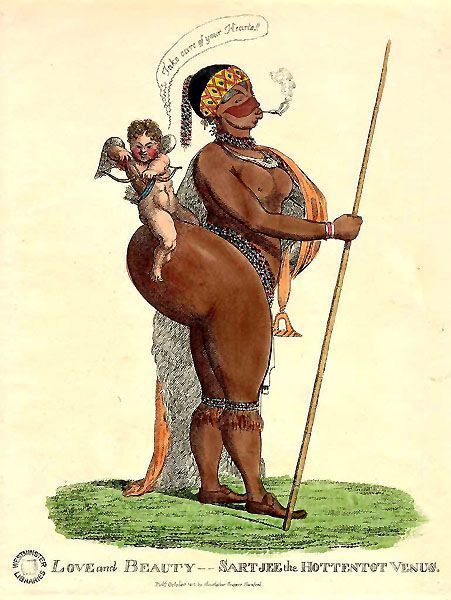
A caricature of Baartman drawn in the early 19th century, photo below

Born Before 1790[1]
Near Gamtoos River, Eastern Cape, Dutch Empire
Died 29 December 1815(1815-12-29)
Paris, France
Resting place Vergaderingskop, Hankey, Eastern Cape, South Africa
33°50′14″S 24°53′05″E / 33.8372°S 24.8848°E / -33.8372; 24.8848Coordinates: 33°50′14″S 24°53′05″E / 33.8372°S 24.8848°E / -33.8372; 24.8848

Other names Hottentot Venus
Ethnicity Khoikhoi
Occupation "freak show" performer

Sarah "Saartjie" Baartman (before 1790 – 29 December 1815)[1]
(also spelled Bartman, Bartmann, Baartmen) was the most famous of at least two Khoikhoi women who were exhibited as freak show attractions in 19th-century Europe under the name Hottentot Venus—"Hottentot" as the then-current name for the Khoi people, now considered an offensive term,[2] and "Venus" in reference to the Roman goddess of love.

Contents
1 Southern Africa
2 Great Britain
3 France
4 Death and legacy
5 Cultural references
6 See also
7 Bibliography
8 Footnotes
9 References
10 External links


Southern Africa

Sarah Baartman was born to a Khoisan family in the vicinity of the Gamtoos River in what is now the Eastern Cape of South Africa.[2] She was orphaned in a commando raid. Saartjie, pronounced "Sahr-kee", is the diminutive form of her name; in Afrikaans the use of the diminutive form commonly indicates familiarity, endearment or contempt. Her birth name is unknown.

Baartman was a slave[2][3][4] of Dutch farmers near Cape Town when Hendrick Cezar, the brother of her slave owner, suggested that she travel to England for exhibition, promising her that she would become wealthy. Lord Caledon, governor of the Cape, gave permission for the trip, but later regretted it after he fully learned its purpose. She left for London in 1810.

Great Britain

Baartman was exhibited first in London, entertaining people by showing what were thought of as highly unusual bodily features. She had large buttocks (steatopygia) and also the elongated labia of some Khoisan women. To quote historian of science Stephen Jay Gould, "The labia minora, or inner lips, of the ordinary female genitalia are greatly enlarged in Khoi-San women, and may hang down three or four inches below the vulva when women stand, thus giving the impression of a separate and enveloping curtain of skin".[5] Baartman never allowed this trait to be exhibited while she was alive,[6] and an account of her appearance in London in 1810 makes it clear that she was wearing a garment, although a tight-fitting one.[7]

Her exhibition in London, scant years after the passing of the Slave Trade Act 1807, created a scandal. An abolitionist benevolent society called the African Association – the equivalent of a charity or pressure group – conducted a newspaper campaign for her release. Hendrick Cezar in an answer protested that Baartman was entitled to earn her living by this means: "...has she not as good a right to exhibit herself as an Irish Giant or a Dwarf?".[8] The African Association took the matter to court and on 24 November 1810 at the Court of King's Bench the Attorney-General began the attempt 'to give her liberty to say whether she was exhibited by her own consent'. In support he produced two affidavits in court. The first, from a Mr Bullock of Liverpool Museum, was intended to show Baartman had been brought to Britain by persons who referred to her as if she were property. The second, by the Secretary of the African Association, described the degrading conditions under which she was exhibited and also gave evidence of coercion.[7] Baartman was questioned before a court in Dutch, in which she was fluent, and stated that she was not under restraint and understood perfectly that she was guaranteed half of the profits. The conditions under which she made these statements are suspect, because it directly contradicts accounts of her exhibitions made by Zachary Macaulay of the African Institution and other eyewitnesses.[6] A written contract was also produced by Dunlop, though this is considered by modern commentators as a legal subterfuge.[8]

Ironically the publicity given by the court case increased Baartman's popularity as an exhibit.[8] She later toured other parts of Britain and visited Ireland.[8] On 1 December 1811 Baartman was christened at Manchester Cathedral.[9][10]

France

Baartman was sold[citation needed] to a Frenchman, who took her to his country.[11] An animal trainer, S. Réaux, exhibited her under more pressured conditions for fifteen months. French naturalists, among them Georges Cuvier, head keeper of the menagerie at the Muséum national d'Histoire naturelle, visited her. She was the subject of several scientific paintings at the Jardin du Roi, where she was examined in March 1815: as Saint-Hilaire [12] and Frédéric Cuvier, a younger brother of Georges, reported, "she was obliging enough to undress and to allow herself to be painted in the nude." In accordance with her own cultural norms of modesty[13] however, throughout these sessions she wore a small apron-like garment which concealed her genitalia. She steadily refused to remove this even when offered money by one of the attending scientists.[8] Once her novelty had worn thin with Parisians, she began to drink heavily and support herself with prostitution.[2]

Death and Legacy

She died on 29 December 1815 of an undetermined[14] inflammatory ailment, possibly smallpox,[15] while other sources suggest she contracted syphilis,[2] or pneumonia. An autopsy was conducted, and published by French anatomist Henri Marie Ducrotay de Blainville in 1816 and republished by French naturalist Georges Cuvier in the Memoires du Museum d'Histoire Naturelle in 1817. Cuvier notes in his monograph that its subject was an intelligent woman with an excellent memory, particularly for faces. In addition to her native tongue she spoke fluent Dutch, passable English and a smattering of French. He describes her shoulders and back as "graceful", arms "slender", hands and feet as "charming" and "pretty". He adds she was adept at playing the jew's harp, could dance according to the traditions of her country and had a lively personality. Despite this he interpreted her remains, in accordance with his theories on racial evolution, as evidencing ape-like traits. He thought her small ears were similar to those of an orangutan and also compared her vivacity, when alive, to the quickness of a monkey.[8] Her skeleton, preserved genitals and brain were placed on display in Paris' Musée de l'Homme[16] until 1974, when they were removed from public view and stored out of sight; a cast was still shown[17] for the following two years.


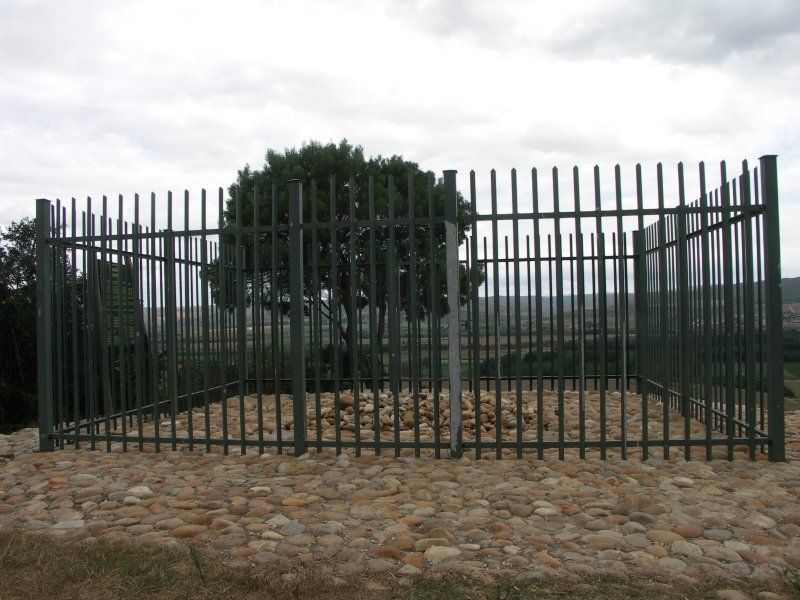
Last resting place of Saartjie Baartman, on a hill overlooking Hankey in the Gamtoos River Valley, Eastern Cape, South Africa, photo below. There were sporadic calls for the return of her remains, beginning in the 1940s, but the case became prominent only after Stephen Jay Gould wrote The Hottentot Venus in the 1980s. After the victory of the African National Congress in the South African general election, 1994, President Nelson Mandela formally requested that France return the remains. After much legal wrangling and debates in the French National Assembly, France acceded to the request on 6 March 2002. Her remains were repatriated to her homeland, the Gamtoos Valley, on 6 May 2002[11] and they were buried on 9 August 2002 on Vergaderingskop, a hill in the town of Hankey over 200 years after her birth.[18]

Baartman became an icon in South Africa as representative of many aspects of the nation's history. The Saartjie Baartman Centre for Women and Children,[19] a refuge for survivors of domestic violence, opened in Cape Town in 1999. South Africa's first offshore environmental protection vessel, the Sarah Baartman, is also named after her.[20]

Cultural References

Signboard at the grave, photo below, including the poem by Diana Ferrus
On 10 January 1811 at the New Theatre, London, a pantomime called 'The Hottentot Venus' featured at the end of the evening's entertainment.[21]
In his 1847 novel Vanity Fair, William Makepeace Thackeray referred to the Hottentot Venus, explaining George's aversion to marrying a woman of color.
Dame Edith Sitwell referred to her allusively in "Hornpipe", a poem in the satirical collection "Façade".[22]
Poet Elizabeth Alexander explores her story in a 1987 poem and 1990 book, both entitled The Venus Hottentot.
Playwright Suzan-Lori Parks used the story of Saartjie Baartman as the basis for her 1996 play Venus.
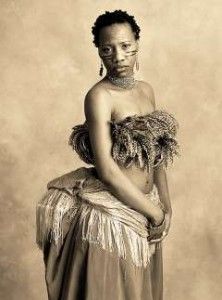
Artist Lyle Ashton Harris collaborated with the model Renee Valerie Cox to produce a photographic image, Hottentot Venus 2000
A movie entitled Black Venus, directed by Abdellatif Kechiche and starring Yahima Torres as Sarah, was released in 2010.
Composer Hendrik Hofmeyr composed a 20 minute opera entitled Saartjie which was to be premiered by Cape Town Opera in November 2010.
Poet Douglas Kearney published a poem titled "Drop It Like It's Hottentot Venus" in April 2012.[23]

See also South Africa Portal
Biography Portal
Human Zoo
Ota Benga
Racism in Europe

Bibliography

Sara Baartman and the Hottentot Venus: a ghost story and a biography. Princeton University Press. 2009. ISBN 0-691-13580-0.
Holmes, Rachel (2006). The Hottentot Venus. Bloomsbury, Random House. ISBN 0-7475-7776-5.
Footnotes1.^ a b Sara Baartman and the Hottentot Venus: a ghost story and a biography. Princeton University Press. 2009. pp. 184. ISBN 978-0-691-13580-9.
2.^ a b c d e Lucille Davie (12 August 2002). "Sarah Baartman, at rest at last". SouthAfrica.info. http://www.southafrica.info/ess_info...y/saartjie.htm.
3.^ Venus abused | Salon Books
4.^ Sara Story
5.^ Gould, 1985
6.^ a b (Strother 1999)
7.^ a b The Times, 26 November 1810, p. 3: "...she is dressed in a colour as nearly resembling her skin as possible. The dress is contrived to exhibit the entire frame of her body, and the spectators are even invited to examine the peculiarities of her form."
8.^ a b c d e f Sadiah Qureshi, Displaying Sara Baartman, the ‘Hottentot Venus’ History of Science, Volume 42, Part 2, Number 136, June 2004, p.233-257
9.^ The Times, Thursday 12 December 1811, p.3:'The African fair one who has so greatly attracted the notice of the town...is stated to have been baptized on Sunday week last, in the Collegiate church at Manchester, by the name of Sarah Bartmann.'
10.^ England Births and Christenings 1538-1975, Sarah Bartmann http://www.familysearch.org
11.^ a b "'Hottentot Venus' goes home". BBC. 29 April 2002. http://news.bbc.co.uk/2/low/europe/1957240.stm. Retrieved 13 October 2008.
12.^ possibly Étienne Geoffroy Saint-Hilaire
13.^ “It is but justice to the modesty of the Hottentots to say that I have constantly found as many difficulties in the part of the women to submit to the exposure parts which a closer inspection required, as in all probability would have occurred in persuading an equal number of females of any other description to undergo examination.” William Somerville, a British surgeon stationed at the Cape between 1799 and 1802, describing his difficulty in gathering information about Khoisan anatomy.
14.^ The Journal of Science and the Arts III (V): p. 154. 1818. http://www.archive.org/stream/journa...p/search/venus. Retrieved 19 July 2010.
15.^ In The Blood by Steve Jones has it that "Saartje's hands are covered by the marks of the smallpox that killed her" (p. 204).
16.^ Hal Morgan and Kerry Tucker. Rumor! Fairfield, Pennsylvania: Penguin Books, 1984, p. 29.
17.^ Untrodden fields of anthropology : observations on the esoteric manners and customs of semi-civilized peoples. American Anthropoligical society. http://www.archive.org/stream/cu3192...p/search/venus. Retrieved 19 July 2010.
18.^ Kerseboom, Simone. ""Burying Sara Baartman": Commemoration, Memory and Historica Ethics.1". Stellenbosch University History Department. http://academic.sun.ac.za/history/news/s_kerseboom.pdf. Retrieved 23 October 2008.
19.^ The Saartjie Baartman Centre for Woman and Children
20.^ "SA takes on poachers". 11 November 2005. Archived from the original on 30 September 2007. http://web.archive.org/web/200709302...645283,00.html.
21.^ The Times, 10 January 1811; p. 2
22.^ Walton: 'Hornpipe' from Facade
23.^ National poetry month at the rumpus
ReferencesCrais, Clifton and Pamela Scully (2008). Sara Baartman and the Hottentot Venus: A Ghost Story and a Biography. Princeton, Princeton University Press. ISBN 978-0-691-13580-9
Fausto- Sterling, Anne (1995). "Gender, Race, and Nation: The Comparative Anatomy of 'Hottentot' Women in Europe, 1815–1817". In Terry, Jennifer and Jacqueline Urla (Ed.) "Deviant Bodies: Critical Perspectives on Difference in Science and Popular Culture", 19-48. Bloomington, Indiana University Press. ISBN 0-253-32898-5.
Gilman, Sander L. (1985). "Black Bodies, White Bodies: Toward an Iconography of Female Sexuality in Late Nineteenth-Century Art, Medicine, and Literature". In Gates, Henry (Ed.) Race, Writing and Difference 223-261. Chicago, University of Chicago Press.
Gould, Stephen Jay (1985). "The Hottentot Venus". In The Flamingo's Smile, 291-305. New York, W.W. Norton and Company. ISBN 0-393-30375-6.
Ritter, Sabine: Facetten der Sarah Baartman: Repräsentationen und Rekonstruktionen der ‚Hottentottenvenus‘. Münster etc.: Lit 2010. ISBN 3-643-10950-4.
Strother, Z.S. (1999). "Display of the Body Hottentot", in Lindfors, B., (ed.), Africans on Stage: Studies in Ethnological Show Business. Bloomington, Indiana, Indiana University Press: 1-55.
Qureshi, Sadiah (2004), 'Displaying Sara Baartman, the 'Hottentot Venus', History of Science 42:233-257. PDF available here.
Willis, Deborah (Ed.) "Black Venus 2010: They Called Her 'Hottentot' ISBN 978-1-4399-0205-9. Philadelphia, PA. Temple University Press
External links Wikimedia Commons has media related to: Saartjie Baartman

South Africa government site about her, including Diana Ferrus's pivotal poem
A French print
Mara Verna's interactive audio and video piece including a bibliography
Guardian article on the return of her remains
A documentary film called The Life and Times of Sara Baartman by Zola Masekokipedia to start.
Baartman.jpg
85.1 KB ·2870 views
grave.jpg
107.6 KB ·5844 views
sign.jpg
82.6 KB ·3505 views
saarjtie.jpg
17.8 KB ·9560 views
sarah.jpg
2.6 KB ·10465 views
hottentot.jpg
2.7 KB ·3450 views
7 Users Say Thank You For This Post:
Bastet, docfr8, durt, DVEEUS, Sharon, TwistedPrincess, xthabeast
▼ PROMO FROM DOCUMENTING REALITY
Want to escape?
Join Now
Hidden for upgraded members.
  #2  
08-04-2012, 11:05 PM
DoubleZ1013's Avatar
DoubleZ1013
Offline:
My Rank: SERGEANT
Poster Rank:1243
Female
Join Date: Dec 2010
Posts: 501
 
Mentioned: 1 Post(s)
Quoted: 25 Post(s)
Activity Longevity
0/20 16/20
Today Posts
0/11 ssssss501
Re: Saartjie Baartman, Aka, Hottentot Venus, Aka, The First Black Vixen

I always thought of her story being a sad one. It made me mad that it took so long to return her remains to her homeland.
3 Users Say Thank You For This Post:
DiamondSmiles, Rachee, TwistedPrincess
  #3  
08-04-2012, 11:15 PM
DiamondSmiles's Avatar
DiamondSmiles
Offline:
★The Queen★
Poster Rank:68
Female
Join Date: Jun 2011
Posts: 23,498
Contributions: 120
 
Mentioned: 95 Post(s)
Quoted: 3083 Post(s)
Activity Longevity
0/20 16/20
Today Posts
0/11 ssss23498
Re: Saartjie Baartman, Aka, Hottentot Venus, Aka, The First Black Vixen

I always thought of her story being a sad one. It made me mad that it took so long to return her remains to her homeland.
Very sad how people take advantage of those who are different. She was smart enough to speak four languages! I have enough trouble with one.

I hadn't heard of her until I found her in a dissection article about human sex organs being on display for 200 years.
3 Users Say Thank You For This Post:
Darkest Angel, DoubleZ1013, Sharon
  #4  
08-05-2012, 03:41 AM
TwistedPrincess's Avatar
TwistedPrincess
Offline:
My Rank: STAFF SERGEANT
Poster Rank:779
Join Date: Oct 2010
Posts: 1,015
 
Mentioned: 2 Post(s)
Quoted: 34 Post(s)
Activity Longevity
0/20 16/20
Today Posts
0/11 sssss1015
Re: Saartjie Baartman, Aka, Hottentot Venus, Aka, The First Black Vixen

i never heard of her until i read this post. very seldom will i watch a movie but somehow managed to sit through and watch the two part story of her on you tube. over 2 and one half hour movie. not the greatest movie but still one worth watching in my opinion. how sad for her to have had to live her life. she had no family, even her child was dead, and she was exploited in both life and when her life ended at the young age of 25.
2 Users Say Thank You For This Post:
DiamondSmiles, DoubleZ1013
  #5  
08-05-2012, 06:35 PM
Rachee's Avatar
Rachee
Offline:
Southern Belle
Poster Rank:689
goes off half cocked
Join Date: Apr 2012
Posts: 1,249
 
Mentioned: 0 Post(s)
Quoted: 21 Post(s)
Activity Longevity
0/20 15/20
Today Posts
0/11 sssss1249
Re: Saartjie Baartman, Aka, Hottentot Venus, Aka, The First Black Vixen

Poor thing. Breaks my heart
This User Says Thank You For This Post:
DiamondSmiles
  #6  
08-06-2012, 05:02 PM
King Herald's Avatar
King Herald
Offline:
★ Legacy Member ★
Poster Rank:427
Male
Join Date: Sep 2009
Posts: 2,700
 
Mentioned: 2 Post(s)
Quoted: 331 Post(s)
Activity Longevity
0/20 17/20
Today Posts
0/11 sssss2700
Re: Saartjie Baartman, Aka, Hottentot Venus, Aka, The First Black Vixen

She is but one of 10,000,000++ Africans who were torn from their homeland in that same period of time. And only a tiny percentage of them ever made it home. A sad and shameful time for western 'civilization'.
This User Says Thank You For This Post:
DiamondSmiles
  #7  
08-06-2012, 07:19 PM
GlassToTheArson's Avatar
GlassToTheArson
Offline:
Yaut'ja Elite
Poster Rank:544
Male
Join Date: Jul 2009
Posts: 1,846
Contributions: 11
 
Mentioned: 3 Post(s)
Quoted: 107 Post(s)
Activity Longevity
0/20 17/20
Today Posts
0/11 sssss1846
Re: Saartjie Baartman, Aka, Hottentot Venus, Aka, The First Black Vixen

  #8  
08-06-2012, 07:47 PM
Sharon's Avatar
Sharon
Offline:
♚ Legacy Gold Member ♚
Poster Rank:34
Female
Join Date: Nov 2008
Posts: 43,403
Contributions: 204
 
Mentioned: 95 Post(s)
Quoted: 2281 Post(s)
Activity Longevity
0/20 18/20
Today Posts
0/11 ssss43403
Re: Saartjie Baartman, Aka, Hottentot Venus, Aka, The First Black Vixen

Interesting yet very very sad
This User Says Thank You For This Post:
DiamondSmiles
  #9  
08-07-2012, 12:34 AM
DiamondSmiles's Avatar
DiamondSmiles
Offline:
★The Queen★
Poster Rank:68
Female
Join Date: Jun 2011
Posts: 23,498
Contributions: 120
 
Mentioned: 95 Post(s)
Quoted: 3083 Post(s)
Activity Longevity
0/20 16/20
Today Posts
0/11 ssss23498
Re: Saartjie Baartman, Aka, Hottentot Venus, Aka, The First Black Vixen

What about in the old west and in Europe when the women all wore hooped skirts? I imagined all the cowboys and those women all smelled bad and tried to cover it up with perfume. Yuck!

What was that about that made her such a freak to people? Who would know what was under her clothes unless they wore skimpy clothing?
  #10  
08-07-2012, 01:42 AM
Airbornemama's Avatar
Airbornemama
Offline:
So Fucking Banned
Poster Rank:261
Join Date: May 2010
Posts: 5,346
 
Mentioned: 4 Post(s)
Quoted: 41 Post(s)
Activity Longevity
0/20 17/20
Today Posts
0/11 sssss5346
Re: Saartjie Baartman, Aka, Hottentot Venus, Aka, The First Black Vixen

Eat your heart out Kim Kardashian!!
This User Says Thank You For This Post:
DiamondSmiles
Documenting Reality Death Pictures & Death Videos Human Deformities & Medical Problems Saartjie Baartman, Aka, Hottentot Venus, Aka, The First Black Vixen


Powered by vBulletin Copyright 2000-2010 Jelsoft Enterprises Limited.

Search Engine Friendly URLs by vBSEO