|
#1
●
07-18-2024, 03:41 PM
|
 These are the rooms Poster Rank:26 of ruin. Join Date: Sep 2014 Posts: 54,008 54,008Posts 87,658Thanked 30,403Quoted 145Mentioned 0Contrib. |
|
Progressive Abdominal Swelling
A 48-year-old, postmenopausal black African woman presented to our casualty department with a 5-year history of progressive abdominal swelling. Five years prior to presenting, which was 1 year before she reached menopause, she had noticed that her abdomen was gradually distending. The patient was referred to a tertiary hospital but only went 5 years later. Upon admission, she had marked temporal wasting, with bilateral pitting lower limb edema extending to her sacrum. Her case was discussed by a multidisciplinary team (MDT) that included gynecological oncologists, radiation oncologists, general surgeons, anesthetists, and nursing staff. The MDT considered the risks of death following hemodynamic instability and bleeding as well as the postoperative risks of deep vein thrombosis, pulmonary embolism, difficulty weaning off the ventilator, and death. The conclusion of the meeting was to take the patient for staging laparotomy despite these risks. At laparotomy, through a right paramedian incision, a huge abdominopelvic mass was found filling the whole abdomen and pelvis. The liver, spleen, and hemidiaphragms looked normal. The mass was shelled out by blunt dissection (Fig. 2). The mass burst during mobilization, however, with rapid drainage of dark-colored fluid and decompression 50 min into the surgery. The patient was critically ill in the ICU. On the day of admission, she had a cardiac arrest and was successfully resuscitated. By day 10, she was noted to have multiple organ failure with oliguria, falling level of consciousness, aspiration pneumonia, a gangrenous abdominal wall (Fig. 3), and coagulopathy. She required inotropic support and ventilation. She died on day 10 after surgery. The pathology report showed a partial cystic lesion with benign epithelia of mucin-secreting columnar cells.  · 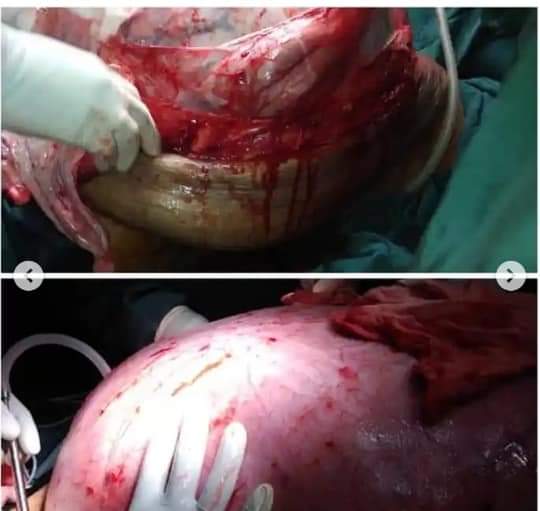 ·  · 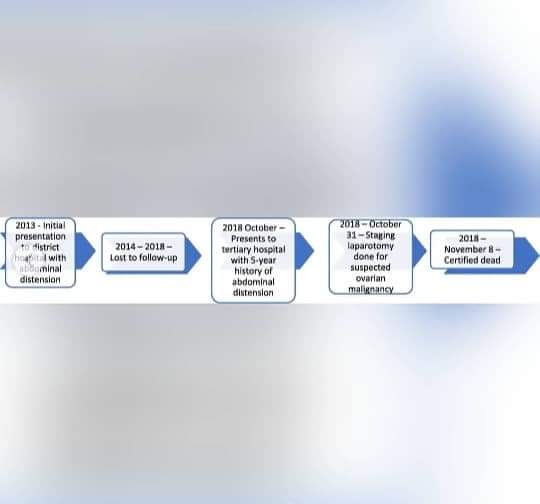 · |
|
#2
●
07-19-2024, 02:40 AM
|
 ✝Mudderator from Hell✝ Poster Rank:10 e-mail Join Date: Oct 2006 Posts: 96,644
Contributions: 901
96,644Posts 543,080Thanked 10,365Quoted 479Mentioned 901Contrib. |
|
Re: Progressive Abdominal Swelling
 living 5 years with that living 5 years with that |