|
#1
●
08-15-2024, 04:00 PM
|
 These are the rooms Poster Rank:26 of ruin. Join Date: Sep 2014 Posts: 54,008 54,008Posts 87,658Thanked 30,403Quoted 145Mentioned 0Contrib. |
|
Parapagus Dicephalus Conjoined Twins
A 35-year-old pregnant woman, gravida 8, parity 7, abortus 0 was evaluated in our emergency department with a chief complaint of abdominal pain. She was evaluated by a midwife first. It was noted that her cervix was dilated to seven centimeters and 80% effaced with vertex presentation and positive fetal heart beats. She had no prenatal follow up, and her previous pregnancies were uncomplicated. She did not have a family history of twinning. She was admitted to the hospital and observed by external fetal heart rate monitor. After 25 minutes of observation, the midwife detected early deep decelerations in the fetal heart rate and notified the obstetrician. Since the fetus was in acute distress and the fetal head was posterior and asynclytic with frontal bossing, the patient was taken to the operating room for cesarean delivery under general anesthesia. CTs were delivered through a low segment uterine incision. The Apgar scores at 1, 5 and 10 minutes were 8, 10, 10 respectively. Total weight of the newborns was 4750 g. The placenta was monochorionic and minimally enlarged. There was only one umbilical cord with three vessels and one umbilicus. During first evaluation, both of newborns were active and crying. There were two heads, three upper limbs and three lower limbs. The twins could move right and left side limbs and the medial arm and foot appeared to be non-functional. The external genitalia was not clearly identical (Figure 1, 2). X-ray images revealed that there was one heart and fused lungs (Figure 3, X-ray). After initial evaluation, the patient was transferred to a multidisciplinary hospital. According to information received from the hospital, the twins could be feeding with nasogastric catheter. Surgery for separation was excluded because of visceral anatomy.  ·  · 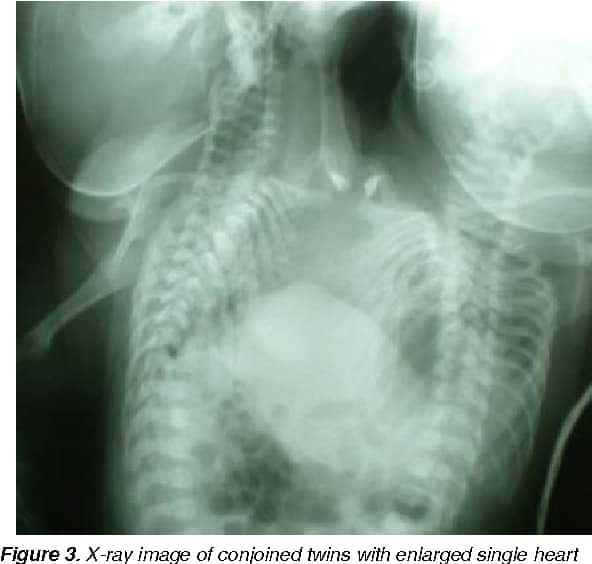 · |