|
#1
●
03-29-2022, 06:00 AM
|
 ♚ Legacy Gold Member ♚ Poster Rank:348 Okay, Fed. Join Date: Aug 2021 Posts: 3,612 3,612Posts 5,717Thanked 2,693Quoted 48Mentioned 0Contrib. |
|
Myasis in Prolapsed Uterus
The case of an elderly female with total genital prolapse and superinfected uterine myasis. The successful treatment included mechanical extraction of the larvae, antibiotics, and ivermectin. Myasis is a parasitic infestation of humans or other vertebrates by fly larvae.The flies are insects belonging to the Diptera order, nearly 16 families, of which 5 bear medical importance:*Muscidae,*Sarcophagidae*(fleshflies),* Calliphoridae*(blowflies),*Oestridae*(botflies), and*Cuterebridae. Myasis generally affected skin and exposed necrotic tissue, colonization has also been described in natural cavities, especially ears, nostrils, gastrointestinal, and genitourinary tracts; and less frequently, involving the uterus.This occurs directly when the flies deposit their eggs on affected parts of the body and indirectly when consuming contaminated water or food, or via the phoresy phenomenon in which the fly uses hematophages as vectors.Flies attack, attracted by infected wounds 1.Usually, it is present in individuals from rural areas with deficient hygienic habits, psychiatric problems, and limited access to the health care system. 2.The basis of the treatment lies on the mechanical removal of the larvae. Full Medical Document: An 82-year-old illiterate female attending gynecologic service at Valle University Hospital, Cali, Colombia, with total genital prolapse noted for the last 5 years. Four ulcers were observed in the prolapsed uterus, the biggest one with a diameter of 6 × 3 cm, with necrotic edges. These were cavitated and infested by live larvae, Sarcophagidae (fleshflies) vs Calliphoridae (blowflies) families; with fetid discharge and inflammation of adjacent tissue (FIGURE 1, FIGURE 2). The patient had a body mass index (BMI) of 31, personal neglect, poor hygiene, without signs of senile dementia. Antecedents of one vaginal delivery without complications. No chronic pathology. She is originally from a rural area, but has been living in an urban area for the last 5 years, in an industrial zone far from animal breeding or sanitary landfills. She was hospitalized for 7 days, received intravenous ceftriaxone-metronidazole; oral ivermectin (drops at 0.6%, 1 drop per kilogram of body weight) and topical ivermectin. Additional treatment included mechanical extraction of larvae with forceps and daily washing of lesions until obtaining granulation tissue (Figure 3). Posthospitalization, topical estrogen was applied on the genital prolapse for 1 month. Surgical correction of the genital prolapse was performed via vaginal hysterectomy with anterior and posterior colporrhaphy; a procedure without complications. 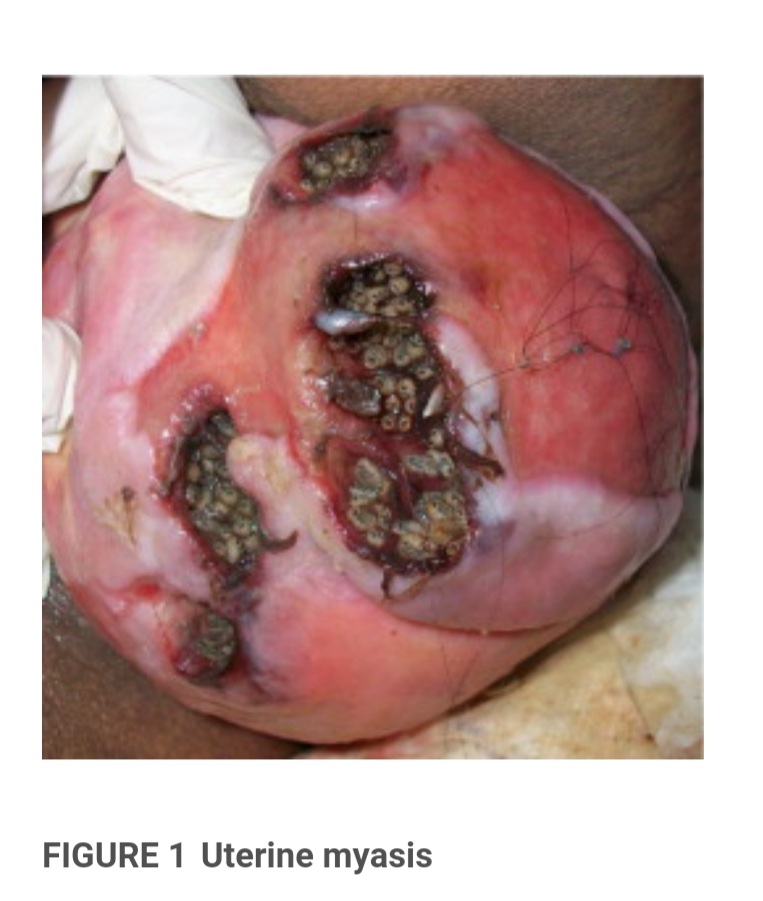 · 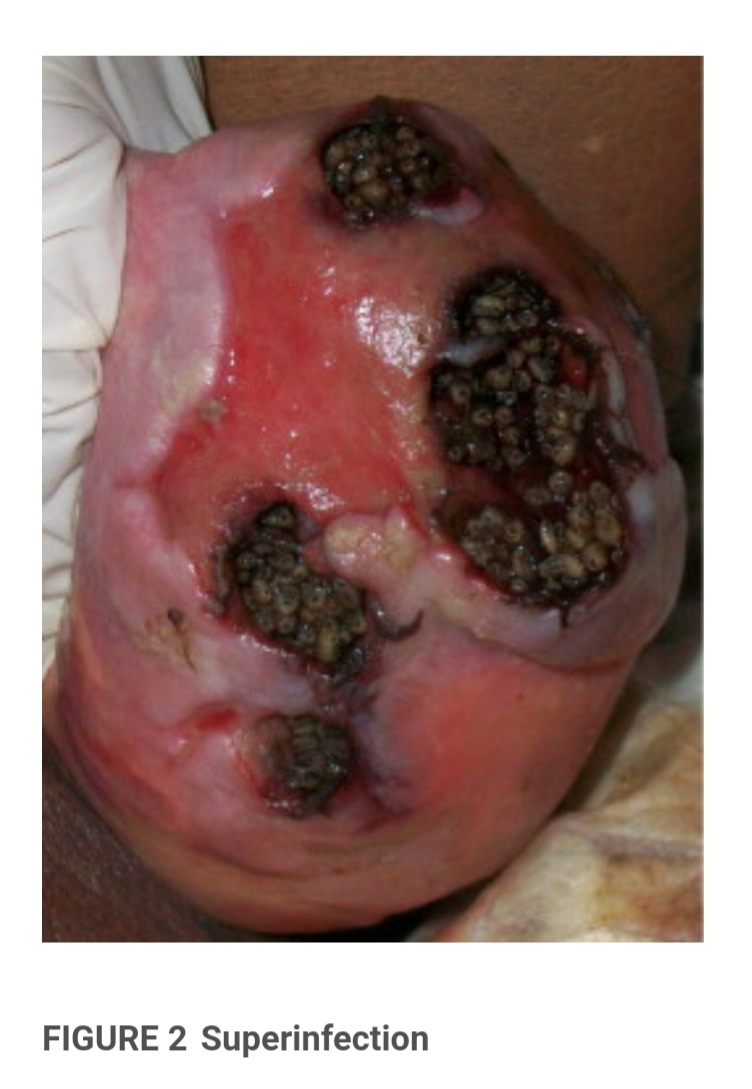 · 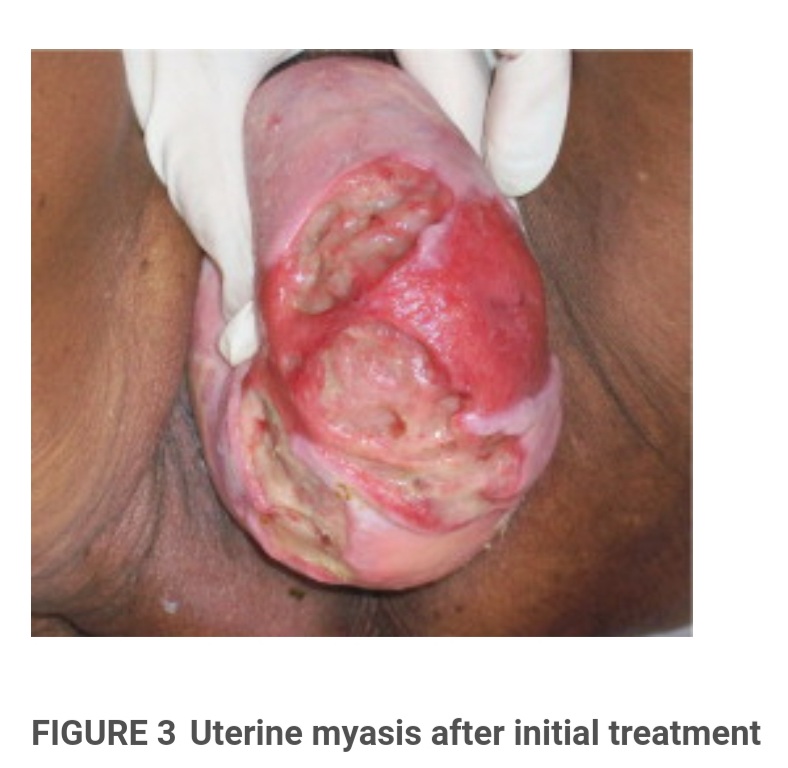 · |
|
#2
●
03-29-2022, 06:02 AM
|
| ♚ Legacy Gold Member ♚ Poster Rank:348 Okay, Fed. Join Date: Aug 2021 Posts: 3,612 3,612Posts 5,717Thanked 2,693Quoted 48Mentioned 0Contrib. |
|
Re: Myasis in Prolapsed Uterus
BTW, not sure if this is a repost...I searched and didn't see anything relatively similar...but this is my first post so hopefully I didn't fuck it up  |
|
#4
●
03-29-2022, 06:31 AM
|
 ✝Mudderator from Hell✝ Poster Rank:10 e-mail Join Date: Oct 2006 Posts: 96,631
Contributions: 901
96,631Posts 543,014Thanked 10,365Quoted 479Mentioned 901Contrib. |
|
Re: Myasis in Prolapsed Uterus
nasty  |
|
#5
●
03-29-2022, 07:17 AM
|
| ♚ Legacy Gold Member ♚ Poster Rank:348 Okay, Fed. Join Date: Aug 2021 Posts: 3,612 3,612Posts 5,717Thanked 2,693Quoted 48Mentioned 0Contrib. |
|
Re: Myasis in Prolapsed Uterus
You should see the removal videos of these tiny abominations.  I'll definitely have nightmares. I'll definitely have nightmares.
|
|
#6
●
03-30-2022, 12:40 AM
|
 ~So Much Blood~ Poster Rank:123 Gore Hag Join Date: Mar 2010 Posts: 13,150
Contributions: 1
13,150Posts 43,744Thanked 822Quoted 28Mentioned 1Contrib. |
|
Re: Myasis in Prolapsed Uterus
So she had this condition for the past 5 years? I don't understand how one could live like this, so disgusting...  |
|
#7
●
03-30-2022, 05:46 AM
|
 My Rank: MAJOR Poster Rank:194 Join Date: Sep 2014 Posts: 7,870 7,870Posts 10,947Thanked 5,734Quoted 27Mentioned 0Contrib. |
|
Re: Myasis in Prolapsed Uterus
They should have just put her down.
|
|
#8
●
03-30-2022, 07:27 AM
|
 ★ Legacy Member ★ Poster Rank:778 I'm not A bitch.... I'm THE bitch. Join Date: Jul 2012 Posts: 1,030 1,030Posts 1,727Thanked 174Quoted 4Mentioned 0Contrib. |
|
Re: Myasis in Prolapsed Uterus
I lived on a ranch for 10 years (ex-husband and his family) and we gave the fucking cattle ivermectin.
|
|
#9
●
03-30-2022, 01:52 PM
|
 ☆☆☆Jumbo Lesbian Cunt☆☆☆ Poster Rank:57 My pronouns are thin/skinny Join Date: Nov 2012 Posts: 25,917
Contributions: 1
25,917Posts 30,808Thanked 13,921Quoted 160Mentioned 1Contrib. |
|
Re: Myasis in Prolapsed Uterus
She had the prolapse for five years.
|