|
#1
●
06-14-2024, 04:07 PM
| ||||||||
 These are the rooms Poster Rank:26 of ruin. Join Date: Sep 2014 Posts: 54,011 Mentioned: 145 Post(s) Quoted: 30403 Post(s)
| ||||||||
|
Merkel Cell Carcinoma
A 65-year-old male presented with Merkel cell carcinoma on his left forearm. This was followed by wide local excision and sentinel lymph node biopsy which was negative. CT staging showed no systemic disease. This was followed by three cycles of radiotherapy. His disease rapidly recurred within a few months followed by chemotherapy. Again, the disease recurred rapidly around his forearm and elbow. This was followed by amputation at his shoulder 2 years after his initial diagnosis. Soon after his amputation, the disease recurred around his amputated stump and chest (Figure 1). There was no evidence of systemic disease. He underwent electrochemotherapy (ECT) as a last resort, with IV bleomycin. An immediate outcome was seen after his treatment, with all disease nodules disappearing within 2 weeks of treatment (Figure 2). At 6 weeks, he had a repeat treatment for new lesions around his chest. Post-operative recovery was uneventful. 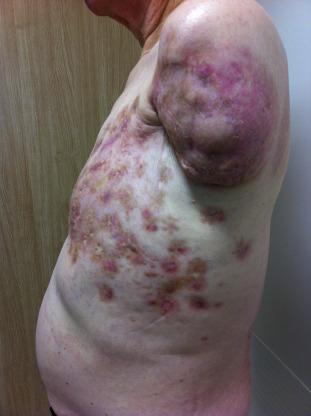 · 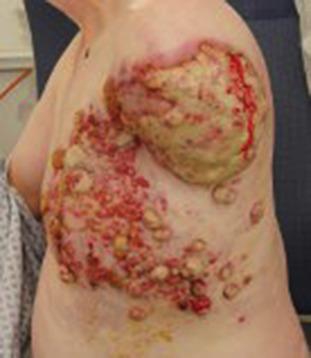 · |
|
#2
●
06-14-2024, 08:44 PM
| ||||||||
 ★ Legacy Member ★ Poster Rank:252 So many choices now Join Date: Jul 2015 Posts: 5,548 Mentioned: 15 Post(s) Quoted: 2120 Post(s)
| ||||||||
|
Re: Merkel Cell Carcinoma
There comes a time when you have to resign yourself to a very painful future and just eat a bullet instead.
|
|
#5
●
06-15-2024, 08:48 AM
| ||||||||
 ✝Mudderator from Hell✝ Poster Rank:10 e-mail Join Date: Oct 2006 Posts: 96,597
Contributions: 817
Mentioned: 476 Post(s) Quoted: 10339 Post(s)
| ||||||||
|
Re: Merkel Cell Carcinoma
First pic: Four months post ECT treatment. There was no evidence of any residual disease. The area of hyperpigmentation is common following ECT treatment. There is an increasing incidence of MCC in England, especially over the past 10 years. There are several possible reasons for this; MCC was not routinely recognized by pathologists until a highly effective microscopic stain (“CK20”) was developed in the 1990s. In addition, better recognition and increased numbers of exposure to the risk factors associated with MCC are on the rise, and increases in ultraviolet (UV) exposure, greater numbers of people over the age of 50 and more people living with immunosuppressive disease. The main treatment modality for early-stage tumour is excisional surgery and/or radiotherapy. Chemotherapy with etoposide and cisplatin or carboplatin is only used in patients with systemic metastases. Due to the low incidence of MCC, experiences with recurrent lesions or advanced-stage tumours are very limited. To the best of our knowledge, there are only a couple of other cases of Merkel cell carcinoma being treated by ECT available in the published literature. ECT uses pulses of electricity to increase cell-membrane permeability, which enhances the effect of chemotherapy causing sudden cell death. Using this method of drug delivery, studies have shown a 300- to 700-fold increase in bleomycin cytotoxicity enabling one-off treatment for patients with MCC. The effectiveness of ECT is well documented by a number of trials and case studies that have been published for other skin malignancies such as melanoma, squamous cell carcinoma and Kaposi sarcoma. Its use is mainly palliative, and it is highly effective, safe and cost-effective. Its use in inoperable disease improves the quality of life by reducing disease burden and the effect of ulceration. In two studies, patients were asked if they would agree to another treatment if necessary; 96% of patients in one study and 100% in the other study agreed. So ECT is an effective treatment modality for inoperable Merkel cell tumours and should be one of the many treatment repertoires that any skin cancer unit can offer. So there is hope. |