|
#1
●
01-14-2023, 11:10 PM
| ||||||||
 These are the rooms Poster Rank:26 of ruin. Join Date: Sep 2014 Posts: 54,011 Mentioned: 145 Post(s) Quoted: 30403 Post(s)
| ||||||||
|
Man Shoots Gun, Homemade Target Finds That Offensive
Source: A 36-year-old male was brought to the emergency department (ED) with a deep facial laceration (Figure 1) after being struck by a target fragment from a homemade target after bullet impact. The patient was firing a 9-mm semi-automatic handgun. Per the patient, the target had been used frequently in the past and was constructed from wood and metal. After discharging his firearm multiple times, the patient reported that everything suddenly went black and he felt his body go limp. Emergency medical services reported 1 liter of blood loss en route. On exam, an 11-cm-deep, right-sided facial laceration extending from the lateral aspect of the right lip to the posterior right ear was noted. Further inspection revealed a full thickness laceration to the masseter muscle, with exposed mandible and obvious deformity. A significant pulsatile hemorrhage was evident. The patient’s airway was patent, lungs clear, Glasgow Coma Scale 15, and extremities atraumatic. Rapid sequence intubation, including the concomitant administration of midazolam, propofol, and succinylcholine, was undertaken, massive transfusion protocol initiated, tranexamic acid (TXA) administered, and the patient prepped for immediate surgery. The patient was taken to the operating room by the trauma and oral maxillofacial surgery (OMFS) teams for hemorrhage control, surgical debridement, and wound closure. Following the initial operation, the patient underwent a computed tomography (CT) scan of the maxillofacial structures, which confirmed a non-displaced fracture of the right mastoid and mandibular condyle . Four days after the initial insult, the patient underwent a right mastoidectomy and facial repair. The OMFS team elected for conservative therapy for the condyle fracture. On discharge, the OMFS team reported a physical exam consistent with House-Brachmann VI. The patient was referred to an outpatient neuro-otologist with an immediate follow-up exam demonstrating paralysis consistent with House-Brachmann V. Three months later, the patient’s facial wound had healed well with no signs of infection . He reported an improved ability to raise his right eyebrow and close his right eyelid as well as difficulty hearing on the affected side. He further reported some difficulty chewing initially but tolerated a liquid diet for eight weeks before slowly progressing to a soft diet. The patient continued to have partial right facial paralysis on examination. 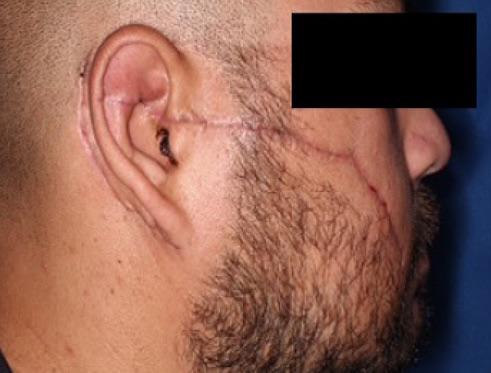 · 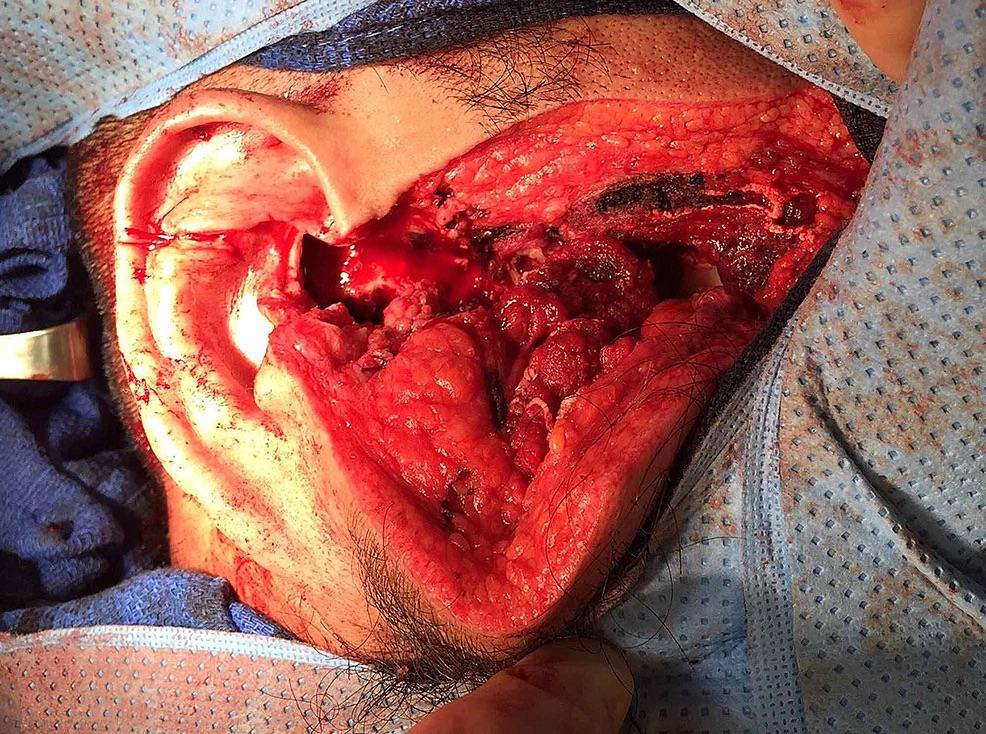 · |
|
#2
●
01-15-2023, 02:04 AM
| ||||||||
 ✝Mudderator from Hell✝ Poster Rank:10 e-mail Join Date: Oct 2006 Posts: 96,642
Contributions: 817
Mentioned: 476 Post(s) Quoted: 10343 Post(s)
| ||||||||
|
Re: Man Shoots Gun, Homemade Target Finds That Offensive
Horrific. oh, and the wound too. nice repair though |