|
#14
●
04-24-2013, 12:16 AM
|
|
Re: Horn on the Sole of a Foot
Good thing those shoes that make Chinese women's feet small are in style! They are actually called, "Chinese Washwoman," too! I'm guessing that might be what caused it judging from the shape of the rest of the foot, but, it looks more like a male foot to me. Also good thing, I wear what I want and won't wear them |
|
#15
●
04-24-2013, 12:18 AM
|
|
Re: Horn on the Sole of a Foot
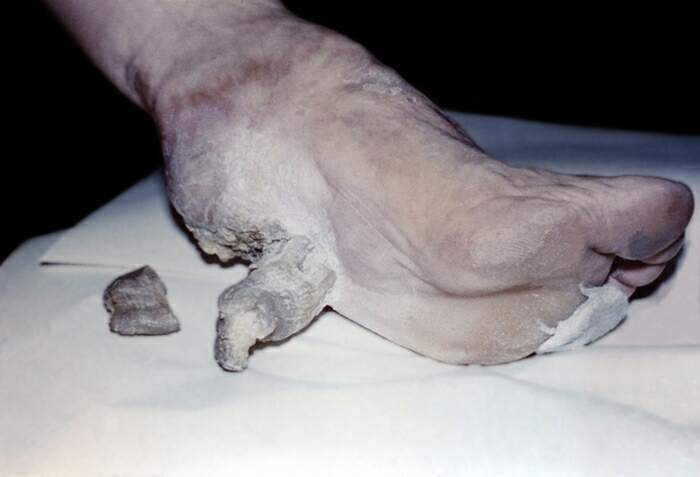
Looks like a hoof! I had to look them up, Kelly, but, I sent you some pictures. A source I read, beside the below, says they can appear anywhere the sun hits, so a heal must be a very rare one! And the penis?! Even rarer! Hell, guys, you can get them on your penises! **Cutaneous Horn** From Wikipedia Classification and External Resources Cutaneous horns, also known by the Latin name cornu cutaneum, are unusual keratinous skin tumors with the appearance of horns, or sometimes of wood or coral. Formally, this is a clinical diagnosis for a, "conical projection above the surface of the skin." They are usually small and localized, but can, in very rare cases be much larger. Although often benign, they can also be malignant or premalignant. Etiology The cause of cutaneous horns is still unknown, but it is believed that exposure to radiation can trigger the condition. This is evidenced by a higher rate of cases occurring on the face and hands, areas that are often exposed to sunlight. Other cases have reported cutaneous horns arising from burn scars. As with many other wart-like skin conditions, a link to the HPV virus family, especially the HPV-2 subtype has been suggested. Prominent cases Zhang Ruifang, aged 101, (living in Linlou Village, Henan province, China), has grown a cutaneous horn on her forehead, resembling what those who have examined her and her family call, "Devil's Horns." Notably, this growth has expanded to reach a total of 6 centimeters in length. Another is forming on the opposite side of her forehead. Huang Yuanfan, aged 84 (living in Ziyuan, China). Madame Dimanche, called Widow Sunday, a French woman living in Paris in the early 19th century, grew, in six years from the age of 76, a 24.9 cm (9.8") horn from her forehead before it was successfully removed by French surgeon Br. Joseph Souberbeille (1754–1846). A wax model of her head is on display at the Mütter Museum, The College of Physicians of Philadelphia, US. Mortality/Morbidity The lesion at the base of the keratin mound is benign in the majority of cases. Malignancy is present in up to 20% of cases, with squamous cell carcinoma being the most common type. The incidence of squamous cell carcinoma increases to 37% when the cutaneous horn is present on the penis. Tenderness at the base of the lesion is often a clue to the presence of a possible underlying squamous cell carcinoma. Treatments As the horn is composed of keratin, the same material found in fingernails, the horn can usually be removed with a sterile razor. However, the underlying condition will still need to be treated. Treatments vary, but they can include surgery, radiation therapy, and chemotherapy. Actinic keratosis with cutaneous horn, photo below. |
|
#17
●
04-24-2013, 11:50 AM
|
|
Re: Horn on the Sole of a Foot
Contribution to the thread by diamondsmiles: cutaneoudhorns.jpg cutaneoushorn2.jpg cutaneoushorn3.jpg cutaneoushorn4.jpg cutanioushorn5.jpg cutaneoushorn6.jpg |