|
#1
●
04-18-2011, 05:10 AM
|
 ♚ Legacy Gold Member ♚ Poster Rank:35 Female Join Date: Nov 2008 Posts: 43,321
Contributions: 233
43,321Posts 76,140Thanked 2,282Quoted 95Mentioned 233Contrib. |
|
Historic Trepanation
Trepanation is the practice of making a hole in the skull in order to improve the brain pulsations and hence the overall well being. A trepan is the instrument used for making a hole in the skull bone. It is sometimes spelled trephine. The idea is to pump up the brainbloodvolume. It's known that one's level of consciousness is directly related to the volume of blood in one's brain. As a result, trepanners say, one feels happier and more energetic. The practice of trepanation has been around since the Stone Age. Trepanation is the oldest surgical procedure practiced by mankind. At no time had evidence been found that brain surgery was the intention of this procedure. To the contrary, evidence shows that from the very earliest trepanations elaborate care was taken not to penetrate below the level of the bone membrane. Care was taken not to penetrate through the dura matter and damage the brain. Trepanning was performed either by bone abrasion (by using a sharp-edged stone or volcanic glass knifes) or by cutting (using semicircular trephines, which cut by means of a swinging motion, such as those found in the Central and South America civilizations). The Egyptians invented the circular trephine, made by a tube with serrated borders, which cuts much easier by means of rotation, and which was then extensively used in Greece and Rome, and gave origin to the "crown" trephine, used in Europe from the first to the 19th century. One of the major inventions in trephine technology was the central spike, which was used to center the rotational movement, so that a better precision was achieved. How long took a surgical trepanning? When it is made in a single session (yes, in some cultures the trepanning is made in several sessions, which can take up to 12 days!), it takes from 30 to 60 minutes of continuous sawing or drilling. Paul Broca, the ubiquitous French neurosurgeon and anthropologist, determined this experimentally in animals and cadavers, in 1867. I love the corpse's pensive pose. I'm NOT responsable for that arrow!! The trephine drills and saw below date from ancient Greece, the Aztec era 1200 AD to the 19th century. The crown trephines on the b/w heads are from the 17th century.  ·  · 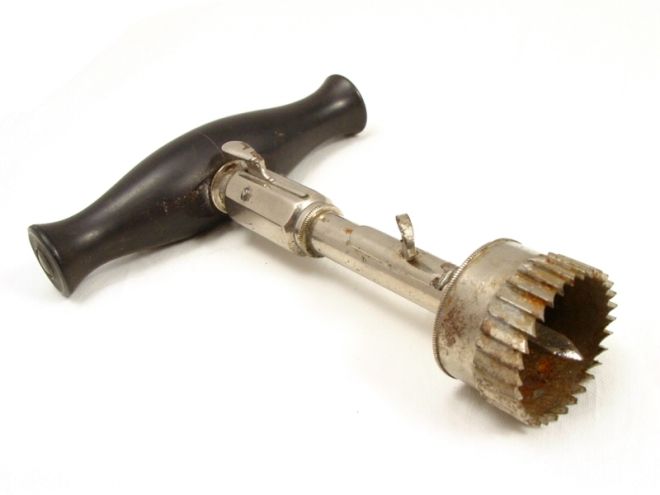 ·  · 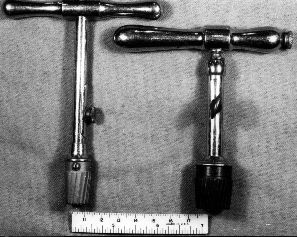 · 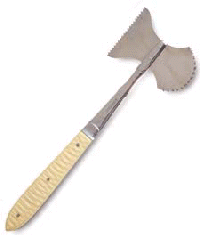 · 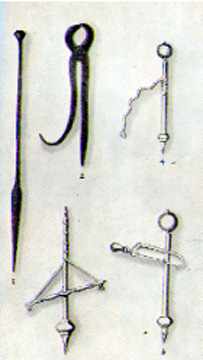 · |
|
#3
●
04-18-2011, 07:29 AM
|
| ♚ Legacy Gold Member ♚ Poster Rank:35 Female Join Date: Nov 2008 Posts: 43,321
Contributions: 233
43,321Posts 76,140Thanked 2,282Quoted 95Mentioned 233Contrib. |
|
Re: Historic Trepanation
Added more info, good suggestion Pelle  |
|
#4
●
04-18-2011, 09:37 PM
|
 Australia Mate! Poster Rank:344 I have a map of Tasmania Join Date: Aug 2009 Posts: 3,712 3,712Posts 2,301Thanked 86Quoted 1Mentioned 0Contrib. |
|
Re: Historic Trepanation
I know a few people who need this done...
|
|
#7
●
11-23-2011, 02:11 AM
|
 ★The Queen★ Poster Rank:68 Female Join Date: Jun 2011 Posts: 23,461
Contributions: 145
23,461Posts 28,287Thanked 3,083Quoted 95Mentioned 145Contrib. |
|
Re: Historic Trepanation
I'm glad modern medical equipment, (at least most of it), doesn't look so much like torture devices, although the halo is still creepy.
|
|
#9
●
11-23-2011, 05:08 PM
|
 My Rank: LANCE CORPORAL Poster Rank:3331 Join Date: Nov 2009 Posts: 109 109Posts 15Thanked 0Quoted 0Mentioned 0Contrib. |
|
Re: Historic Trepanation
Oi! I did a 9th grade presentation on this yesterday :o I was just thinking of posting exactly this, but you beat me to it |