|
#1
●
03-21-2013, 08:51 AM
| ||||||||
 My Rank: MAJOR Poster Rank:12 Join Date: Jun 2009 Posts: 93,128
Contributions: 226
Mentioned: 91 Post(s) Quoted: 2009 Post(s)
| ||||||||
|
Gastroesophogeal Ring
These rings are located just above the GE (gastroesophageal) junction. These rings occur in 4-6% of the population. The cause of these rings is not clearly understood. The majority of these rings cause no symptoms, and patients are unaware of their presence. When the opening of the esophagus becomes smaller as the diameter of these rings shrink, solid, poorly chewed food can get caught at the level of the ring. This occurs when the diameter of the ring reaches approximately 1 cm. The patient then experiences chest pain, or dysphagia. Rarely, the food becomes impacted. These patients experience continued chest pain and difficulty swallowing. A flexible endoscope sometimes has to be inserted through the mouth into the esophagus to extract the impacted food to relieve the obstruction. Here is a Schatzki ring seen on barium xray: 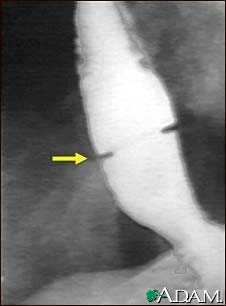 Here is a view of the esophagus and proximal stomach to orient you. Here the esophagus is turned inside out, so you are actually looking at the internal surface of the tube: 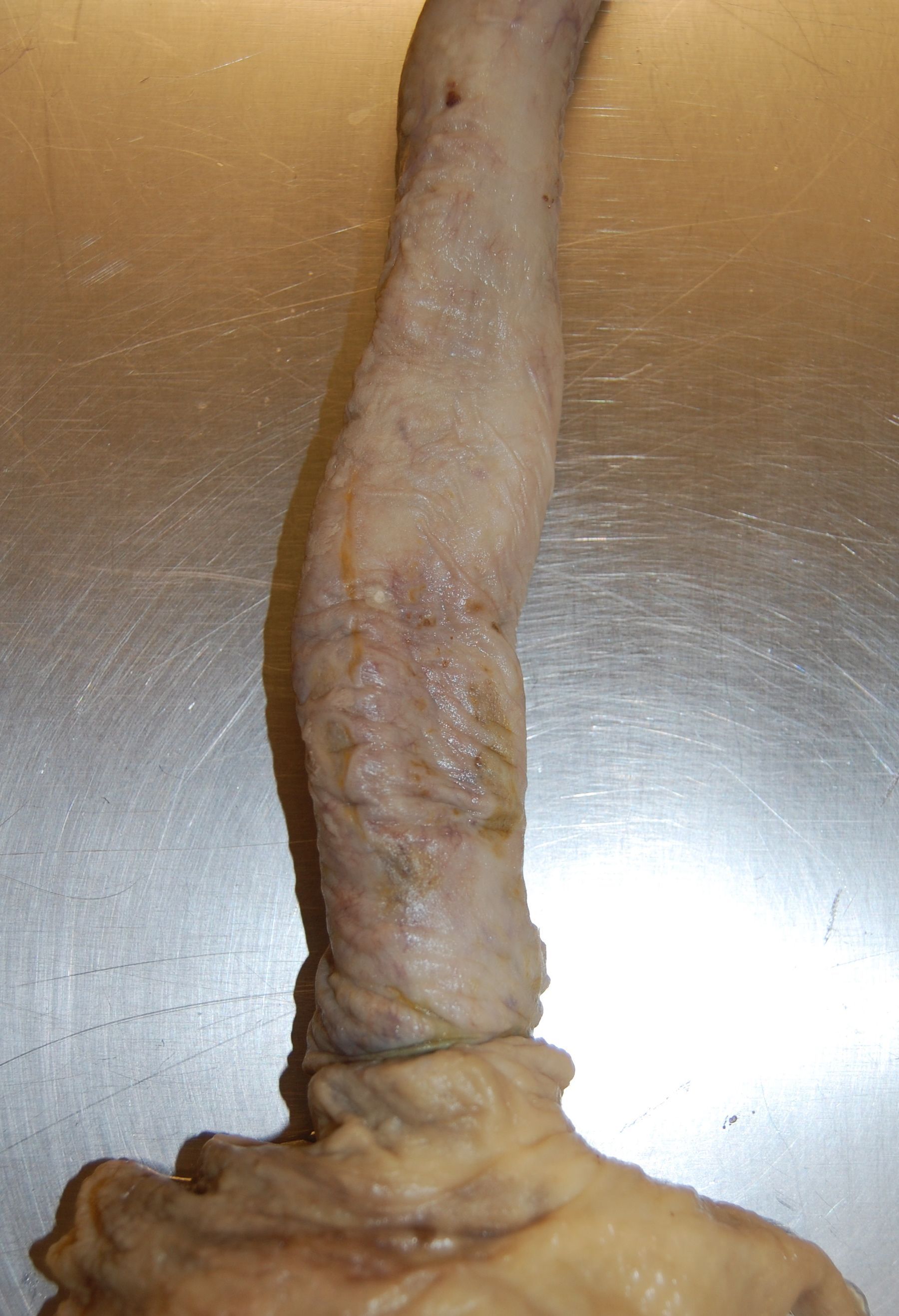 Here is a closer view of the specimen at the GE (gastroesophageal) junction. Here you can clearly see the Schatzki ring. It almost looks like someone tied a rubber band around the esophagus just above the GE junction: 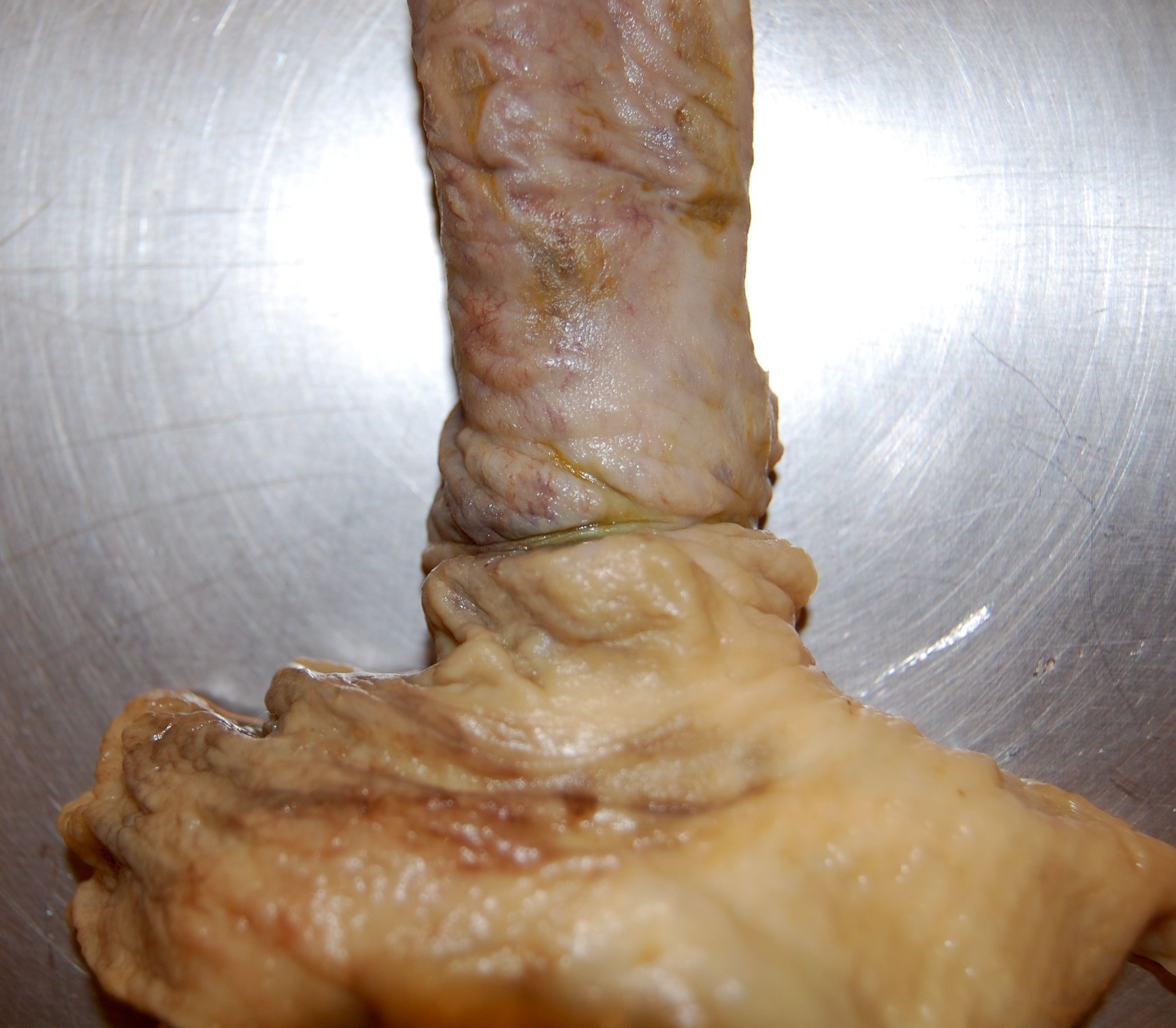 Treatment involves procedures that will stretch these rings. Stretching can be performed with endoscopes or tapered dilators. Deflated ballon devices may also be introduced into the esophagus. The balloon will be placed at the level of the Schatzki ring and then will be inflated to stretch it. If swallowing problems occur, repeated treatments may be necessary. Open surgery is hardly ever necessary to handle these rings. Esophageal stricture can also be caused by trauma, tumors. etc. These conditions need to be ruled out. |