|
#1
●
09-01-2014, 10:08 PM
| ||||||||
 ★The Queen★ Poster Rank:68 Female Join Date: Jun 2011 Posts: 23,496
Contributions: 120
Mentioned: 95 Post(s) Quoted: 3083 Post(s)
| ||||||||
|
The Feline Cyclopia, (still Photo)
This, from an article about interesting human eyes, and this cat. By Michelle Bennett. July 7, 2014 This poor little cyclops kitty looks like something out of a science fiction movie, but it’s the genuine article. The kitten was born on December 28, 2005, in Oregon City, Oregon, with one large eye in the place where its nose should have been. The unfortunate feline succumbed to the inevitable after only two days on this earth. Our hearts go out to the unique creature who graced this world with its presence for too short a time. This kitten’s condition is the result of a disorder known as holoprosencephaly, an affliction in which the embryonic forebrain fails to develop into two distinct hemispheres. That means that the brain looks like one undistinguished mass rather than an organ with two distinct sides. That can result in deformities of certain facial features, including the upper lip, the eyes, and the nose. Although this ailment can also occur in humans, it is rare for an affected fetus to survive to term, especially with the more severe forms of the disease, as this kitty exhibited. The specific form of the disorder suffered by this kitten is known as alobar holoprosencephaly, and it is characterized by the complete absence of one of the lobes of the brain. Rather than possessing a right lobe and a left lobe, the brain is merged into a single body. The typical presentation of this version of the condition includes the absence of an olfactory gland and the merging of two eyes into a single unit in the center of the face. Other forms of the malady include semilobar holoprosencephaly, lobar holoprosencephaly, and syntelencephaly. Semilobar holoprosencephaly involves the partial separation of the forebrain into distinct lobes, although the division can be nearly complete in the event of lobar holoprosencephaly. Syntelencephaly is somewhat different and is characterized by incomplete separation of the parietal lobe and the posterior frontal lobe rather than the right and left lobes. It is unclear whether syntelencephaly is truly related to the other types of holoprosencephaly or a separate disorder, but, it is currently classified in the same category. The version of the disorder that this kitty suffered from, alobar holoprosencephaly, is the most severe form of the malady. The failure of the facial features to divide and form symmetric units on either side of the face, (two eyes, two nostrils), mirrors the failure of the brain to divide into separate lobes. It is nearly impossible for a creature to survive under those conditions. 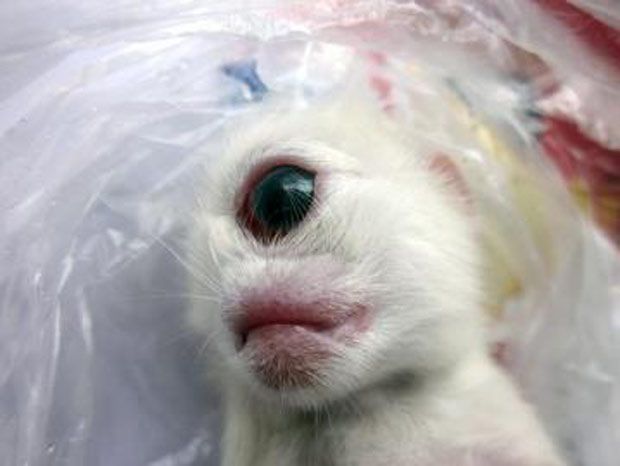 · |
|
#2
●
09-01-2014, 10:41 PM
| ||||||||
 My Rank: SERGEANT Poster Rank:1152 Join Date: Jan 2014 Posts: 563 Mentioned: 3 Post(s) Quoted: 116 Post(s)
| ||||||||
|
Re: The Feline Cyclopia, (still Photo)
I'd love to see some video of the little critter moving around during the days it was alive.
|
|
#3
●
09-01-2014, 11:20 PM
| ||||||||
| ★The Queen★ Poster Rank:68 Female Join Date: Jun 2011 Posts: 23,496
Contributions: 120
Mentioned: 95 Post(s) Quoted: 3083 Post(s)
| ||||||||
|
Re: The Feline Cyclopia, (still Photo)
I'll be damned, profezzorx! I didn't think there was one. Not the same cat, and not a lot of movement. When the human touches the head, you see a bit of movement. Probably, just a reflex. From the owner: "9/30/2010 my cat gave birth to 5 kittens and one cyclops cat with what looks like a horn on it's forehead or a finger?" |
|
#4
●
09-02-2014, 03:56 AM
| ||||||||
 My Rank: CORPORAL Poster Rank:1651 Join Date: Jul 2009 Posts: 335 Mentioned: 0 Post(s) Quoted: 31 Post(s)
| ||||||||
|
Re: The Feline Cyclopia, (still Photo)
Poor little kittyclops.
|
|
#5
●
09-02-2014, 05:24 AM
| ||||||||
 Born in the USA Poster Rank:126 100% female Join Date: Jul 2012 Posts: 12,876
Contributions: 1
Mentioned: 81 Post(s) Quoted: 1799 Post(s)
| ||||||||
|
Re: The Feline Cyclopia, (still Photo)
The white one would have been an interesting, unique pet had it survived. Too bad.  |
|
#8
●
09-02-2014, 04:27 PM
| ||||||||
| My Rank: PRIVATE Poster Rank:6179 Join Date: Feb 2014 Posts: 37 Mentioned: 0 Post(s) Quoted: 7 Post(s)
| ||||||||
|
Re: The Feline Cyclopia, (still Photo)
More commonly seen in cats than any other animal, because use of a common medication (which I will not name) during early embryo development causes it in felines. Always fatal, is it affects development of the brain and respiratory tract (among others). BTW, the 'finger' in the video is actually the nose. The nose develops at the top of the head and migrates down between the eyes as the embryo develops.
|